
The Question I Cannot Stop Asking
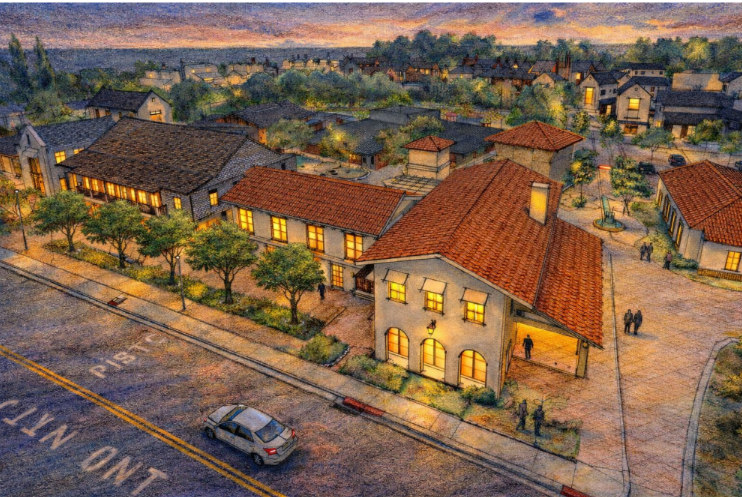
Yountville Commons - Conceptual Sketch of the two-story buildings along Yount St with historic Town Hall on the right and the scale of the fully proposed main village in the distance. Phase 1 only included 40 units.
In June 2020, the Napa Valley Unified School District closed Yountville Elementary School after more than 125 years of continuous operation. The school board’s reason was simple. There were not enough children to fill it. There were not enough children because there were not enough families who could afford to live here. There were not enough families who could afford to live here because, over the last 20 years, roughly half the homes in Yountville have been slowly purchased as second residences as long-term investments. The school did not close because the town stopped caring about education. It closed because the town had become a place where young families with children were competing with wealthy and older families and were priced out of town. When the town did choose to build, it built new luxury hotels. So the hard truth is that Yountville did not lose its school. The town slowly traded it for second homes and wealthy visitors who now, in turn, pay the taxes that fund the majority of costs to keep Yountville charming, peaceful, and, on the surface, unchanged. Who would make that trade, the comfort of a preserved, charming town for one in which most of its own workers can no longer afford to live?
It is the conundrum behind the Town’s Housing Element. It is the motive behind Measure S. It was the hope behind the Commons.
Why would the businesses that depend most on Yountville’s workers be some of the loudest voices working to keep workers out of Yountville? Of course, they say they want workforce housing. But they have concerns. And making sure that all those many concerns are discussed is the most dependable way to delay progress. It is a long-studied and proven method because it’s effective.
I do not ask that as a charge. I ask it as a puzzle. I do not live in Yountville. I do not vote here. But for two years I have studied this town, watched the meetings, met with hundreds of residents across all incomes, and read deeply the history of this town. I worked at Domaine Chandon as a back waiter in 1986. Yountville is not a strange new place to me and I have come to admire much of what Yountville is. But I cannot understand a really basic question.
Let me lay it out.
The Town’s Housing Element documents that 82 percent of the people who work in Yountville commute in. Studies estimate that between 1,000 and 3,000 workers drive into this town every day depending on the season to do the work this economy depends on. The first phase of the commons was 40 units. The state requires Yountville to plan to build at least 72 units by 2031. The massive need for workforce housing dwarfs the Commons project. The need dwarfs the entire planning cycle. The school that closed could not have been saved by 40 apartments. It could not have been saved by 72. The gap is so much bigger than that.
But if even 40 units is a threat, what is it a threat to?
That is the puzzle.
The referendum power of 235 voters in a town of 2,000 that allowed the Commons to be suspended was added to the California Constitution in 1911. Hiram Johnson and the Progressive reformers built it because the Southern Pacific Railroad had captured the state legislature. They wanted to give the public a check on concentrated private power. They built a tool that could protect the people from a small, well-connected, well-funded interest.
That tool can also do the opposite.
That ten percent threshold allows a small, well-organized, well-funded group to force a public vote on almost any local ordinance. The same instrument that protects the public from private power can be used to protect private power from the public. Whether that is what has happened here is a question worth asking honestly. I have my suspicions.
More to the point, I do not understand how a modest first phase of workforce housing, on a publicly owned site, paid for with money Yountville’s own voters dedicated to this purpose, is treated as a crisis. I do not understand how two years of public process have produced objections but no alternative. I do not understand how this project came to be talked about as a housing project, when housing was never the headline.
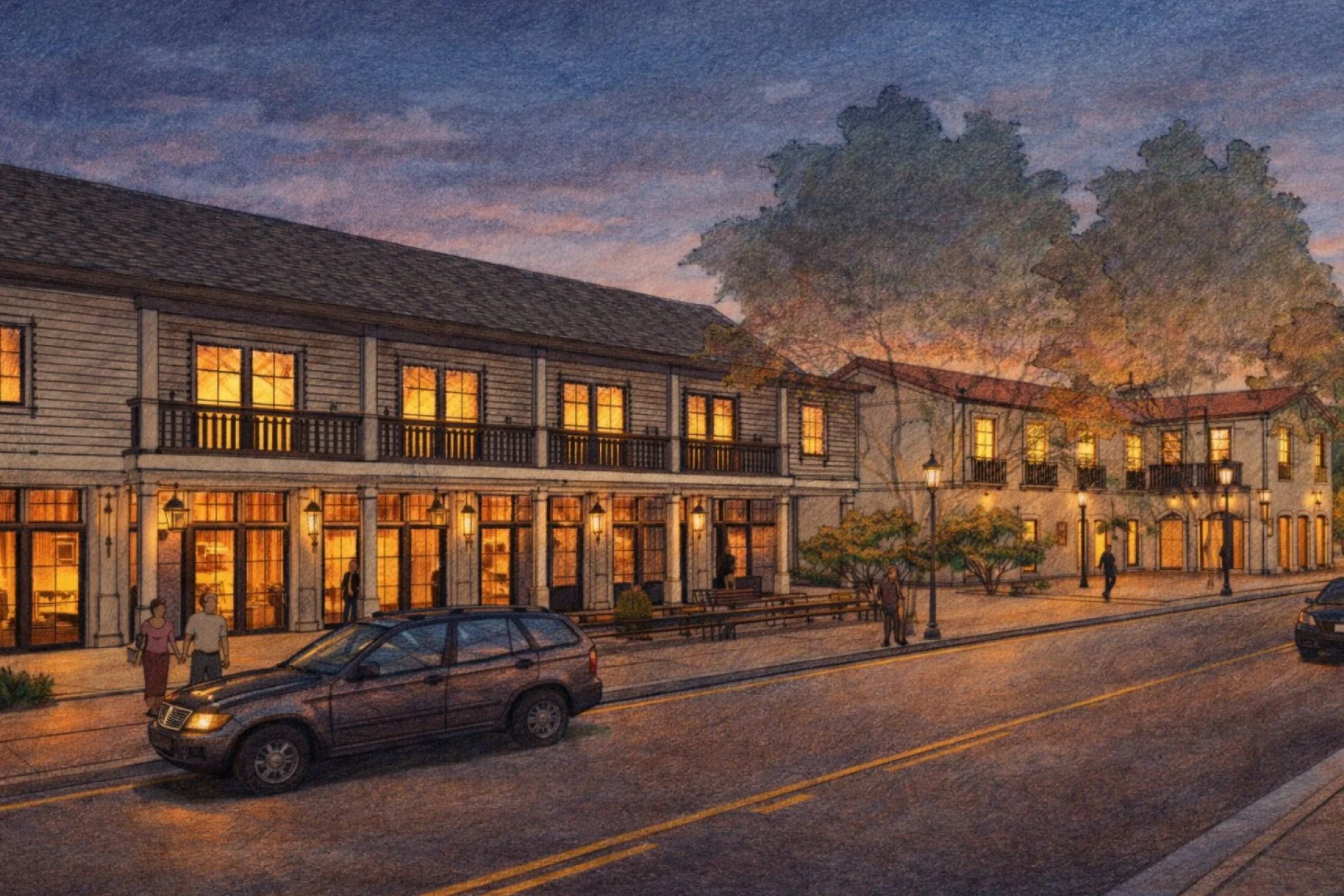
Yountville Commons - Concept Sketch of the two story Yount Street buildings that would provide homes for the local workforce.
The Commons is a public space. The former Yountville Elementary School for more than a century was reserved for children during school hours and mostly empty the rest of the time. Upon purchasing the site, the first thing the Town did was to take down the fence. The old library was turned into a health club. The former lunchroom was turned into the Don and Sally Schmitt Hall, a hub for holiday kids' camps, superbly run by Yountville’s Parks and Rec Division. An unused ball field became the town’s first dog park, with many residents complaining about the radical change. It is now a popular Town amenity. A cafe was established in the former Little League snack shack. Of course, there are still a few who wonder where the Little League went. It would be funny if it were not so sad. The abandoned school garden became a shared garden under the guidance of a talented local farmer, Peter Jacobson. And on a small portion of the site, the Town was going to add thirty to forty workforce homes in five buildings with more than enough parking to see if the whole thing could work, could be loved, could be a statement about what Yountville stood for. That was the plan. That is the plan that was suspended by only 10% of registered voters in Yountville, CA.
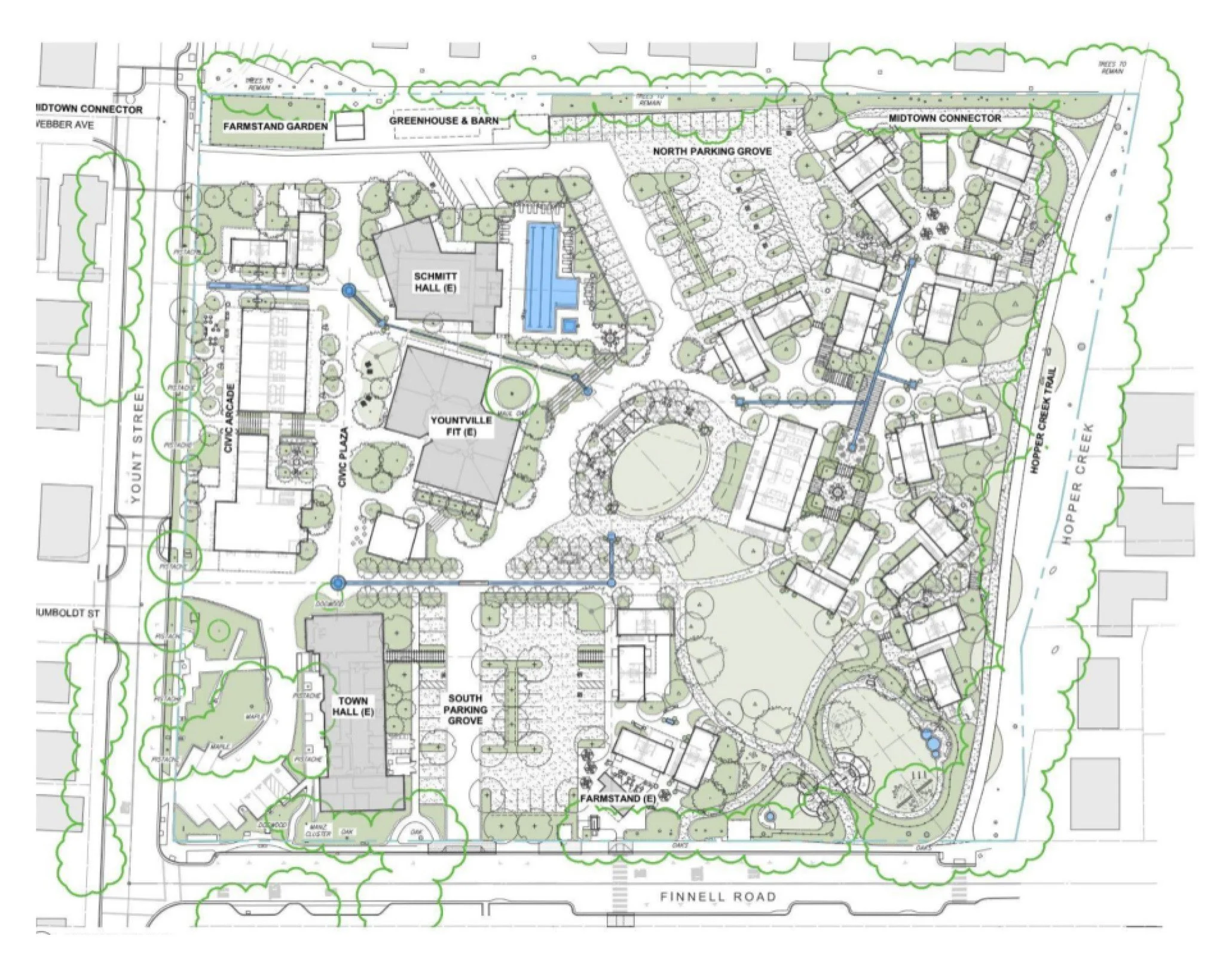
Yountville Commons - The site plan would have allowed up to 150 units of deed-restricted housing to be built over several years. That zoning would have solved the state-mandated housing requirements for the town for the foreseeable future. The repeal undid that accomplishment.
As we show in a nearby article, these units would be added to the approximately 90 deed-restricted homes already in Yountville. The Commons would not have transformed that reality into something entirely different. It would have extended it, modestly, against a need far larger than any one project could solve.
And these are not strangers arriving at the edge of town. They are already here every day. Their cars are already parked on the streets and in the lots. Their work is already woven into the life of Yountville. The question is whether a town that already depends on them is willing to make a little more room for them to live here too.
The housing was small and specific. Workers who already work in Yountville could find a place to live without bidding against a second-home buyer. Housekeepers and dishwashers here are paid minimum wage. Turnover in those positions runs extraordinarily high. They lose the bidding war for holiday homes every time. The Commons would have given a small number of them one more place where they did not have to bid against the visitor market.
The intent, explained over a two-year community outreach, was to do what every long-term investor in Yountville has done for years. Acquire an asset. Fix it up and rent it out. Hold it. Develop it for the benefit of the people who hold it. The difference is who the people are. For a second-home buyer, the people who benefit are the buyer and the buyer’s family. For the town, the people who benefit are everyone who lives and works here. Both are legitimate uses of property. The private version has been celebrated as a smart long-term investment for decades. The public version, on publicly owned land, is being called a threat, an enormous risk to the town’s wealth.
Yountville’s most famous restaurants can tell you the farm that grew the lettuce, the ranch that raised the lamb, and the name of the cheesemaker who touched the chèvre. It will not celebrate the name of the woman who cleaned the room. Or, more honestly, it can. It just cannot offer her a place to live within twenty miles of where she works.
That is not a planning problem. That is what this town has become.
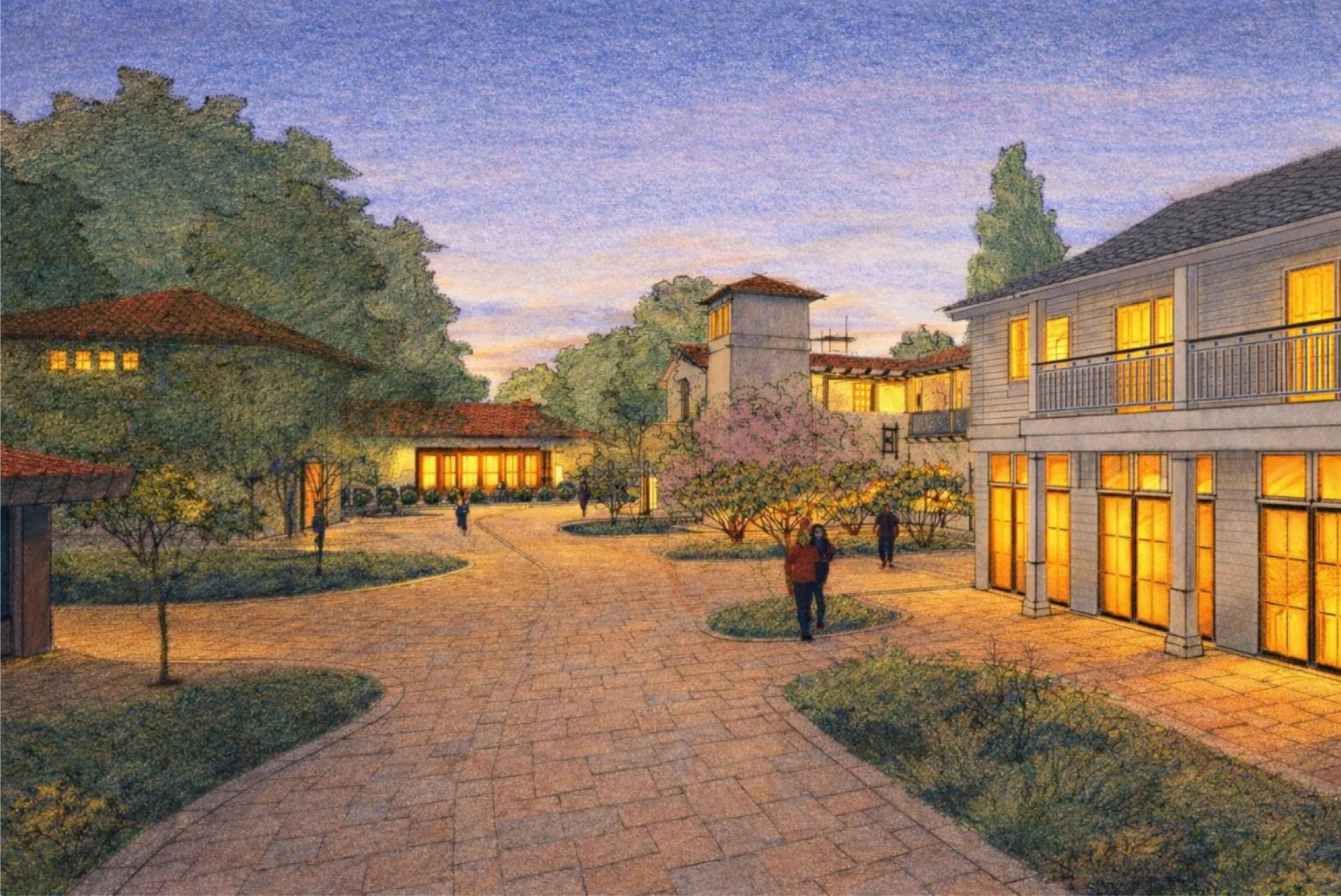
Yountville Commons - Concept sketch of an interior plaza with proposed workforce homes on the right with the town hall in the distance.
The Commons is not unique. The pattern is documented. In 2019, three political scientists published a Cambridge University Press study called Neighborhood Defenders. They examined thousands of public comments at planning meetings in 97 Massachusetts cities and towns. They found that the people who turn out to oppose housing are not representative of their communities. They are significantly older. They are significantly whiter. They are far more likely to be homeowners. They outnumber housing supporters at public meetings by roughly four to one. The result, across hundreds of cities and towns, is delayed, smaller, and blocked housing.
Yountville did not invent this. The town has only joined it.
So here is what I want to say to this town, including to those who do not want this project.
If you have a better idea, name it. Name the site. Name the funding. Name the schedule. Name the units. Name the income levels. Name the path to compliance. If you have those answers, the town should listen. We will all listen.
If the only thing you can name is what you do not want, then say that. Say you do not want it. Do not call it support for workforce housing. Just be honest with your neighbors.
The referendum is the law. The repeal of the Commons zoning ordinance is now history. But the need does not go away. The workers do not go away. The commute does not go away. Measure S does not go away. The former school site does not go away. The state mandate to provide the minimum amounts of housing across all income bands is now in the spotlight. And the obligation certainly got more expensive, although I am not sure anyone has said so out loud.
A town that depends on its workers by day cannot ask them to vanish by night. Or rather, it can. Yountville has.
So here is the question I cannot stop asking. Why does a town that cannot run without its workers treat a small number of additional homes for those workers as a threat? A threat to what?
I do not have the answer. The referendum settled a single zoning question but nothing else. The need is still here and the obligation has only grown. What the residents do about that is the only question left, and it is still very much in front of them.
