
The Town That Misplaced Its Children
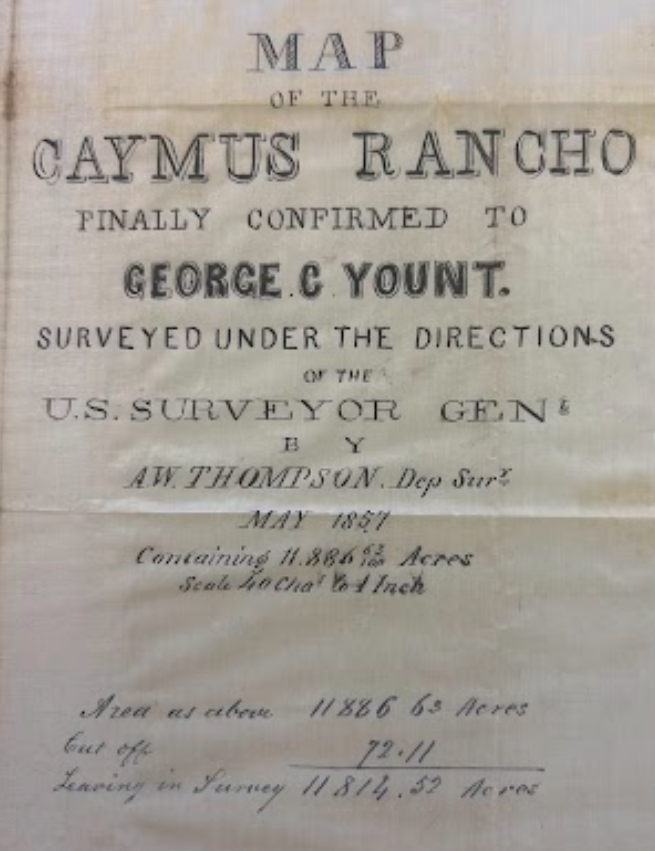
Title panel from the 1857 survey map of Caymus Rancho, confirmed to George C. Yount.
Through the influence of Mariano Guadalupe Vallejo, George C. Yount received the two league Rancho Caymus in 1836, and became the first permanent Anglo-American settler in the Napa Valley. Photographed for research at The Bancroft Library, University of California, Berkeley.
Yountville began before California had settled on being California, before statehood, before the Civil War, before the railroad, before the wine train, before restaurants became pilgrimage sites, before tourists learned to say terroir without embarrassment, before bocce courts and pickleball schedules began carrying more civic urgency than kindergarten enrollment. It began in Mexican California, with George C. Yount and Rancho Caymus, in a valley that still belonged more to distance than to commerce. The first settlement was not picturesque in the way later generations would need it to be picturesque. It was agricultural, practical, hard-used. There were mills, animals, crops, smoke, dust, harness leather, debts, tools, weather, and children who learned early that childhood on the frontier was not a protected category. Charm came later, after money and nostalgia had done their usual laundering of hardship.
The people who came early did not come for lifestyle. They came because land was power, water was wealth, and California was still loose enough around the edges that a person could imagine stepping into another version of himself. The valley offered fertility and distance, two qualities Americans have always mistaken for destiny. Yount’s settlement had the feel of a place made by men who needed things to work before they needed them to be admired. The idea that this little agricultural stop would one day become a village of tasting menus, landscape ordinances, and hotel rooms expensive enough to fund a municipal government would have seemed less like prophecy than fever.
Then the Civil War ended, and the men who survived it began to age.
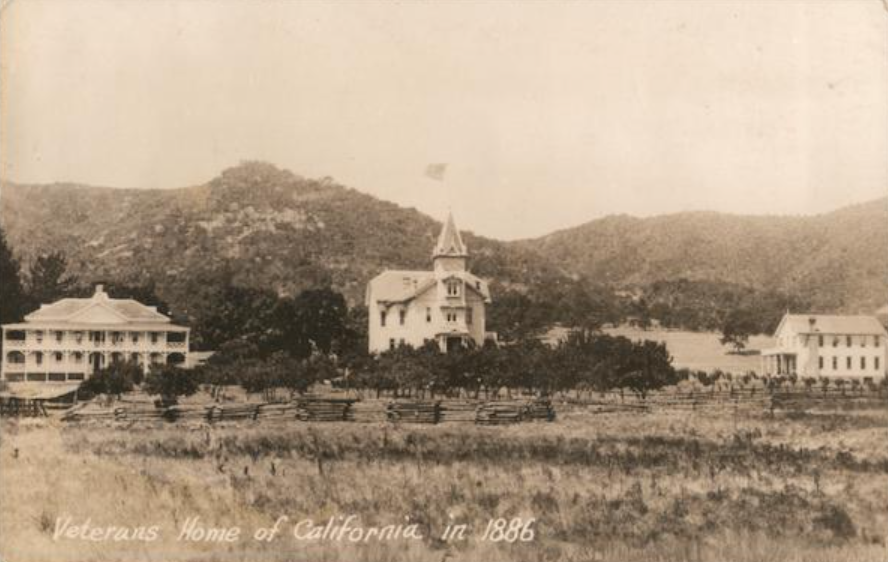
The California Veteran’s home in Yountville opened to its first residents on April 1, 1884. By the end of 1891, the population had grown to 408 men. In 2012, the home had reached it’s budgeted capacity at 1,021 men and their spouses. By 2025, the population of the home had declined to 543 in part due to a lack of affordable housing for workers in the region.
That fact sounds simple only because history books tend to stop at surrender. Armies disband. Generals write memoirs. Politicians build monuments. The dead are counted, and the living are thanked, and then the living keep living, often badly. The United States had asked young men to save the Union and then had to decide what obligation remained when those men became old, poor, ill, disabled, widowed, lonely, proud, drunk, half-mad, or simply inconvenient. There was no Social Security, no Medicare, no assisted living industry with brochures showing a smiling couple beside a fountain. There were pensions, sometimes. There were families, sometimes. There was luck, sometimes. But luck is not a system.
The Veterans Home at Yountville came out of that national embarrassment, though it took the form Americans prefer when charity makes them nervous. It was not merely a poorhouse, though poverty was part of it. It was not merely a hospital, though sickness and injury would become central to its purpose. It was not merely a club, though the Grand Army of the Republic and the fraternity of old soldiers gave it the atmosphere of a society whose members had earned the right to speak in shorthand about suffering. It was barracks, farm, infirmary, refuge, dining hall, village, discipline, companionship, and public promise all at once. Men who had once marched through mud and artillery smoke could spend their last years under California trees, among other men who understood the things they did not have to explain.
It may seem odd now that a home for Union veterans would be placed so far from the battlefields of that war, but the West had become a place where men tried to outrun memory. Former soldiers came to California for work, mining, farming, health, climate, reinvention, or simply distance from whatever had become impossible back East. California was not a vacation then. It was a second draft of life. Napa Valley offered what reformers and veterans’ associations believed old soldiers needed: land, air, routine, food, gardens, work for those who could still work, medical care for those who could not, comradeship for men who had outlived the only people who knew them fully, and enough distance from city temptations to make order seem plausible.
Yountville was remote, but not unreachable, and the distinction mattered. The railroad made the whole experiment possible. Without the Napa Valley Railroad, the Veterans Home would have been a noble inconvenience planted in a beautiful valley. With the railroad, it became an institution. Lumber, coal, medicine, livestock, doctors, administrators, visitors, supplies, mail, news, and veterans themselves could move up and down the valley. Crops could go out. Materials could come in. The railroad did not simply connect Yountville to Vallejo and the Bay. It connected a small agricultural settlement to the machinery of the modern state.
For decades, the Veterans Home was the largest and most consequential civic fact in Yountville. In many ways, it was Yountville, or at least the part of Yountville with institutional weight. It had its own economy, rituals, infirmaries, workshops, grounds, farms, parades, gossip, politics, funerals, and ghosts. Long before the town had chef-driven destiny, polished sidewalks, and guests in linen looking for the correct patio, it had old soldiers waiting out the afternoon beneath trees. The first major public meaning of Yountville was not luxury. It was obligation. The place mattered because California decided that certain people who had served, aged, suffered, or lacked means still belonged somewhere. That is a vital touchstone for anyone who wishes to know where Yountville came from.
The automobile arrived later, with its usual American promises. Every road promised freedom. Every garage promised independence. Every subdivision promised a private Eden. Every bypass promised relief. Somehow, all of it produced traffic. Yountville received one of history’s quiet gifts when Highway 29 did not finally run through the center of town the way it ran through St. Helena. St. Helena got the car age as a permanent tenant on Main Street. Its historic center survived, but it had to survive with a state highway in its chest. Yountville, by contrast, kept traffic along the edge, near enough to feed the place and far enough away to preserve the illusion of a village.
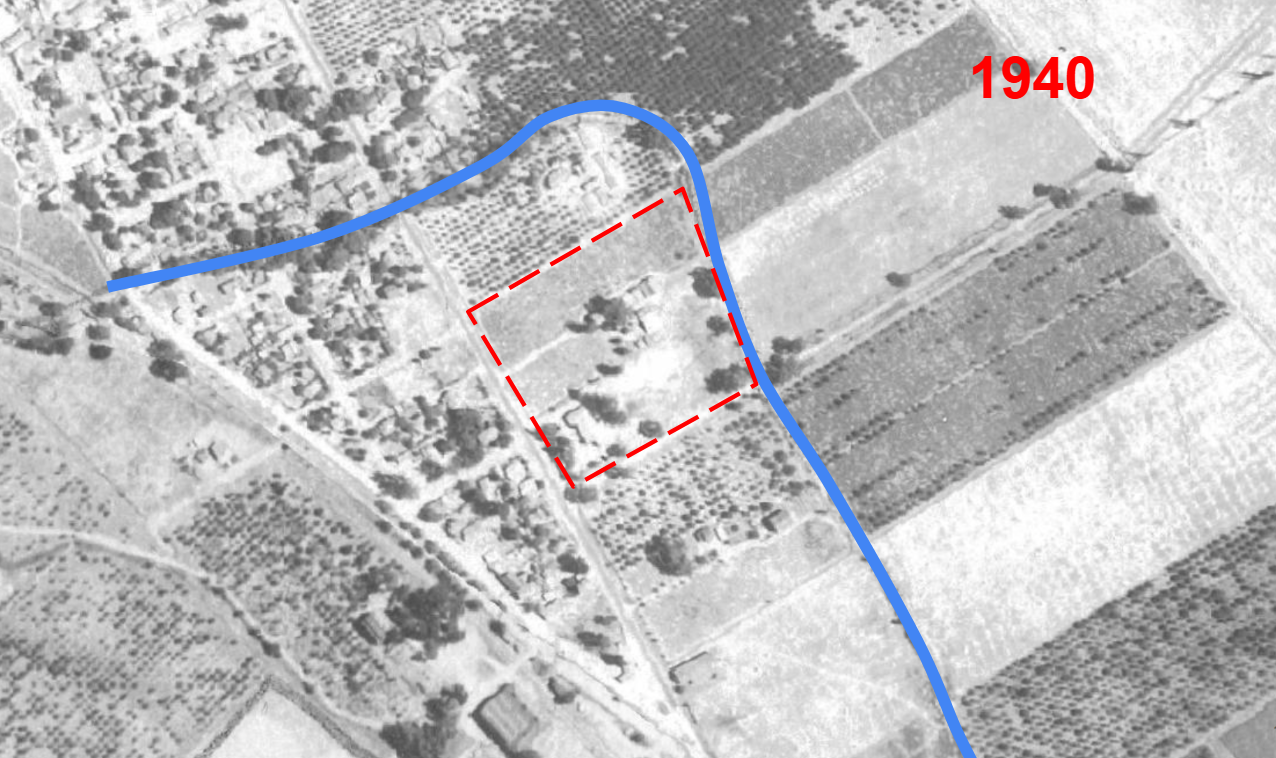
Before Yountville filled in. This 1940 aerial image shows the former elementary school site outlined in red and Hopper Creek traced in blue. At the time, the land around it was still a working agricultural landscape of orchards, vineyards, farm roads, and scattered buildings. In the decades that followed, much of modern Yountville was built over that landscape, turning fields and orchards into the homes, hotels, restaurants, civic buildings, and businesses residents recognize today.
That alignment mattered more than later design guidelines would ever admit. Once traffic owns a main street, it never fully gives it back. It demands turning movements, signals, lane widths, driveways, visibility, parking, and the gradual surrender of pedestrian ease. Yountville was spared that particular wound. The cars moved nearby. Washington Street retained a scale the town would later learn to market as if restraint had been entirely a matter of taste. The village remained legible. Quiet survived long enough to become valuable.
By the 1950s and early 1960s, however, quiet itself had become a temporary condition in California. The state was growing with a force that made planning feel like sandbags before a flood. Orchards in Santa Clara Valley were being erased with such speed that yesterday’s apricot tree became tomorrow’s ranch house and the next decade’s traffic report. Southern California had already demonstrated the full method: take paradise, divide it into lots, pave it, sell it, regret it, and move on. Napa Valley looked to the ordinary postwar development imagination like unfinished business: flat land, good weather, agricultural parcels, highway access, small towns, proximity to the Bay Area, money asleep in fields.
This was the moment when the valley’s great act of self-preservation became possible because a few people understood the predator before it had fully arrived. Jack Davies and the others who championed the Agricultural Preserve saw that the danger would not come all at once. It would come as one reasonable subdivision after another, each modest in scale, each defended as compatible, each marketed as inevitable, until the valley was gone and everyone could plausibly claim not to know when the loss had occurred. In California in 1968, growth was not merely policy. It was religion, industry, patriotism, and habit. One did not stop growth. One prepared the ribbon scissors.
Napa County did something astonishing. It changed the rules so the landscape could remain protected. Agricultural land would not be treated as suburban inventory or private dirt merely awaiting its highest speculative purpose. The valley floor would be preserved for farming, open space, vineyard rows, and the economic life rooted in them. The Agricultural Preserve was not nostalgia. It was intervention. It understood the lesson that The Leopard made famous and that preservationists often quote without following to its end: if things are to remain, things must change. Napa Valley changed the law so that agriculture could remain.
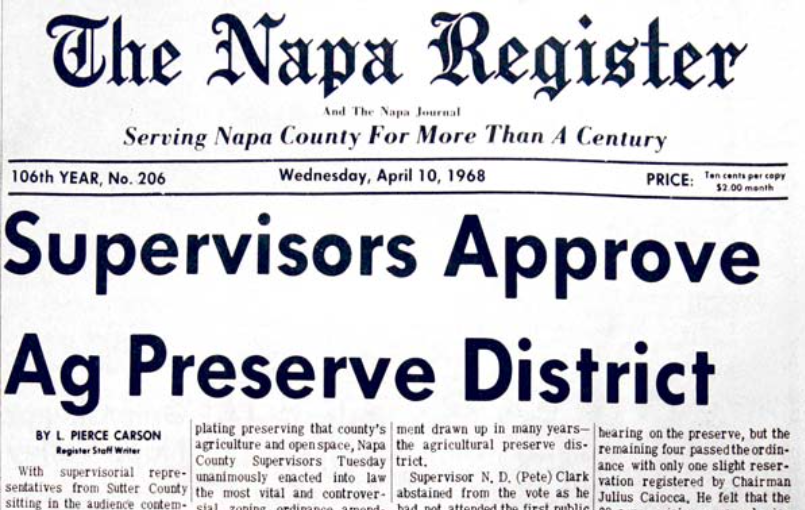
The bargain that shaped modern Yountville. This 1968 Napa Register headline marks the defining land-use decision in Napa County history: the creation of the Agricultural Preserve. The preserve helped protect the valley’s open land, vineyards, and rural edge from suburban expansion. It also hardened the boundary between protected agricultural land and the few towns allowed to absorb housing, jobs, hotels, restaurants, and civic life. The Yountville Moon begins from that unresolved bargain: preservation worked, but the housing consequences were deferred.
The brilliance of that decision is beyond serious dispute. So is its innocence. The Agricultural Preserve knew how to protect vineyards from tract houses. It did not know how to make the towns mature into places capable of holding the people the protected economy would require. This is not a criticism of its founders so much as the tragedy hidden inside their success. They saw the disaster directly in front of them, which was sprawl across the valley floor. They did not fully see the second disaster forming behind it: if the land outside town would not take growth, and if the towns themselves did not accept a more intelligent urban form within their boundaries, then the workers, young families, teachers, mechanics, cooks, caregivers, and public employees would eventually be asked to support the valley from elsewhere.
At first the contradiction remained invisible because the valley still contained enough ordinary life to disguise it. The schools had children. The houses held households. A three-bedroom home could still shelter a teacher, a mechanic, a winery worker, or a public employee raising a family. The Veterans Home still reinforced an older civic idea that ordinary people, vulnerable people, aging people, and people of modest means belonged in Yountville. There was enough unvarnished life in town to keep sentiment honest. Preservation did not yet feel like exclusion. It felt like rescue.
Then preservation succeeded, and success brought the next condition. Napa Valley did not become San Jose. It became something more profitable and more socially confusing: a protected agricultural landscape wrapped in luxury consumption. The vineyards remained, but their meaning changed. Agriculture became scenery. Scenery became brand. Brand became wealth. Wealth became scarcity. Scarcity became a kind of moral language, and moral language eventually finds its way into zoning.
Yountville was perfectly suited to this new arrangement. It was small enough to feel intimate, pretty enough to sell, old enough to romanticize, restrained enough to seem authentic, and spared enough by the highway to preserve the village image that visitors wanted to believe had simply survived by virtue. The modest houses, once ordinary pieces of postwar California family infrastructure, began acquiring a second identity. They were no longer merely shelter. They were positions inside a landscape whose meaning had changed around them.
The three-bedroom family house is not usually treated as a tragic object, but in Yountville it became one. It had once contained the roaring ordinary life of middle-class California: lunch pails, homework, casseroles, bicycles, Little League uniforms, arguments, bills, cousins sleeping on floors, dogs, swing sets, and children who assumed the town belonged partly to them because children assume that about any place where they are allowed to grow up. Then the children left because there was nowhere nearby they could afford to begin adult life. The parents stayed because they loved the place, because Proposition 13 rewarded staying, because few smaller units existed for people who wanted to downsize without leaving, and because inertia is one of the strongest land-use forces in California.
From the sidewalk, the neighborhood still looked stable. The same roofs held the same sky. The same lawns were cut. The trees matured. The holiday wreaths appeared on schedule. But inside the houses, the civic math had changed. Three bedrooms held two people, then one person, then an occasional resident, then the memory of a family rather than the family itself. Garages filled with cardboard boxes, broken lamps, old golf clubs, inherited furniture, tax records, holiday decorations, and the museum archive of American permanence. A neighborhood can lose its children without losing its buildings, which is why the loss can be mistaken for peace.
Some version of the same man appears in every town that has passed through this stage. He has lived there forever, or long enough to call it forever. He remembers bicycles in the street, school carnivals, Little League, and a time when everyone knew everyone, which usually means everyone like him knew everyone like him. He rises in public with real sorrow in his voice and asks what happened to the children. His grief is genuine. That is what makes the moment difficult. A few minutes later, when housing is discussed, he worries that apartments or workforce units will change the character of the town.
He is not a villain. Villains would be easier. He is sentimental, sincere, frightened, property-conscious, and caught inside the homeowner’s most durable illusion: that a community can remain young while its houses become old, expensive, and unavailable. He misses the children produced by a housing economy he no longer wants to recreate. He mourns the outcome and defends the cause. This is the comic tragedy at the center of preservation politics, and the comedy has to be handled carefully because the clown is not someone else. The clown is the part of civic life that wants memory without replacement, schools without families, restaurants without cooks living nearby, caregivers without apartments, and a living town without the inconvenience of new life.
By then Yountville had sorted itself into tribes, though the word is less harsh than it sounds because each tribe carries part of the town’s truth. The Veterans Home remained the oldest moral fact, a reminder that Yountville’s public history began with the idea that people who served, aged, suffered, or lacked means still deserved a place. Old Town became beautiful and increasingly theatrical, with practical buildings converted into stages for luxury experience. The French Laundry became the perfect emblem not because it is bad, but because it is so good that it reveals the transformation completely. What had once been a local shell became global pilgrimage. The building remained, but its social meaning changed. Laundry became liturgy. Supper became sacrament. The town became a stage so exquisitely restored that nobody wanted to ask who could still afford to live backstage.
There were also the 55-plus communities and trailer parks, the density of aging that a town like Yountville could accept because it did not threaten the settled image of the place. Older residents required care, continuity, services, and sympathy, but they did not require playgrounds, starter homes, school expansion, or the civic disorder of young families trying to establish themselves. They arrived not as a disruptive future but as an extension of the present. Around them sat the small suburban subdivisions with quiet garages, low occupancy, and the faint hum of neighborhood anxiety, places where the architecture of family life remained after the families had thinned out.
Then there were the second-home owners, perhaps the most delicate tribe because they often loved the town sincerely and wanted very much for that love to count as residence. Many were generous. They supported causes, knew names, attended events, gave money, adopted the local vocabulary, and spoke movingly about stewardship. But love is not the same as need. They did not need the school to survive. They did not need the local wage scale to work. They did not need an apartment for an adult child taking a job at the Veterans Home. They did not need the cook to live nearby, only to appear on time. Their relationship to the place could be affectionate, even deep, while remaining structurally closer to visitation than dependence. They were visitors who had learned the local dialect of permanence.
The hospitality economy expanded through all of this with the softness of a tide. Guests were celebrated because welcome is profitable, beautiful, and photogenic. Workers smiled because the economy required smiling. Residents smiled too, sometimes with the strained courtesy of hosts who have realized too many people are in the house and the party cannot be stopped without social consequences. The town became expert at welcome. That expertise funded services, polished surfaces, and supported a level of municipal calm many small towns could not imagine. It also required a certain discipline of silence.
There are words for places where guests are celebrated and workers are displaced, but communities rarely choose the sharp ones for themselves. They use softer words: character, scale, compatibility, traffic, parking, neighborhood integrity, process. Process is especially useful because it converts urgent moral questions into a sequence of meetings, studies, comments, continuances, revisions, and procedural fatigue. It allows everyone to remain civil while the underlying structure remains intact.
Meanwhile the workforce became regional. The morning headlights lengthened from wherever the housing market had made room for the people Napa Valley still needed but no longer housed. They arrived early enough to prepare the valley before it became visible to guests. They left after the guests had finished being enchanted. The valley floor stayed agricultural. The towns stayed small. The labor force stretched outward. This was the underbelly of the great preserve, not because the preserve was wrong, but because it was unfinished. The landscape had been protected from sprawl, while the towns were left too free to protect themselves from responsibility.
The elementary school eventually began to say the part nobody wanted to say directly. Schools are merciless institutions because they count bodies, not mythology. Restaurants can thrive on visitors. Festivals can borrow vitality for an afternoon. Public meetings can perform concern. A school needs actual children living close enough to arrive with lunch boxes, colds, missing teeth, unfinished homework, and parents late for work. The old school, which had once seemed like proof of continuity, became evidence of rupture. Enrollment decline was not a mystery of education. It was a housing autopsy.
The people asking what happened to Little League were often the same people most uneasy about the housing that might have brought Little League back. The people lamenting the loss of community often defended the land-use pattern that made community demographically impossible. The people who loved the small town had helped turn it into a retirement village, luxury enclave, hospitality platform, and occasional residence, then stood bewildered before the absence of children as though a demographic weather system had moved through without human cause.
It would be cheap to make them villains. Some were selfish, certainly. Every valley grows what it can. But the deeper story is sadder because many loved the place honestly. They loved it so much they wanted time to stop in the version of town that had given them their own memories. The problem is that stopped time is not neutral. When time is stopped for some people, it becomes exile for others. A town cannot preserve itself by preserving only its surfaces. The roofs, trees, sidewalks, setbacks, vineyards, and storefronts are the vessel. The town is the succession of lives inside it. When the succession breaks, what remains can still be beautiful, valuable, famous, serene, and immaculately maintained, but it becomes less a town than a curated memory of one.
This is where the idea that would become Measure S begins to appear, though not yet as a solution and not yet as a fight. The town was not ready to say that it had benefited from scarcity. It was not ready to say that the people serving meals, cleaning rooms, teaching children, staffing public agencies, caring for veterans, maintaining landscapes, and holding up the visitor economy had been treated as commuting inputs rather than members of the community. It was ready, in the cautious and morally practical way of small wealthy towns, to tax the visitors.
There was comedy in that and decency too. The visitor economy had helped transform the town. Perhaps the visitor economy could help keep the town from becoming an empty shell. A little more on the hotel bill, a surcharge tucked into the price of the fantasy, was easier to imagine than asking residents to tax themselves directly or asking established neighborhoods to confront the physical implications of repair. But even the comedy had its civic seriousness. The idea recognized that the town’s prosperity and its housing problem were not separate stories.
Before that next chapter begins, it matters to see the whole stage. Yountville is not a simple village that stumbled into controversy. It is a settlement born in Mexican California, remade by Union veterans, connected by rail, spared by a highway alignment, incorporated at the edge of postwar growth, protected by an agricultural revolution, enriched by luxury, aged by scarcity, softened by second homes, staffed by commuters, and haunted by the schoolchildren who used to live close enough to walk. The beauty is real. The achievement of preservation is real. The affection people feel for the place is real. So is the question of whether beauty became the alibi that allowed the town to postpone the changes required to remain alive.
The Agricultural Preserve proved that preservation requires change. Jack Davies and his allies understood that if Napa Valley wanted to remain agricultural, it had to stop behaving like ordinary California. They changed the law to protect the land. Yountville, for too long, did not apply the same courage to its own urban life. If a town wants to remain a town, it has to hold more than memory. It has to hold workers, families, teachers, caregivers, young parents, old people who want to downsize without leaving, and children who do not yet know they are the proof of continuity. It has to make room for succession, not everywhere and not carelessly, but enough to keep the school from becoming a memorial and community from becoming a word used mostly by people who no longer depend on one.
For decades, Yountville tried to keep things the same without making the changes required to keep them alive. Beneath the roses, tasting rooms, bocce courts, polished storefronts, low-occupancy bedrooms, garages full of storage, the Veterans Home, the old school, and the public meetings where people wondered with honest sorrow where the children had gone, the answer was already visible. They had gone where the housing was affordable.
