
It Was Never Just a Housing Project
How Yountville Commons began as an act of civic repair before it became a political argument
The first mistake in understanding Yountville Commons is to begin with the housing.
That is where the argument eventually landed, and once it did, almost everything else disappeared from view. The old school site became a unit count. The plan became a price tag. The public conversation narrowed to whether Yountville should build workforce housing at the center of town, how much of it, and at what cost. Those were legitimate questions, and they deserved careful answers. But they were not the first questions the Town asked when it bought the former Yountville Elementary School from Napa Unified School District. They were not the questions residents encountered when the fences came down. And they were not the questions that gave the place its new name.
The Commons was never merely a housing project. It was a civic reclamation project.
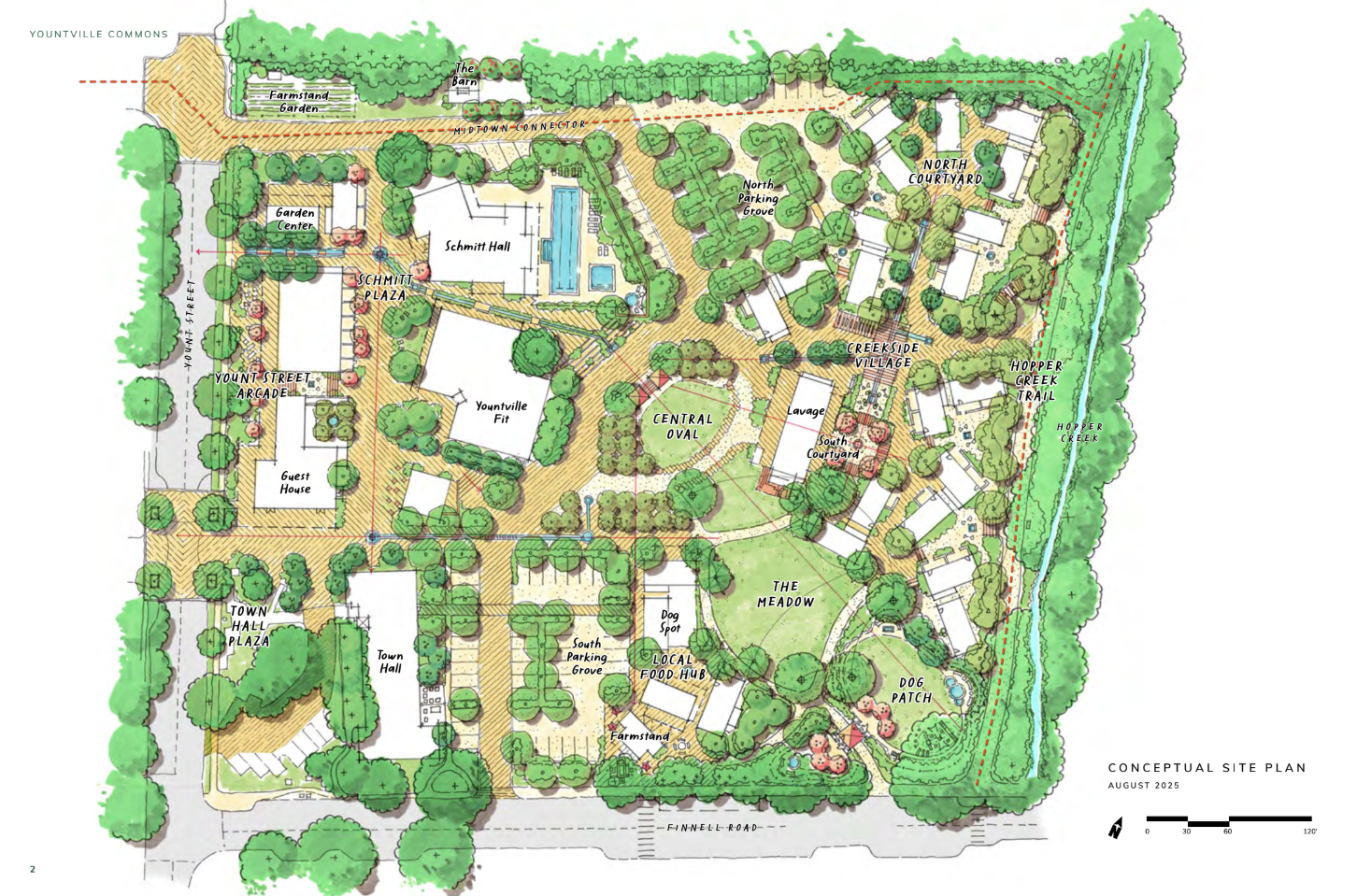
The Yountville Commons Conceptual Site plan was unanimously approved in March 2025 by both the Town Council and the Zoning and Design Review Board after a year of several public meetings, focus groups and one-on-one interviews with residents.
That distinction matters because it changes the whole story. A housing project begins with buildings and residents. A civic reclamation project begins with land, memory, access, and public purpose. It asks what happens when a place that once helped define a town goes silent, and whether public ownership can bring it back into common life. Housing was always part of the answer, because Yountville’s workforce housing shortage is real and long documented. But housing was not the whole answer. The Commons was an attempt to hold several truths at once: that the town needed homes for people who work there, that it needed public gathering places, that it had inherited an important site in the center of town, and that the future of that site should not be surrendered to either neglect or a single-purpose solution.
The old school had already done one kind of civic work for more than a century. It educated children. It anchored routines. It gave families a reason to cross paths. Its fields, garden, library, classrooms, and cafeteria belonged to the lived geography of the town. Then the school closed in 2020, and the site sat behind fences, idle and increasingly unmaintained. In a town as small and land-constrained as Yountville, an abandoned seven-acre civic property at the center of town is not a neutral condition. It is a wound in the public realm.
When the Town purchased the site in 2024, it did not begin by walling the property off for a future developer. It did the opposite. It removed barriers. It reopened the grounds. It made quick, useful improvements that residents could understand without reading a planning document. The former library became Yountville Fit, a health and wellness center. The cafeteria became Don and Sally Schmitt Hall, cleaned, painted, and returned to use for Parks and Recreation programs. A disused field became the town’s first dog park. The snack shack became a farmstand café. The neglected school garden came back to life as a working culinary garden.
These were sometimes described as “interim uses,” which is technically correct but spiritually inadequate. They were more than placeholders. They were proof of intent. Before the Town asked residents to imagine a long-term plan, it showed them what public ownership could do immediately. The old school was no longer a closed campus waiting for a speculative future. It was becoming useful again.
That is why the name mattered.
Calling the place Yountville Commons was not a marketing gesture. It was a claim about ownership and belonging. A commons is not simply open space. It is shared ground. It is land whose meaning comes from use, memory, and collective responsibility. By renaming the former school site the Commons, the Town was saying that the center of town belonged to the community as a whole, and that its future would be shaped in public. The name carried a promise: this would not be treated as surplus land, a private development opportunity, or a single-issue parcel. It would be a place where civic life, landscape, memory, daily use, and housing could be considered together.
That idea is harder to argue than a number. It does not fit neatly on a protest sign. It requires patience. It requires a willingness to see planning not as a trick or a scheme, but as the slow work of deciding how a town should live on land it owns. The Community Design Workbook prepared in 2025 tried to do exactly that. Its language was not the language of a conventional housing proposal. It spoke instead of green fabric, mobility fabric, built fabric, public outdoor rooms, shaded passages, activity nodes, gradual transitions, human scale, incremental growth, and local identity. Those terms can sound abstract, but they point to a simple civic question: how do you turn a closed school campus into a living part of town?
The answer began with the land itself.
Hopper Creek was not treated as a leftover edge or a problem to be hidden. It was understood as a living thread connecting the site to the rest of Yountville. The trail along the creek was not merely recreational; it was part of the town’s daily mobility network. The open spaces were not decorative relief around buildings; they were the structure of the place. Gardens, paths, trees, small parks, and shaded outdoor rooms were meant to shape how people moved, lingered, crossed paths, and felt welcome.
That was the green fabric: not landscaping applied after development, but landscape as civic infrastructure.
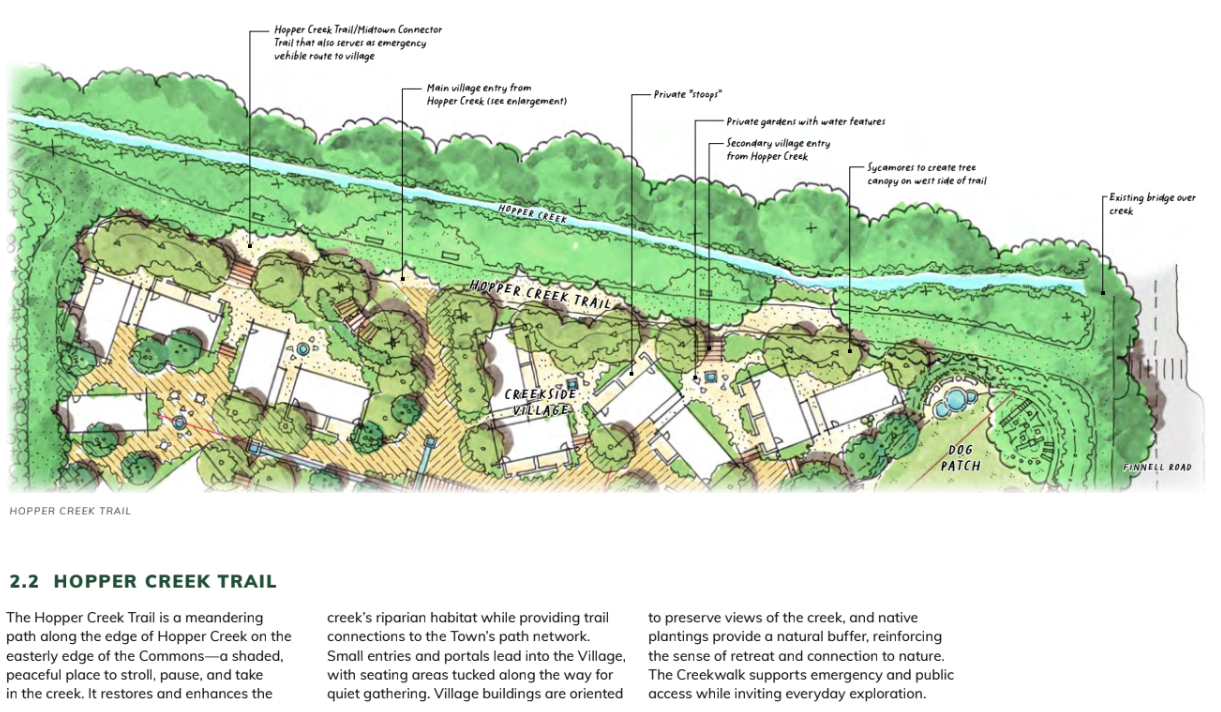
One of several conceptual sketches showing how existing uses such as the Hopper Creek pathway was incorporated into the Commons site design. Dozens of residents we met with expressed clear desire to not block off the site from this popular pedestrian route.
The mobility fabric carried the same idea into movement. The Commons was not imagined as an isolated enclave. It sat between the west side of town, where regional bicycle connections bring people toward Yountville from Napa, and the east side, where many residents live. Properly designed, the site could become a safe and useful crossing, a place people moved through as well as to. Its lanes would be limited and calm. Its paths would matter more than its driveways. Its parking areas could serve more than cars, becoming flexible spaces for markets, events, and public gathering when vehicles did not need them.
This was not anti-car ideology. It was small-town common sense. In a town where scale is one of the qualities people most cherish, public land should not be organized first around automobile storage. It should be organized around the people who walk to a class, ride a bike through town, meet a neighbor under a tree, take a child to camp, buy lunch at the farmstand, or sit for a few minutes in the shade.
The built fabric was equally important. Yountville’s best-loved buildings are not always grand. Their strength lies in their adaptability. Town Hall, once a grammar school, still carries its original civic dignity. The French Laundry, once a washhouse, became something entirely different without losing the legibility of its form. That is one of the quiet lessons of old towns: buildings endure when they are simple enough to change.
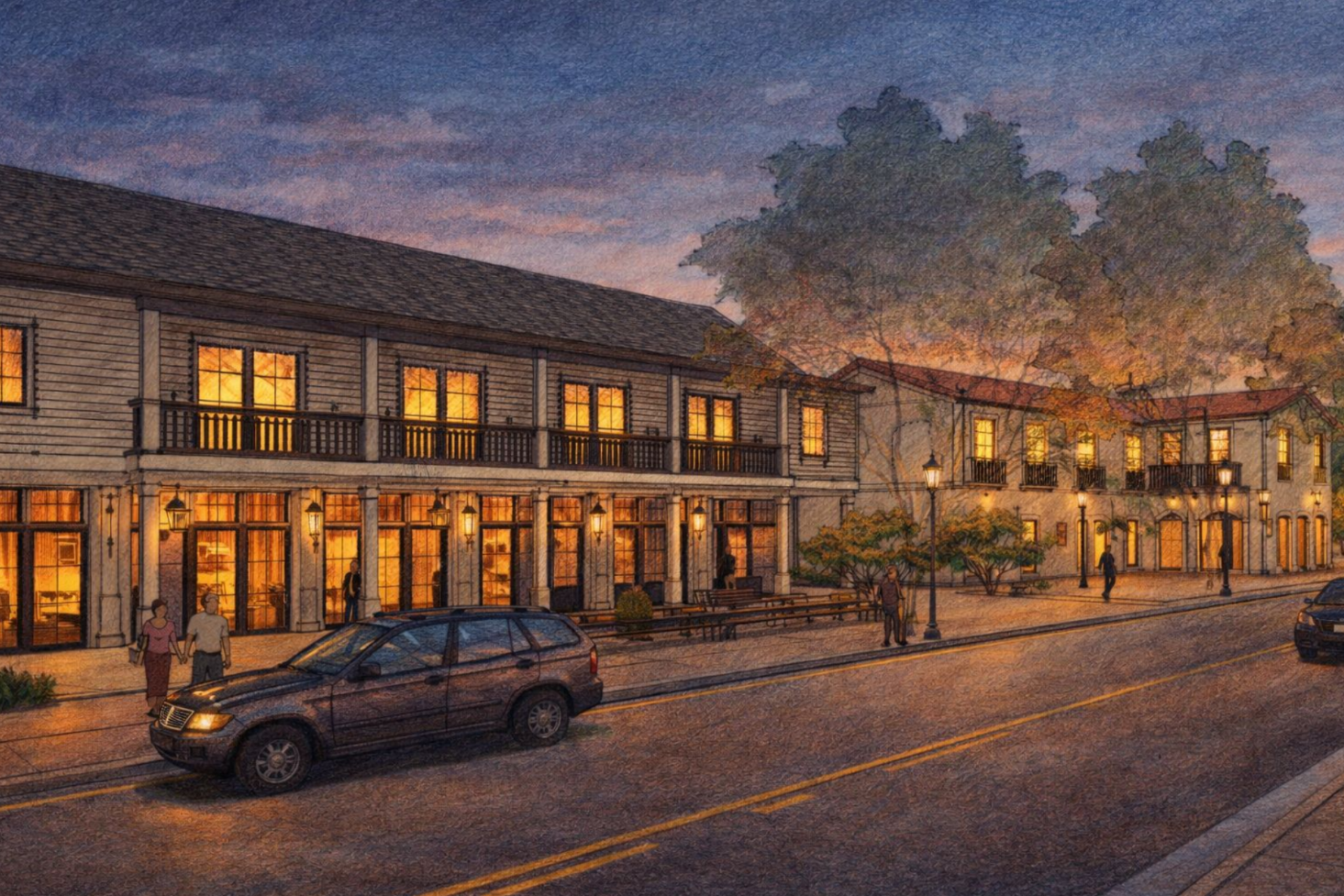
THIS. One of the most common themes during our community outreach was to make sure the new buildings would match the scale of other buildings in Yountville. This conceptual image of the Yount Street buildings could allow a range of uses over time including housing, civic uses, and simple porches. This is technically called form-based design where the exterior spaces are designed first.
The Commons plan drew from that lesson. Its buildings were not meant to overwhelm the town with novelty. They were meant to be simple, well-proportioned, and adaptable. Porches, stoops, awnings, benches, fountains, garden walls, and shaded paths were not decorative afterthoughts. They were the devices by which a building becomes neighborly. A public-facing building says something different from a private object in a field. A chair under an awning says something different from a sign that says “public welcome.” In a town, these details matter because they tell people how to behave. They tell people whether they belong.
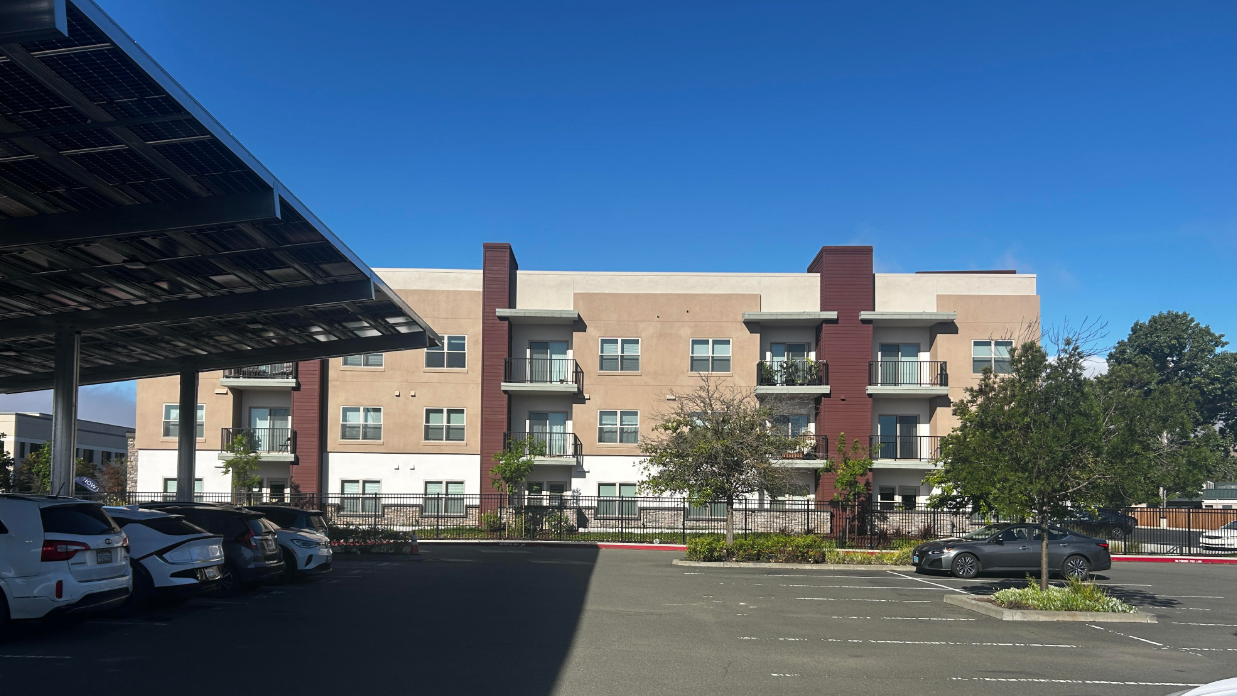
NOT THIS. Perhaps the strongest message from our initial interviews across a wide range of residents is what they did NOT want for the Yountville Commons. Modern apartment buildings with large expanses of asphalt parking lots in front of them were to be avoided at all costs!
Housing fit within that structure, not outside it.
This is the point most easily lost in the later argument. The Commons did include workforce housing, and it needed to. Yountville cannot honestly describe itself as a complete town if the people who cook its food, care for its seniors, clean its rooms, staff its public services, and sustain its hospitality economy have almost no chance of living there. A town can preserve its charm and still become socially incomplete. It can protect its scale and still hollow out its daily life. The purpose of the Commons was to recognize that workforce housing is not an external burden placed on the town. It is one of the civic functions a town must consider if it wants its public life to remain real.
But housing at the Commons was not conceived as a subdivision sealed off from everyone else. It was one ingredient in a mixed civic precinct. Residents would live near public gardens, trails, community rooms, recreation spaces, and small gathering places. Longtime residents would continue using the site. Workers would gain a foothold in the town they serve. Visitors might pass through without ever realizing that the place they were enjoying also helped answer a serious housing need. That was the point. The plan was trying to make usefulness beautiful and beauty useful.
The alternative was not purity. The alternative was fragmentation.
Without a public plan, the former school site could have remained a collection of disconnected interim uses, politically popular but incomplete. Or the Town could have waited for future pressures to solve the problem badly. It could have waited for another private development proposal and negotiated a few affordable units on someone else’s timetable. It could have tried to meet state housing obligations with scattered, marginal sites. It could have treated the school grounds as an amenity and pushed the harder civic question somewhere else. All of those choices would have been easier to explain in the short term. None would have answered the larger question public ownership placed before the town.
What made the Commons unusual was not that it proposed housing. Many towns propose housing. What made it unusual was that the Town owned the land, began by making it public, and then tried to plan the whole site before handing pieces of it to any future partner. That order mattered. Public ownership gave Yountville a rare form of control. It could decide the character of the place before financing narrowed the possibilities. It could set the relationship between housing and civic life before a developer defined the program. It could determine the streets, paths, open spaces, building scale, and public uses before the site was reduced to a transaction.
This is what planning ahead was supposed to buy: not certainty, but leverage.
It allowed the Town to say what the Commons was before anyone else said what it could be worth. It allowed the public to debate a vision rather than react to a private proposal. It allowed housing to be placed inside a larger civic framework, instead of being treated as an isolated concession extracted from another project. It allowed the Town to ask how the site might evolve over time, parcel by parcel, building by building, use by use.
That incremental quality was central. The Commons was not imagined as a single act of construction. In a small town, the best places rarely arrive all at once. They accumulate. A school becomes a town hall. A washhouse becomes a restaurant. A field becomes a dog park. A snack shack becomes a café. A garden is replanted. A hall is repainted and filled again with children. A path becomes part of a daily walk. A first set of homes proves whether the next should follow. The vision was not a frozen master plan. It was a way of giving the town a framework sturdy enough to absorb change.
That is why the later reduction of the Commons to “the housing project” was so damaging. It did not merely criticize one part of the plan. It erased the plan’s central premise. Once the Commons became only a housing project, every shared use looked like window dressing. Every design principle sounded like rhetoric. Every public improvement seemed like a prelude to something residents had not been told. The very things that should have made the project more understandable — its phasing, its mixture of uses, its reuse of existing buildings, its attention to public space — became harder to defend because the debate had collapsed into a single category.
And once the price entered the conversation, the collapse was almost complete.
The full buildout estimate became, for many people, the imagined cost of “the housing project.” But that number belonged to a different question: what would it cost to study, entitle, and understand the possible long-term buildout of the entire site? The Town was required to look at the whole thing, because environmental review does not allow a community to pretend that later phases do not exist. But studying the whole site was never the same as deciding to build the whole site at once. The difference between a planning envelope and a spending plan is not a technicality. It is the difference between prudence and panic.
The second essay in this series takes up that cost question directly. It asks why a town had to price a project it never meant to build all at once, and why the number produced by responsible planning became the easiest weapon against the plan itself. But that argument only makes sense after recovering the first principle: the Commons was not born as a bill. It was born as an effort to return a closed civic place to common life.
The school site asked something of Yountville because it was too important to ignore. It sat at the center of town. It carried memory. It contained buildings, trees, gardens, fields, and paths that could be reused. It offered one of the few chances Yountville may ever have to shape public land on its own terms. To treat that opportunity as only a housing fight was to make the town smaller than the question before it.
The better question was always larger.
What should a small town do when it gets back a piece of itself? Should it preserve the memory and avoid the need? Should it meet the need and sacrifice the memory? Or can it do the harder thing: reuse what is there, welcome what is missing, and create a place where public life becomes richer because more people can share in it?
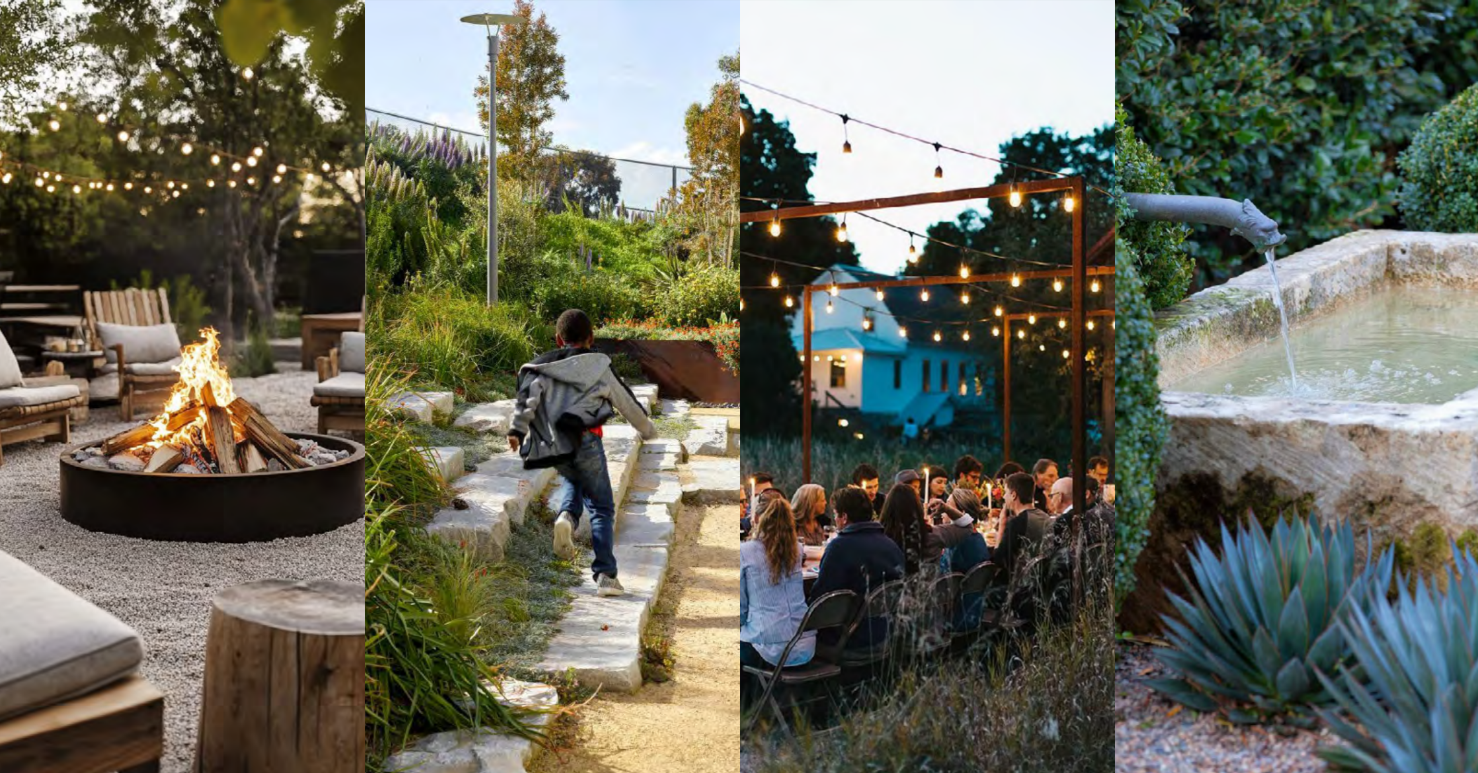
One of the tools used in working with residents was not just reactions to sketches and plans but how they responded to images such as these which described small gestures within a larger framework across a range of uses. Housing was just one element of those.
Yountville Commons was an attempt at that harder thing.
It may be debated. It may be revised. It may be built more slowly, or in smaller pieces, or with different partners than originally imagined. Reasonable people can argue about scale, timing, financing, and design. They should. That is what a commons requires. But they should argue about the thing itself, not a flattened version of it.
The Commons was never just a housing project. It was the old school reopened. It was the fence coming down. It was a garden replanted, a hall reused, a field given back to dogs and their owners, a snack shack made useful again, a path reconnected, a creek respected, a public site renamed for public life. It was also a place where some of the people who sustain Yountville might finally be able to live in Yountville.
That was not a contradiction. That was the vision.
A town is not preserved by freezing its best places in memory. It is preserved by finding new public uses worthy of them. The former school had already served one Yountville. The Commons asked whether it could serve the next.
