
About the Moon

Every community tells stories about itself.
Some of those stories are celebratory. Others are cautionary. A few become so familiar that they harden into articles of faith, repeated often enough that no one pauses to ask whether they remain true or whether changing circumstances demand a second look. The healthiest communities revisit those stories from time to time, not because they enjoy conflict, but because each generation inherits a place it did not create and assumes responsibility for deciding what comes next.
A success, and its cost
Yountville, in many respects, is one of California's remarkable success stories. It has preserved a small-town scale that much of the state surrendered decades ago. It remains surrounded by an agricultural landscape that earlier generations fought to protect. Its tree-lined streets, public parks, and carefully maintained character reflect a long tradition of stewardship rooted in the belief that places worth loving are also worth preserving. Those instincts were not misguided. Napa County's Agricultural Preserve remains one of the most consequential land-use decisions in California history, and communities like Yountville bear witness to the foresight of those who recognized that growth without intention can consume the very qualities that make a place special.
Success, however, rarely arrives without tradeoffs. The same policies that protected the valley's extraordinary character also contributed, often unintentionally, to challenges that have become increasingly difficult to ignore. Young families struggle to establish themselves in the communities where they were raised. Employers find it harder to recruit and retain workers who can afford to live nearby. Seniors seek ways to age in place while remaining connected to the neighborhoods they helped build. The people who sustain local institutions increasingly commute from farther away, carrying the burdens of time and distance that housing scarcity imposes.
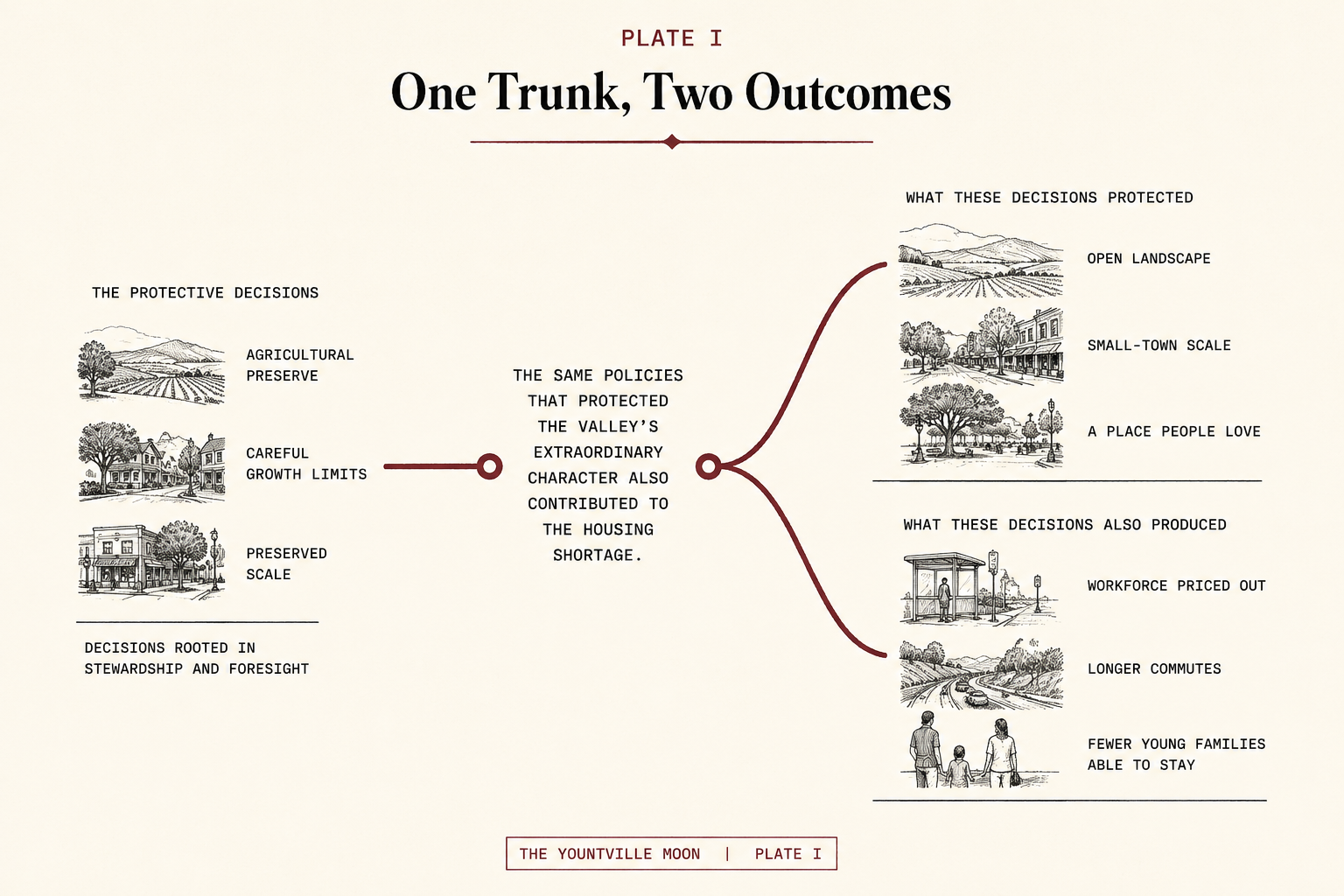
These are not uniquely Yountville problems. They are California problems. Yet they become particularly visible in small towns, where the relationship between public decisions and everyday life is difficult to overlook. In communities such as this one, residents are not debating abstract theories. They are wrestling with questions about declining enrollments, neighborhood character, economic opportunity, environmental stewardship, and whether future generations will have an opportunity to participate in the life of the places they call home.
A place of many histories
Understanding those questions requires context. California itself is a place of overlapping histories. Long before statehood, this region was home to Native communities whose relationship with the land stretched across centuries. Spanish expeditions passed through Northern California in the eighteenth century, followed by Mexican governance that left its imprint through ranchos, institutions, and many of the place names that still define the state today. American settlement layered itself onto what came before, bringing its own ambitions, assumptions, and aspirations.
Each generation inherited a California it did not build, and each generation reshaped it.
The Napa Valley that exists today emerged from those successive layers of history. The people who sustain it have never belonged to a single profession, background, language, or generation. Families whose roots in the valley stretch back decades live alongside newer arrivals seeking opportunity. Teachers, nurses, tradespeople, hospitality workers, agricultural laborers, entrepreneurs, retirees, and caregivers all contribute to the daily life of the communities they share.
The story of California has never belonged exclusively to one group of people. Neither does the story of Yountville.
This publication was created in recognition of that complexity.
What I bring to these pages
By profession, I am an architect. My firm was hired by the Town of Yountville to help lead the public outreach and subsequent design effort for what became known as the Yountville Commons. Over several years, that work involved public meetings, design workshops, technical studies, financial analyses, conversations with residents, and the difficult task of translating competing priorities into a coherent proposal. The first phase of the Commons represented the portion of the project Town officials believed could realistically be financed before additional partners, including nonprofit housing organizations, became involved.
That experience shaped my perspective, and readers deserve to know it. I believe Yountville's housing challenges are real. I believe the Town undertook a serious effort to understand them. The Commons was the Town's attempt to respond, and some residents disagreed with it. In early 2026, a petition signed by about one in ten registered voters suspended the project's zoning. The vote settled what the opponents were against. It has not yet shown what they are for.
I do not pretend to be neutral. Where I hold an opinion, I will identify it as my own. Where facts are disputed, I will show the evidence. Where reasonable people disagree, I will say so.
The purpose of the Moon is not to conceal those disagreements. Its purpose is to provide the historical context, factual foundation, and explanatory framework necessary to understand them.
Why the facts did not settle it
One of the most surprising lessons of the Commons process was discovering that information alone does not necessarily produce consensus. The Town commissioned studies. Public meetings were held. Consultants completed analyses. Residents volunteered countless hours serving on committees and commissions. Years of work were invested in understanding both the problem and a range of possible responses.
And yet disagreement persisted.
That should not surprise us. Communities have always struggled to reconcile competing values. People who care deeply about the same place frequently arrive at different conclusions about what should happen next. One resident may prioritize preserving neighborhood character. Another may focus on whether teachers, healthcare workers, and hospitality employees can afford to remain nearby. Others may worry about fiscal responsibility, unintended consequences, or the cumulative effects of change.
Healthy communities make room for those differences. Difficulties arise when disagreement shifts away from solutions and toward competing versions of reality itself. Reports go unread. Public processes fade from memory. Complex questions collapse into slogans. Individuals with sincere intentions begin speaking past one another because they no longer share a common understanding of the facts.
What the Moon is for
The Yountville Moon emerged from a conviction that communities deserve better than that. Its mission is simple: clarity through the fog.
The Moon is neither an exercise in outrage nor an attempt to manufacture consensus. It exists because most people do not have the time to read hundreds of pages of planning documents, attend every public meeting, or reconstruct years of institutional history before forming opinions about issues that affect their lives. They are raising children, caring for aging parents, commuting to work, operating businesses, volunteering in their communities, and navigating the ordinary responsibilities of adulthood.
Those people still deserve access to the facts.
The Moon attempts to bridge that gap by gathering information, providing context, explaining tradeoffs, and presenting complicated subjects in language that respects readers' intelligence without assuming specialized expertise.
Voices beyond my own
No single person possesses all the expertise required to navigate the challenges facing modern communities. For that reason, readers will occasionally encounter invited contributors whose knowledge extends beyond my own. Economists, historians, planners, educators, architects, and others bring valuable perspectives to questions that rarely fit neatly within disciplinary boundaries. Some contributors may disagree with one another. That is not a weakness. It reflects the reality that understanding is often enriched through the thoughtful exchange of differing viewpoints.
The Commons Explained, one of the publication's future sections, will embody this approach. Its purpose is not to secure agreement regarding a particular outcome. Rather, it attempts to explain, through words and graphics, how a major public project evolved, what problems it sought to address, how decisions were made, and what alternatives were considered. In an age increasingly defined by abbreviated attention spans and compressed narratives, explanation itself becomes a public service.
What the Moon is not
Readers should also understand what the Moon is not. It is not a platform for anonymous comments or letters to the editor, and that choice was deliberate. Public participation matters deeply. Citizens should question assumptions, challenge conclusions, and hold institutions accountable. Yet experience suggests that comment sections often reward certainty over curiosity, performance over understanding, and provocation over evidence. Under the polite language of "continuing the conversation," they can amplify outlier opinions, encourage personal attacks, and deepen divisions without improving public understanding.
Communities already possess more meaningful forums in which disagreement can unfold in public and under shared rules. They are called public meetings. If you have something important to say about the future of your town, attend one. Sit patiently through the entire agenda. Listen to your neighbors. Listen to your elected representatives. Wait your turn. Then deliver your message respectfully into the public record. Democracy asks many things of us, but showing up remains among the most important.
The alternative, of course, is to start your own newspaper. Anyone who has attempted such an endeavor quickly discovers why there are so few of them. Healthy communities depend upon people willing to do the difficult work of explanation, interpretation, and civic participation. The Moon represents one contribution to that effort, imperfect though it may be.
Understanding, not agreement
The opposite of division is not agreement. It is understanding.
Understanding begins with curiosity. It asks us to wonder why neighbors reach different conclusions before assigning motives to their beliefs. It invites us to examine the historical circumstances that produced present conditions. It reminds us that certainty is not always a virtue and that humility remains an essential component of public life, whether you're a longtime business owner or a recent arrival.
The Yountville Moon cannot resolve Yountville's disagreements, nor should it aspire to. Communities are not strengthened by the absence of conflict but by the quality of the conversations they are able to sustain through it. If these pages help readers understand a difficult issue more clearly, appreciate the historical circumstances that produced it, or ask a better question at the next public meeting, then they will have served their purpose.
Welcome to the Yountville Moon.
— Brendan Kelly
Editor, The Yountville Moon