
The Price of Planning Ahead
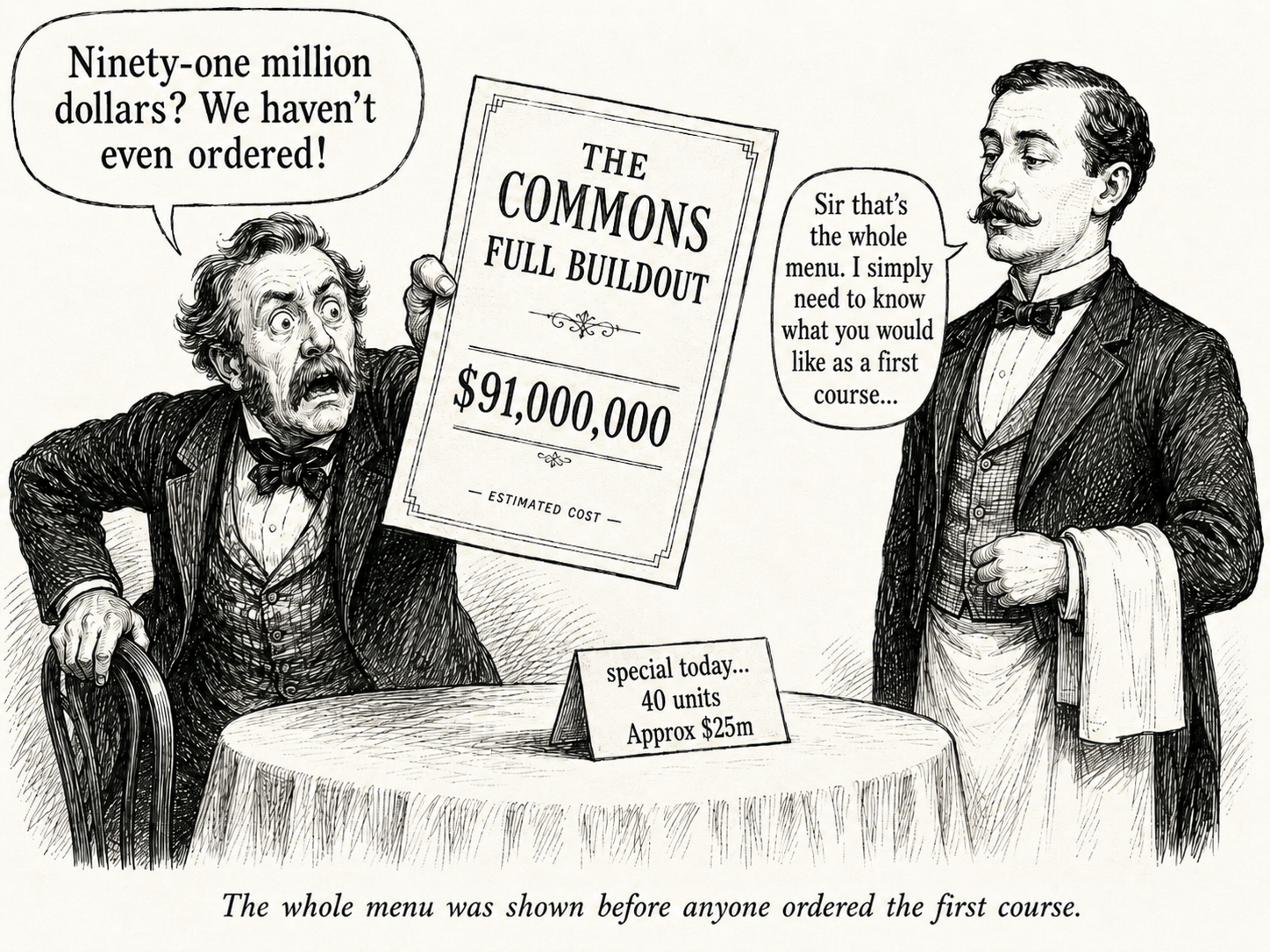
The cartoon captures the mistake at the center of the Commons cost debate: the Town showed the full long-term menu so it could decide what to build first, but many residents read that menu as if the whole bill had already come due.
Why Yountville had to understand the cost of the whole Commons before deciding what part it could actually build.
For a number of Yountville residents, the Commons debate came down to one number: roughly $91 million.
That number sounded enormous because it was enormous. It was repeated as if it described a project the Town of Yountville had already decided to build, finance, and complete all at once. To anyone hearing the figure without context, the conclusion was easy enough to reach. How could a town of 3,000 people possibly spend that much money on the old school site?
But that was not what the number meant.
The $91 million estimate was not a construction contract. It was not a check the Town was preparing to write. It was not even a decision to build the full Commons plan. It was an estimate of what the entire seven-acre site might cost if, over many years and with future partners, the Town eventually built out the full civic and housing framework that had been studied.
That distinction matters because the Town was not at the end of a construction process. It was near the beginning of a decision-making process. It was trying to understand the whole menu before deciding what it could afford to order first.
That is where much of the public confusion began.
What Was Repealed
In June 2026, after a successful referendum effort, the Town Council repealed the zoning and tentative map that had been approved for the Commons. In plain English, that means the Town set aside the land-use approvals that would have allowed the old school site to be developed gradually as a mixed civic and workforce-housing campus.
The repeal did not sell the land. It did not end Measure S. It did not eliminate the need for workforce housing. It did not erase the Town’s state housing obligations. It did not make Yountville’s workers suddenly able to live in Yountville. It did not repeal the opportunity to consider a workforce housing project on the part of the school that is already zoned for public facilities.
It narrowed the path.
Before the repeal, the Town had a framework for using the former school site over time. After the repeal, the Town still owned the land, but the larger staged plan was gone. What remained was the same public property, the same housing need, and a more complicated route to doing anything substantial about it.
That is why the cost question deserves a calmer second look. The argument was not simply about whether $91 million was too much money. Reasonable people can absolutely debate whether Yountville should ever build a project of that scale, whether there is a market for it, which unit mix is most appropriate, or whether the site should carry fewer homes. Those are fair questions.
The problem is that the repeal happened while the Town was still trying to sort those questions out.
What the $91 Million Actually Described
The $91 million estimate described the full possible buildout of the Commons, not the first phase.
That full buildout represented roughly 75,000 square feet of new construction, somewhere between 75 and 150 homes depending on the final unit mix, and about five acres of landscaping, parking, infrastructure, utilities, circulation, and public amenities spread across a seven-acre site.
One way to understand the number is to divide it by the larger possible unit count. At 150 homes, the full-buildout estimate comes to a little over $600,000 per home. That is not a wild number in the Bay Area. In fact, for workforce and below-market housing in Northern California, it is a fairly conservative planning figure.
That does not mean Yountville should have built 150 homes. It does not mean the market existed for that exact project. It does not mean every later phase made sense. It simply means the headline number, when placed in the real world of Bay Area housing costs, was not evidence of fantasy or corruption. It was a planning estimate for a large public site.
The Town’s actual near-term question was much smaller: could it build a first phase?
That first phase was expected to be about 40 homes in five buildings, at an estimated cost of roughly $25 million. That was the piece the Town could begin to understand with money it already controlled, Measure S bond capacity, future rental revenue, and conventional financing. Everything beyond that first phase depended on later decisions, later votes, later funding, and likely outside partners such as nonprofit housing developers, tax-credit investors, state programs, or grants.
No one had approved spending $91 million. No one had found $91 million. No one had proposed that the Town build the entire campus in one motion. The real question was whether the Town could take a first responsible step while preserving the option to do more later.
The Menu Problem
The confusion is easier to see through a simple comparison.
Imagine being handed a menu and being told the cost of everything on it: every breakfast, every lunch, every dinner, every dessert, every bottle of wine, every possible meal the restaurant could serve. The total would be enormous. It might be accurate. It might be useful to the owner, the accountant, or someone trying to understand the restaurant as a whole.
But it would not be your dinner bill.
Your actual choice would depend on how hungry you are, what you can afford, who else is at the table, and whether you plan to come back another day. You might order one course now. You might skip the expensive items. You might decide to return later with more people. Knowing the full menu does not mean ordering all of it.
The Commons cost estimate worked the same way. The Town had to understand the full site before choosing the first phase. The public saw the full menu and many understandably mistook it for the bill.
That misunderstanding had consequences. Once the largest number became the story, the more important question was pushed aside: what was the right first order?
Why the Town Had to Study the Whole Site
Some of this confusion came from the way public planning works.
The Town could not responsibly study one small corner of the school site while pretending the rest did not exist. Roads, utilities, drainage, parking, emergency access, landscaping, public space, and neighborhood impacts all depend on the larger framework. The first building is not isolated from the site around it. It connects to pipes, driveways, transformers, sidewalks, storm drains, trees, parking counts, and future decisions.
CEQA did not require the Town to produce a construction budget in the way a contractor prepares a bid. What CEQA required was that the Town define and study the whole project being considered. Once the Town studied a full site framework, responsible public planning required some understanding of what that framework might cost.
That is how the $91 million number entered the conversation. It followed from the effort to understand the whole site. It was not proof that the Town intended to build the whole site at once.
What Planning First Bought
The Town bought the old school site in 2024 because it was a rare public asset in the center of Yountville. The school had closed in 2020 after more than a century of public use. Once the Town owned it, the fences came down and the property began returning to civic life.
The old library became a fitness room. The former lunchroom became Schmitt Hall. A disused ball field became the town’s first dog park. The snack shack became a cafe. The abandoned garden returned to use under the watchful eye of Peter Jacobsen and his hardworking volunteer crew of locals. Long before housing dominated the argument, the Commons was already becoming a public place again.
That matters because the housing plan was not a sudden attempt to turn a school into an apartment complex. It was one piece of a larger civic question: how should Yountville use one of the few large public properties it will ever own?
Planning first gave the Town control over that question. It allowed the Town to decide where buildings might go, which buildings could be renovated as part of the larger vision, how the site might remain public, where open space belonged, how future phases could be separated, and what kind of housing should be considered. A private developer usually answers those questions before the public sees very much. In this case, the Town tried to answer them in public.
That openness was admirable, but it was also dangerous. A project designed in full view gives people access to every uncertainty before it has been resolved. The public sees the big number before the financing plan is complete. It sees the maximum buildout before the first phase is refined. It sees possibilities before they have been narrowed into choices.
The Town was still trying to separate the first real decision from the full theoretical buildout when the repeal cut the process short.
Why Phasing Was the Point
The Commons plan divided the site into 18 parcels. That structure was widely misunderstood.
Eighteen parcels did not mean 18 projects built at once. It meant the opposite. It was a way to let the Town improve the site in pieces, as money and partners became available. One parcel could move. Another could wait. A first phase could be built while later phases remained only possibilities. Some parts of the plan might have changed. Some might never have been built at all.
That is how a small town builds something larger than a single building. It does not do everything at once. It prepares the land, builds what it can, learns from the result, and then decides whether to continue.
The first phase was the only viable path. Not because it answered every question, but because it was the only question the Town was actually ready to answer. Could Yountville build about 40 homes on land it owned, using Measure S, available cash, bond capacity, rental income, and financing, while leaving later phases to future partnerships and future votes?
That was the decision worth debating.
Instead, the debate jumped to the largest possible number and treated it as if it were already a signed contract.
How Yountville Usually Gets Workforce Housing
The alternative to planning the Commons was not a simpler public project. The alternative was waiting.
That is how Yountville has usually gotten workforce housing. A large private project comes forward. The Town approves it. As a condition of approval, the developer provides land, money, or homes. The hotel comes first. The workforce housing follows behind it.
That method has produced real housing, and it should not be dismissed. But it works on the developer’s schedule, not the Town’s. The community does not decide when the housing arrives, how much of it there is, or exactly where it belongs. It negotiates for a public benefit attached to someone else’s private plan.
The Commons was different because the Town owned the land. That gave Yountville a rare chance to set the terms before a partner arrived. It could decide the purpose, the scale, the public spaces, the design expectations, and the phasing strategy first. Then, if outside funding or a nonprofit partner became necessary, the Town would be negotiating from a position of control.
That was the value of planning ahead. It did not eliminate the need for partners. It made partnership more likely to happen on the Town’s terms.
What the Repeal Did Not Answer
The repeal did not answer whether 75 homes, 100 homes, or 150 homes made sense. It did not answer whether 40 homes was the right first phase. It did not answer whether the unit mix should change. It did not answer whether the site should include more civic space, fewer buildings, different parking, or a slower timetable.
Those questions were still open.
What the repeal did was remove the framework that allowed those questions to be answered in sequence. It treated the largest possible version of the plan as if it were the only version of the plan. In doing so, it made the first practical step harder to take.
That is the central irony. The cost estimate was produced because the Town was trying to plan responsibly. The number then became the reason many people concluded the planning had been irresponsible.
The Real Price
The real price of planning ahead is not only the money spent on consultants, architects, engineers, environmental review, or public meetings. It is the political cost of showing the whole problem before the community is ready to separate the possible from the immediate. The difference between what is presented and what is proposed.
Yountville needed to know what the Commons could become. It also needed to decide what it could afford to do first. Those are different questions. The $91 million estimate answered the first one. The proposed first phase was the beginning of the second.
A public plan is not a purchase order. It is a way of seeing the choices before making them. Some parts of the Commons, such as a public pool, may have proved too expensive. Some may have needed to wait. Some would almost certainly have required partners who were not yet at the table. But none of those judgments can be made clearly when the full cost of a long-term framework is mistaken for the price of an immediate decision.
That is what the repeal obscured. The workforce problem that prompted the Commons did not go away. The old school site remains public land. Measure S still exists, and because those housing funds helped make the purchase possible, housing still has to be considered there in some meaningful way. The Town’s state housing obligation remains in force. The same facts that made the Commons necessary are still present, only now with fewer tools available to address them.
What disappeared was not the need, or the land, or the obligation, or the money already committed to the purpose. What disappeared was the clearest path the Town had begun to draw for making a first decision: not whether to build everything, but whether to build something real, modest, and useful enough to begin.
