
Where the Workers Were Counted
Yountville is a small town, and small towns feel disagreement personally. A public debate can begin as a disagreement about policy and quickly become something more painful: neighbors sorting themselves into sides, motives being assigned, and complicated facts reduced to slogans.
The Yountville Moon was not created to make that fracture worse. Its purpose is the opposite. But the opposite of division is not agreement. The opposite of division is understanding.
Dialogue matters. It does not always require a facilitator, a formal meeting, or a microphone at Town Hall. Sometimes it requires the harder and more ordinary work of asking a neighbor why they believe what they believe, listening carefully to the answer, and then trying to sort the facts from the fears, assumptions, and frustrations that surround them. That takes curiosity. It takes effort. It also requires a shared record.
One claim has been circulating in council comment, in letters to the editor, and in conversation around town. The claim is short: “The Town never even studied what the workers needed.”
This essay addresses that claim directly, not to embarrass anyone who has repeated it, but to help everyone work from the same facts. The workforce in and around Yountville has been studied at length, by multiple agencies, using the strongest methodologies available in housing research. The studies sit on the public record. Some are on the Town’s website. Some are housed at the U.S. Census Bureau. Some have been issued by independent regional housing organizations. Anyone with an internet connection can read them.
This essay is a guide to those documents. It names the studies. It states what each one measured. It explains why the methodology behind these studies is stronger than the methodology critics are demanding in their place, which is an employer survey. It places the size of the Yountville Commons against the size of the documented need. And it closes with the question the accusation actually raises, which is not whether the workforce was studied but whether the speaker read what was studied.
A reader who wants to verify any of this can copy this essay, paste it into Claude, ChatGPT, or any other assistant, and ask the assistant to check each document against the citations. Every citation in this essay names a real, publicly available source.
1. The Town’s own adopted study
The first document is the Town of Yountville 2023-2031 Housing Element, adopted by the Town Council on June 4, 2024. The California Department of Housing and Community Development certified the Housing Element on August 7, 2024. The certification letter is signed by Paul McDougall, Senior Program Manager at HCD’s Division of Housing Policy Development. The signed letter is publicly available.
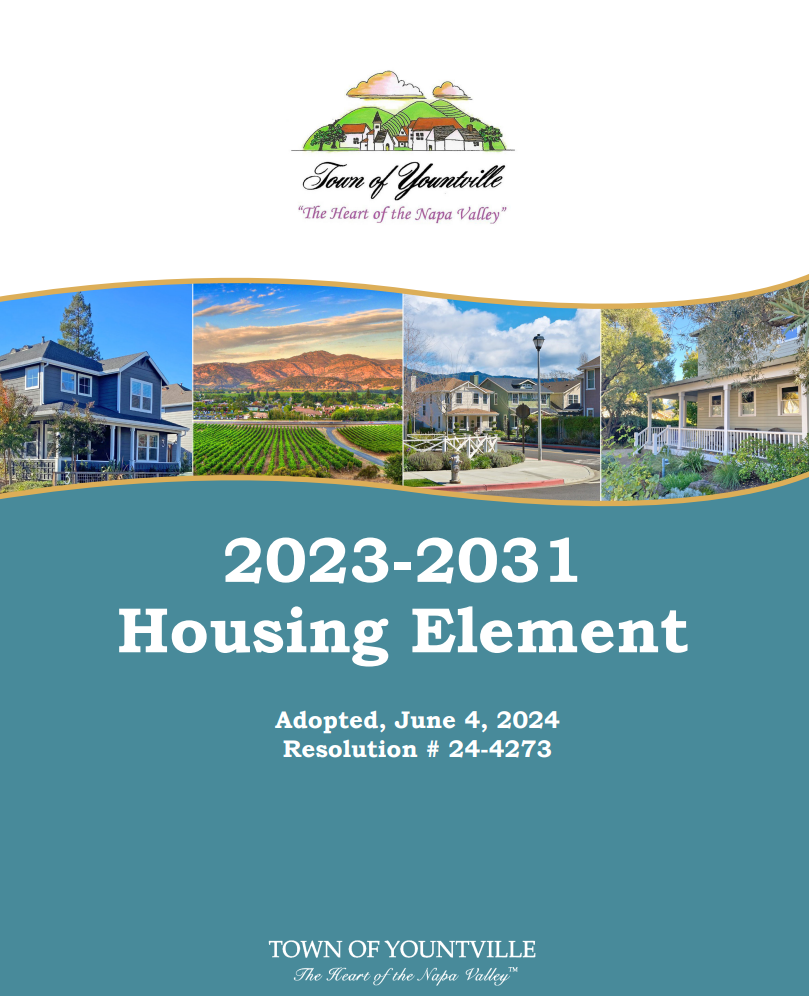
This is not a side document. The Housing Element is a State-mandated chapter of the Yountville General Plan, required by California Government Code Section 65580. Every California city and county must adopt one. Every Housing Element must be certified by HCD as substantially compliant with State law. Yountville’s is until HCD has reason to believe otherwise.
The Housing Element runs several hundred pages. Six appendices accompany the main chapter. Three of those appendices speak directly to workforce housing need.
Appendix A is the Public Participation summary. The Town consulted with regional housing providers, the Napa County Housing Authority, fair housing organizations, and the agencies that work directly with the people who hold jobs in Yountville. Those consultations are documented by name in Appendix A. Those consultations identified themes that the subsequent data analyses also documented: a second-home market eroding the rental supply, a five-year wait for a Housing Choice Voucher, a concentration of jobs at the Veterans Home with few of its workers able to live in town, and a persistent difficulty in housing the service, food, and healthcare workers who keep the town running.
Appendix C is the Housing Needs Assessment. It analyzes demographic trends, employment by industry, income levels, household size, tenure, housing condition, and special housing needs. Table C-11, Employment by Industry, 2019, shows that 16% of resident workers are in other services, 15% in educational, health, and social services, 15% in manufacturing, and 12% in arts, entertainment, recreation, accommodation, and food services. The remaining categories cover construction, trade, finance, professional services, and public administration. These percentages describe the industries in which employed Yountville residents work. They are not a breakdown of all jobs physically located within the Town.
Appendix C is also where the existing affordable housing inventory is tabulated, in Tables C-20 and C-21. Those tables are the starting point for the companion essay in this issue, which documents how that inventory is shrinking. The same Housing Element that documents the workforce documents the precarious state of the housing meant to serve it.
Appendix D is the Fair Housing Assessment. It analyzes who lives in Yountville, who commutes in, and from where. Table D-5, Job Counts by Places: Where Yountville Workers Live, 2019, lists the home jurisdictions of the people who hold jobs in Yountville. 32% of in-commuters live in the City of Napa. 7% commute from Vallejo. 5% from American Canyon. 4% from Fairfield. 1% from St. Helena. The list continues, jurisdiction by jurisdiction.
The data sources behind these tables are named in the Housing Element. The U.S. Census Bureau’s American Community Survey, five-year data, 2015 through 2019. The U.S. Census Bureau’s Longitudinal Employer-Household Dynamics program, 2019 release. The Longitudinal Origin Destination Employment Statistics dataset, 2019 release. The California Employment Development Department’s Local Area Unemployment Statistics. The Association of Bay Area Governments’ Regional Housing Needs Allocation methodology. These are federal and State data products built for exactly the question the Housing Element is answering.
2. What the data show
The number cited most often comes from the LODES dataset published by the Census Bureau. The Housing Element reports that 82% of people working in Yountville live somewhere other than Yountville. The Housing Element states this on page D-22.
Of those in-commuters, 48% live within 10 miles of Yountville. Another 24% live between 10 and 24 miles. And 21% commute more than 25 miles each way. The longest commutes concentrate in Solano County and the East Bay, where housing is more affordable than anywhere in the Napa Valley.
The demographic picture explains why so few of those workers live in town. The median age in Yountville is 63 years. 66% of the population is 55 or older. Almost 60% of the working-age population does not participate in the labor force. The mobile home parks that historically provided lower-cost ownership are now restricted to residents 55 and older for 80% of their units. Recent listings in those parks have commonly exceeded $250,000.
The Town’s deed-restricted affordable inventory totals 97 units across roughly a dozen properties. That count is the result of the February 2025 update from the Town Planning Director and the Housing Authority of the City of Napa, which superseded the 96-unit count reported in the Housing Element’s Tables C-20 and C-21. Of those 97 units, 73 are rental and 24 are ownership. Thirteen units have restrictions scheduled to expire by September 2028. Twenty-four additional ownership units carry recorded covenant terms whose duration and current status have not yet been independently verified for purposes of this series. The companion essay in this issue walks through each of these properties in detail and explains why that number has decreased to 92 in the last two years.
The waitlist for a Housing Choice Voucher in Napa County runs roughly five years.
The jobs-household ratio in 2018 was 2.41. There are more than two jobs in town for every household in town. The Veterans Home is among the Town's largest employers, with approximately 1,000 employees, only a small share of whom live in Yountville. Domaine Chandon, the Washington Street downtown corridor, and the Seventh-Day Adventist Retirement Home account for the next largest employment clusters.
This is a complete picture of a workforce that has been priced out of the town it serves. The picture was produced by the Town, using federal data, and certified by the State.
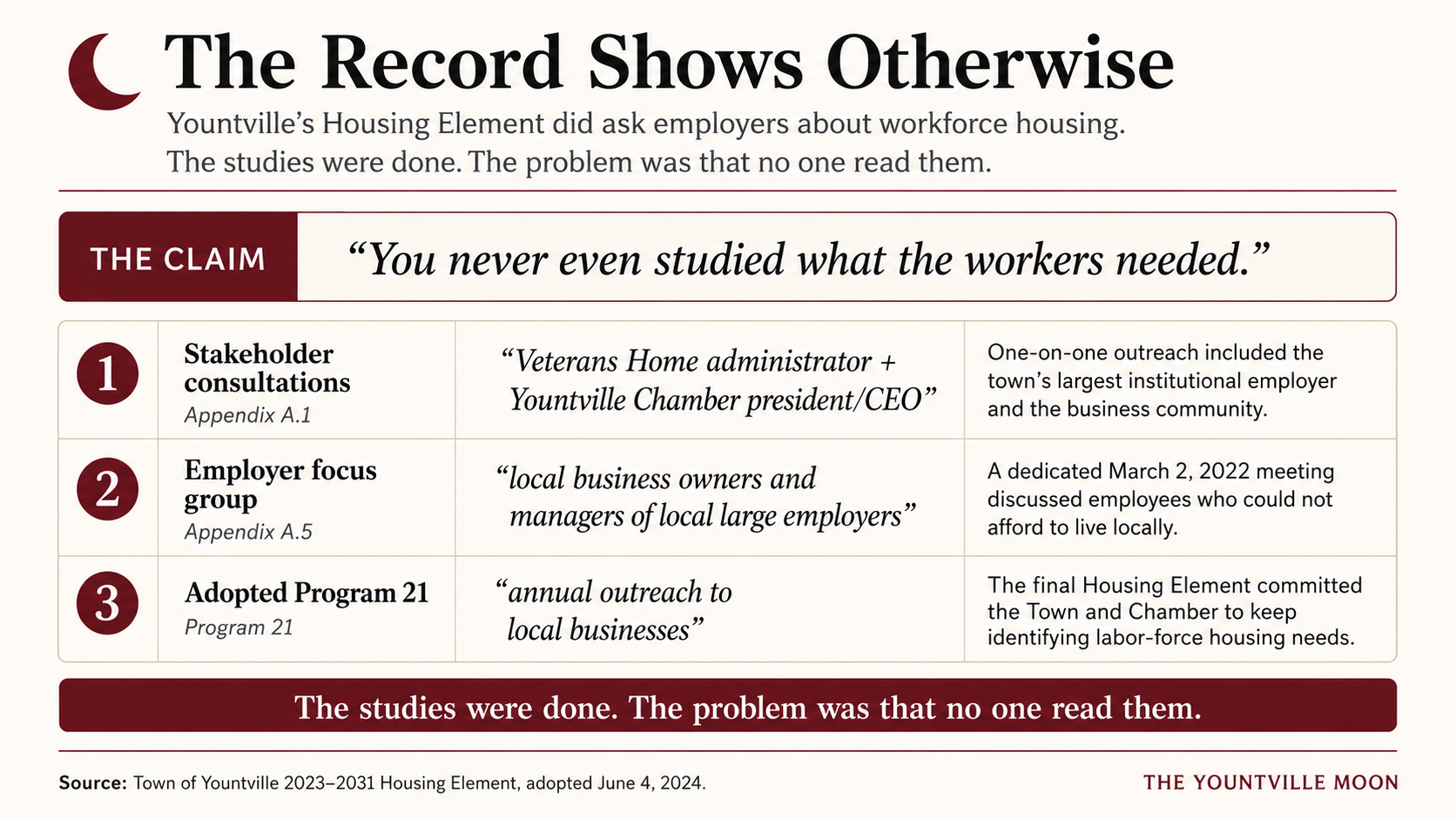
“The workforce was counted. The question is whether anyone read the count.”
3. The scale of the need
Now place the Yountville Commons against the workforce the data describe.
The studies converge on a range. The Housing Element, working from Census LEHD and LODES data for 2019, points to a daily in-commute base of at least 1,000 workers. BAE Urban Economics, which has performed direct economic analysis for the Town, estimates peak daily in-commute closer to 3,000 workers when the wineries, the hotels, and the restaurants are in full season. The true number sits somewhere in that range and shifts by quarter as would be expected for an economy based on the tourism and hospitality sectors.
The Yountville Commons site was zoned to accommodate roughly 150 small units or, alternatively, 75 larger bedroom-counted units. That capacity was set primarily to satisfy current and future Regional Housing Needs Allocation cycles. It was not set to absorb the daily commuter shed. More units meant the town had more flexibility for the site for a long time horizon. Entitlement is where land value is created. An abandoned school is worth roughly what the Town paid for it and little more. The same parcel, rezoned and divided by tentative subdivision map into a development approved for up to 150 homes, is worth a great deal more, because the legal right to build at that density is itself the asset. Securing those entitlements is the single largest value-creation step in the life of any development. The Town did that work, with public dollars, and turned a closed school into a development-ready property worth far above its purchase price. The repeal reversed the zoning and erased much of that entitlement value in one stroke. It did not transfer to anyone. It simply vanished as a public asset.
Phase 1 of the project, the only phase Town officials believed could reasonably be financed in the near term, included about 40 units at an estimated cost of roughly $25.6 million.
Run the math against the conservative end of the studied demand. Phase 1 at 40 units against a 1,000-worker daily in-commute is 4% of the documented need. Phase 1 at the BAE figure is just over 1%. Even a hypothetical full build-out, 150 small units against the 1,000-worker conservative figure, is 15%. Against the BAE figure it is 5%.
Whichever number a reader prefers, the conclusion is the same. The Commons, at any phase, is a drop in the bucket against the documented workforce demand for any unit mix at any price.
The existing affordable inventory confirms the conclusion in a different way. Three of the five Yountville properties operated by Burbank Housing have closed waitlists. Closed waitlists strongly suggest that demand for restricted-rent units in Yountville already exceeds the available supply by a margin large enough that the operator cannot practically maintain a queue. The companion essay documents this in detail.
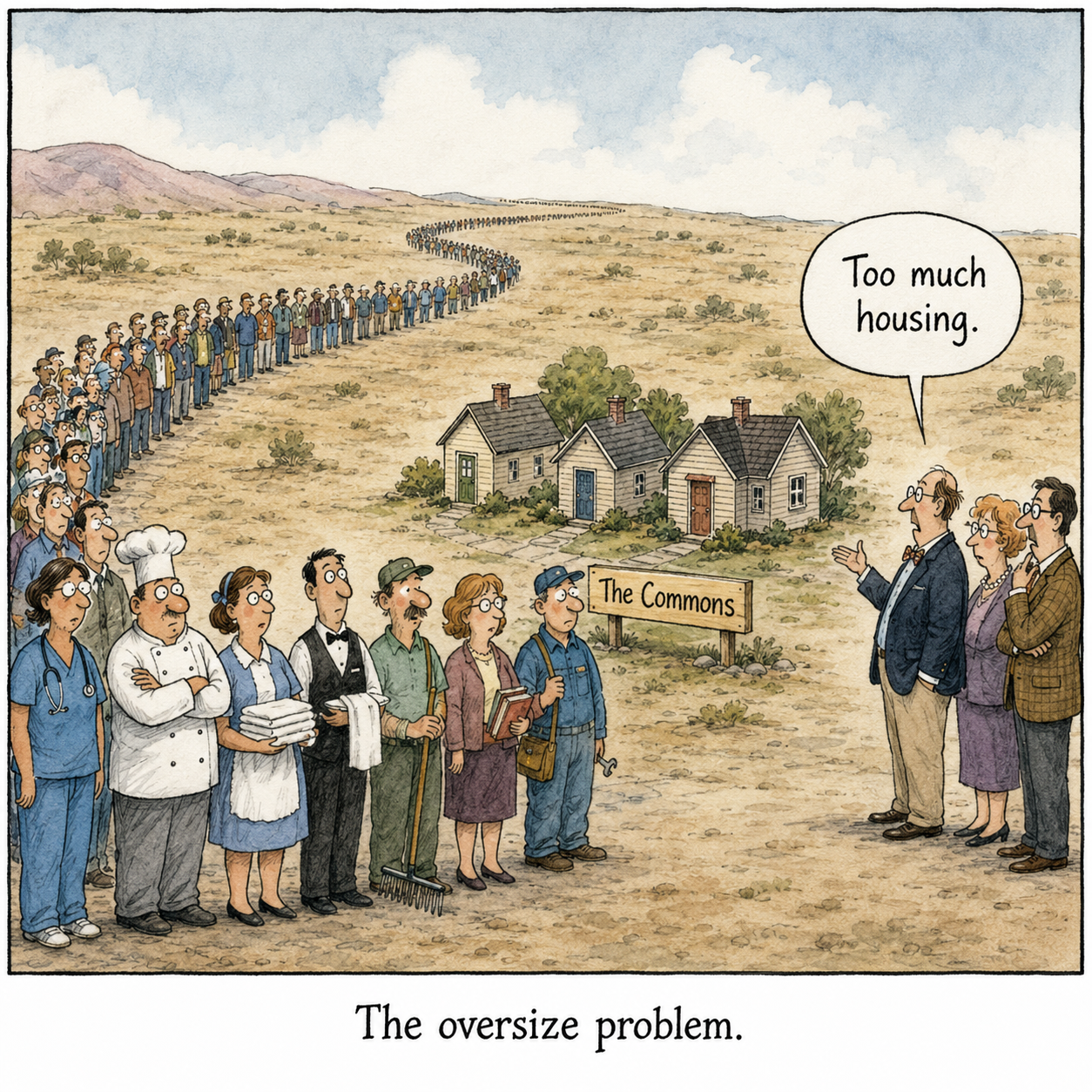
The studies counted the workers. A small group in the town just keeps pretending the tiny amount of housing proposed for them is exactly the thing that is too large.
Given the documented shortages, shrinking inventory, and closed waitlists, there is strong reason to expect that workforce units at the Commons would lease quickly across any variety of unit mixes. The more likely risk is not oversupply but producing too little housing relative to the documented need.
This is the common-sense reading of the numbers. The methodological argument set out below, about why employer surveys are the wrong tool, is correct on its own terms. But it is beside the point. The demand is so large, the existing inventory so small and shrinking, and the project so modest in comparison, that no honest accounting can describe the Commons as oversized, speculative, or built on inflated need. The opposite is true. The Commons is small compared to the large amount of housing Yountville’s workforce needs.
4. The corroborating studies
The Housing Element is not alone on the shelf.
In 2024, Generation Housing published the Napa Valley Housing Needs Assessment. Generation Housing is a regional housing policy organization covering Sonoma and Napa Counties. The assessment looks at workforce earnings, housing cost burden, displacement risk, and unit production by income tier across the Napa Valley. It is publicly available on the organization’s website.
In the same year, Napa County released the Farmworker Housing Needs and Impacts Assessment. That study focuses on agricultural labor, the housing it requires, and the gap between need and supply across the county. It is publicly available through the County.
The South Shore Housing Needs Report, published in 2019 for the Lake Tahoe region, is often cited as a methodological comparable for small wine country workforce housing analyses. It examined the same imbalance between visitor-serving employment and resident housing supply that defines the up-valley towns.
The Terner Center for Housing Innovation at UC Berkeley publishes ongoing research on California workforce housing, density bonus economics, and the cost structure of affordable housing production. Several of those papers are cited in the design record for the Yountville Commons.
The Town also commissioned direct economic and financial analysis through BAE Urban Economics, a firm that specializes in municipal economic and housing analysis. That work informed the project’s financial structure and the 3,000-worker peak in-commute figure cited above.
That is at least five independent studies of the workforce housing question, three of them issued in the last two years, all of them publicly available. Taken together, these studies consistently describe a shortage of housing affecting the same categories of workers Yountville depends upon. None concludes that Yountville has already produced sufficient workforce housing to meet the documented need.
5. Why census data beats an employer survey
The accusation often comes with a remedy attached. The Town, the critics say, should have surveyed employers. Why didn’t the Town go to the wineries and the restaurants and the hotels and ask each one how many workers they had and where those workers lived?
The answer is that the Town has something stronger. The Longitudinal Employer-Household Dynamics program is what an employer survey is trying to be, except complete.
LEHD is built from state unemployment insurance wage records and covers more than 95% of U.S. employment by operation of law. The Census Bureau matches those wage records against household enumeration data and federal earnings records. The result is a quarter-by-quarter dataset of where every covered job is and where the worker holding that job lives, with addresses geocoded.
An employer survey, by comparison, has six structural weaknesses.
Coverage. Surveys depend on which employers agree to respond. LEHD captures every employer that pays into the UI system, by operation of law. UI reporting is not optional.
Verification. Surveys depend on what an HR department types into a form. LEHD wage data is cross-checked against tax records. The numbers must balance.
Granularity. Surveys return whatever address fields each employer chose to track. LEHD returns geocoded home-and-work pairs at the census block level, the finest spatial unit available for commute-shed analysis.
Time. Employer surveys are a snapshot. LEHD is longitudinal. The data covers every quarter going back to 2002 in most states. Trends can be measured. Snapshots cannot.
Definitional consistency. Surveys depend on what each employer chose to call a worker. Part-time, contract, seasonal, and multi-job workers are sometimes counted, sometimes not. LEHD uses a single statutory definition: anyone for whom an employer files a UI wage report.
Disclosure. Employer records vary in how frequently residential addresses are updated, particularly in industries characterized by seasonal employment and workforce mobility. An employer survey captures what the employer was told. LEHD integrates multiple administrative datasets collected through federal and state reporting systems. These are not equivalent measures of the same fact.
This is why no California Housing Element relies on employer surveys as its primary workforce measurement tool. It is also why HCD does not require them. The methodology HCD requires, and the methodology Yountville used, is stronger than the one the accusation is asking for.
6. The real question
So the question was never whether the workforce was studied. The workforce was studied. Repeatedly. In the Housing Element. In its Fair Housing Assessment. In the Generation Housing assessment. In the Napa County farmworker assessment. In the Terner research. In the BAE economic analysis. In the LEHD program at the Census Bureau, on a rolling basis, every quarter, for every covered job in town.
The real question is whether anyone read those studies before issuing the accusation, and whether anyone is willing to look at the size of the Commons against the size of the need and against the trajectory of the existing inventory.
A reader who has time for the accusation has time to go find the answer. The studies are on the shelf. They were on the shelf before the former Yountville Elementary School was purchased by the Town. They will still be on the shelf the day the current Housing Element expires in 2031 when the Town has to repeat the entire process again.
The workforce was counted. The need is large. The existing inventory is small and shrinking. The proposed Yountville Commons at any phase was modest in comparison and structured to last. The accusation does not survive contact with the documents.
7. How to find the documents
For a reader who wants to verify any of this without taking anything on faith, here are the public locations.
The Housing Element. Search “Yountville Housing Element 2023-2031” or visit the Town of Yountville website. The Background Report appendices contain the workforce data. Appendix A is Public Participation. Appendix C is the Housing Needs Assessment. Appendix D is the Fair Housing Assessment. The commute statistics cited in this essay appear on page D-22.
The HCD certification letter. Dated August 7, 2024. Signed by Paul McDougall, Senior Program Manager, California Department of Housing and Community Development, Division of Housing Policy Development. The Town has the letter on file.
The Census LEHD data. lehd.ces.census.gov. The OnTheMap tool lets a reader run their own commute-shed queries for any California place, including Yountville, with no special software.
Generation Housing. generationhousing.org. The Napa Valley Housing Needs Assessment was published in 2024.
Napa County Farmworker Housing Needs and Impacts Assessment. Available through Napa County’s housing pages. Published in 2024.
Terner Center for Housing Innovation. ternercenter.berkeley.edu. The Center publishes ongoing California workforce housing research, freely available.
BAE Urban Economics. bae1.com. The firm’s Yountville economic and financial work is part of the project record at Town Hall.
Paste this essay into any AI assistant with web access and ask it to check the citations against the original sources. The references will hold.
Reasonable people will still argue about what the facts mean. That is what public debate is for. But we should stop pretending the facts were never gathered. The Town studied the need for workforce housing exhaustively.
Residents can disagree about what Yountville should do next. They can argue about design, financing, density, timing, or whether the Commons was the right answer. But they should stop claiming the Town never did its homework.
The homework is sitting on the shelf.
