
Yountville is Not for Sale #8, The Page Gary Is Asking You to Turn
Yountville has an important choice to make this fall, and the good news is that the choice still belongs to the people who live here. Between now and November, there is time to ask questions, check claims, read the documents, listen to the candidates and decide what kind of town we want to leave behind. That is the ordinary work of citizenship. In a town worth caring about, it is also worth doing.
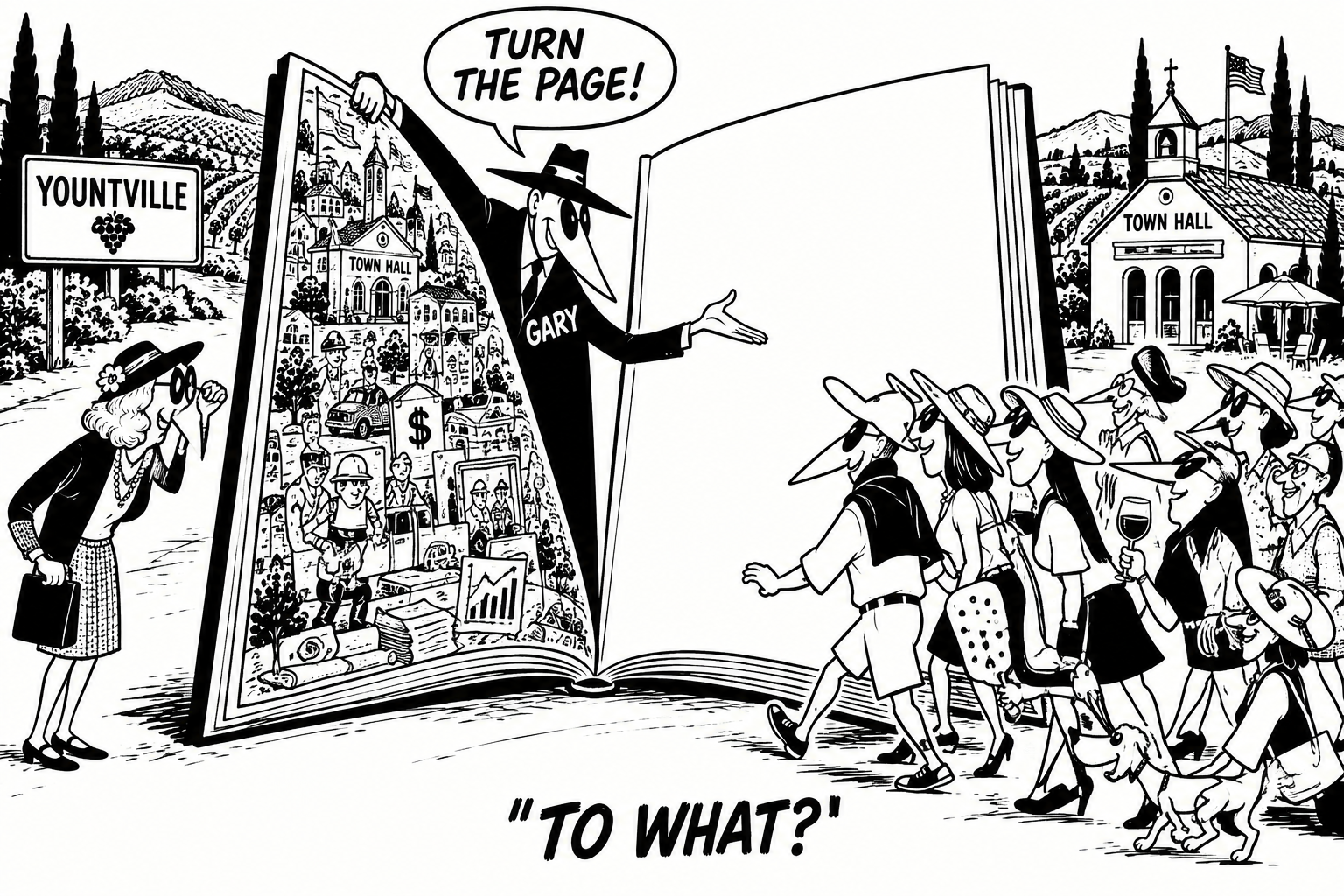
Gary Jabara is asking Yountville to “turn the page.” Fair enough. But his own August 17 email offers no plan for what comes next—no housing proposal, no future for the Commons, no budget, no numbers, no governing program. Before abandoning the complicated page we have, citizenship requires one small act: look at the next page first.
The Important Word Was Keep
There is an old and inconvenient idea about self-government that predates campaign consultants, mailing lists, and complimentary yoga. Benjamin Franklin gave it its shortest form when, leaving the Constitutional Convention, he was asked what kind of government the delegates had made. A republic, he said, if you can keep it. The important word was keep. A republic is not delivered to your door, and it is not maintained on your behalf by the mayor, the town manager, the newspaper, the architect, the retired lawyer, or the man who attends every council meeting because he has more time than you do. It survives because ordinary people accept the mildly irritating obligation of knowing what is being done in their name.
Franklin distrusted grandeur. Thomas Paine insisted that even good government requires scrutiny. Adam Smith, so often reduced to a patron saint of markets, spent real intellectual energy on what happens when concentrated private interests acquire outsized influence over public affairs, because the parties to that bargain hold very different amounts of money, access, and information. None of the three would have accepted the argument that everything is probably fine because the free wine is good.
Which brings us to Yountville, and to the resident this essay is actually about. Not the famous chef, not the telecom entrepreneur, not the council, not the author. You. The person who lives here, votes here, and has been invited, warmly and repeatedly, to let somebody else do the keeping.
The Email That Explains Itself
On August 17, Gary Jabara, owner of The Estate Yountville and of the town’s largest commercial holding, sent an email titled “Building a Better Yountville.” It deserves a careful reading, because Mr. Jabara has done the town a genuine service. He has explained the operation himself, in his own sentences, in the correct order.
“It really began,” he writes, “with the 200+ residents who came together around the referendum to stop the Commons development.” Then comes the sentence worth committing to memory: “That list became our first invitation list.” No inference is required and no source needs protecting. A political effort produced a list. The list became an invitation list. The invitations produced gatherings, which he inventories himself: “We started with a small information session in the Barrel Room, added some wine, then a mariachi band, and most recently Frank Sinatra.” Somewhere between the Barrel Room and Sinatra, by his account, the operation grew into something larger: “we became less a mailing list and more a community.”
The community then receives its instruction. The email speaks of questionable decisions, millions spent, severance agreements and open-ended contracts, calls for “new people, new energy and new ideas,” and arrives at its destination: “It is time to turn the page.” The September gathering will be themed to the harvest, which he explains as “saying goodbye to what has run its course and making room for what comes next,” 78 days before an election for mayor and two council seats. Then the closing thought: “Maybe it’s time for Yountville to do a little harvesting of its own.” He deserves credit for the clarity. Few political operations narrate their own assembly this completely, in writing, over the founder’s signature.
A Word About the Word Referendum
One term in the email requires correction because it is doing quiet work. Mr. Jabara describes the “200+ residents who came together around the referendum to stop the Commons development.” Yountville has held no referendum election on the Commons. No townwide vote occurred, and no majority of Yountville voters walked into a booth and rejected the project. What occurred was a petition signed by 235 registered voters. It was consequential, it was lawful, and its signers owe nobody an apology. The council then repealed the challenged approvals rather than putting the matter before the electorate, which is one of the two responses state law allows.
But 235 signatures and the judgment of Yountville’s voters are not interchangeable things. Calling one the other converts “some residents organized successfully against a project” into “the people rejected the project.” Those are different sentences, and the difference matters more now that Mr. Jabara has identified that same group as the seed of his present political community. A town serious about governing itself should insist on accurate history, particularly when the history is being offered as a mandate for what comes next.
The Genre of the Turned Page
Turn the page is an appealing phrase, and Americans have always been susceptible to the genre it belongs to. Throw the bums out. Drain the swamp. Morning in America. Hope and Change. Make America Great Again. The genre works by offering a trade: your complicated ledger of facts for one clean feeling. A slogan, essentially, is a promise not to explain. Make Yountville Great Again, in whatever local phrasing it eventually adopts, will be the same promise, aimed at the same customer, the citizen who would rather feel represented than stay informed.
Sometimes pages should be turned. The question is what is written on the next one, and here the August email achieves a verifiable emptiness. It contains no candidate’s name, no housing proposal, no plan for the 7.5 acres of public land at the center of town, no stated use for the workforce housing fund the voters created, no budget, and no number. The page Mr. Jabara asks you to turn contains a public record that can be examined, criticized, and judged. The page he asks you to turn to is blank. He has not written what comes next. Nobody turns to a blank page in a contract, and nobody should do it in a town. Before you turn anything, ask him to fill it in: the land, the fund, and the people who work here. Are the Veteran Home Residents that gullible? I say keep the faith.
Politics Comes With Paperwork
Now for the part of this essay written in advance, so that readers may check it against events.
California does not regulate parties, bands, or generosity. It regulates political spending, and it defines that spending by its purpose. Under the Political Reform Act, money spent to influence the qualification of a ballot measure or the outcome of an election is a contribution or an expenditure, whoever spends it and however good the music is. The obligation follows the money, not the name. It attaches whether or not anyone gets around to forming a committee, and it has been attaching, dollar by dollar, to every event in the chronology Mr. Jabara himself published on August 17: an operation born from a petition drive, built on that petition’s list, and now aimed, in his own words, at replacing the town’s leadership in November.
The law offers a man in that position exactly two doors. Behind the first is a committee: a statement of organization filed within ten days of the first $2,000, campaign statements with the Town Clerk, the venues and the wine and the Sinatra evening reported at fair market value, a treasurer’s name on the line. Behind the second door is silence, the end of the events, the end of the advocacy, the list retired. There is no third door in which a wealthy business owner continues organizing and spending at scale while the public file stays empty. That arrangement has a name in the statute books, and it comes with daily late fees.
So here is the prediction, filed before the harvest party rather than after. A committee will be announced. It will arrive wrapped in civic language, a name with Yountville in it, a mission about better government, and it will be presented as a beginning. It will not be a beginning. It will be the paperwork catching up with an operation whose origin, growth, and purpose its founder has already described in prose, and whose spending this publication has already placed before the Fair Political Practices Commission by formal inquiry. When the announcement comes, no outrage is required and no surprise is available. The correct response is three words: there it is. Disclosure is the respectable part of politics, and Mr. Jabara is welcome to it. He should simply understand that he will not be introducing the operation to Yountville. Yountville read about it in August, here in the Yountville Moon.
What Institutions Are For
Meanwhile, something less entertaining has been happening across town. Government kept functioning. The Town received law firm letters, public records demands, warnings about its finances, and months of pressure from the largest commercial interest within its borders. The Town Attorney answered the correspondence. The council acted. The petition process ran its lawful course. Budgets were adopted. Revenue continued to arrive and set a record in June. The land remained publicly owned and Measure S remained intact. None of this proves the Town was right about the Commons. It proves something more modest and more durable: institutions are supposed to withstand pressure.
That is why we have them. Public decisions are not supposed to change because the person demanding change is rich, furious, charming, litigious, generous, or capable of filling a ballroom. Institutions create friction between private desire and public action, and that friction is maddening to anyone convinced he is right. It is also among the principal protections of self-government. The test of Yountville’s institutions is not whether they defend this council, because councils come and go. The test is whether the same rules keep applying when the pressure becomes expensive.
In Praise of Boring
Yountville is vulnerable to all of this precisely because it is comfortable. Many residents worked their whole lives to arrive somewhere Tuesday evenings no longer feel like a civics examination, and they would rather have pickleball, dinner, the dog, the garden, a glass of wine, grandchildren, and the luxury of living where most things work. Fair enough. Enjoy every bit of it. But comfort breeds one dangerous assumption: that somebody else is doing the keeping. Somebody read the budget. Somebody attended the meeting. Somebody knows what the petition actually did. Somebody will notice if an argument about 7.5 acres of public land quietly becomes an organization devoted to changing who governs the town. Eventually everybody assumes somebody else is the citizen, and that is the moment citizenship becomes easiest to acquire wholesale. Not with an envelope of cash, which would be crude, but with access, belonging, grievance, friendship, and invitations, the pleasant sensation of admission to the room where the people who really understand things gather. Wine helps. So does Sinatra.
Against this stands the unfashionable truth that good government is mostly boring, and that its boringness is a virtue. It is water systems and street maintenance, audits and actuarial tables, zoning maps and housing elements, agendas posted on Thursdays, staff reports nobody reads, and votes taken after two hours of testimony. It is numbers entered into columns by people whose names will never appear on a campaign sign. The town you enjoy is the compound interest on generations of that tedium.
If you want to know who deserves your vote, go to a council meeting. Not the recording. The room. Sit in the chairs, listen to the whole thing from start to finish, and read the agenda before you come. You will see two kinds of people. Some come with numbers: what the water system costs, what the budget can carry, what a repair will run. Others come to put on a show, and the show gets louder every month. The people with the numbers are minding your money, your streets, and your town. The performers are minding an audience. And when you have listened long enough to have a real question, stand up at the podium and ask it, a genuine one, one you actually want answered. You will learn more from how it gets answered than from any party invitation you will ever receive. When the show ends, the bills still have to be paid, and you will want to know who was doing the arithmetic.
The Hero of This Story
Nobody should fear political change, and nothing here is an argument for incumbency. Council seats are not hereditary titles. Contracts should be examined, severance agreements scrutinized, public money accounted for, and bad decisions punished at the ballot box. If Mr. Jabara has identified waste, misconduct, or incompetence, he should document it. If the candidates he supports can govern Yountville better, they should explain how, in numbers, in public, on the record. That is democracy. But democracy carries a matching obligation that receives less attention: the voter has to do some work too.
You do not get to outsource citizenship to the person with the nicest party. You do not get to confuse hospitality with public policy or mistake repetition for evidence. And you are entitled to raise an eyebrow when a man who cannot cast a ballot in this town becomes intensely interested in how you cast yours. That does not make his arguments wrong. It makes your responsibility greater.
So turn the page if you conclude it should be turned, but read it first. Ask who wrote it, who paid for the printing, and who benefits from the plot. Ask what happens to the 7.5 acres of public land you already own and to the middle class housing money the voters deliberately created. Ask where the people who cook here, clean here, teach here, and care for hundreds of aging veterans are supposed to live. Ask every candidate what they will build, what they will spend, what they will protect, and what they are prepared to lose. Ask what the new direction is after the music stops.
Then check the answers. Check Gary Jabara’s. Check the council’s. Check the candidates’. Check mine. The documents are public, the meetings are recorded, the votes are on paper, and political money leaves a trail that the law requires to be visible. Get informed. Stay informed. Take some responsibility for the place where you live. An informed resident is unpurchasable at any price, and an uninformed one is simply waiting for a bidder.
Yountville Is Not For Sale
This series is called Yountville Is Not For Sale, and until now the phrase has been read as an argument about land. This fall it is about the other asset, because the first thing placed on the market in any election season is your judgment, and then your vote. Every party, every mailer, every song, every grievance, and every warm email is bidding on the same two items. They cannot be taken from you. They can only be surrendered by you, sometimes for something as inexpensive as a feeling.
That is why the choice before Yountville is larger than Gary Jabara and larger than the Commons. Yountville can be rolled or Yountville can stand up, and standing up does not mean voting the way this publication wants, supporting the Commons, defending the council, or opposing Mr. Jabara. It means refusing to let anybody else do your thinking for you. The proposition behind this series has never been that rich people are unwelcome, that developers are villains, that Town Hall is infallible, or that change should be feared. The proposition is that a town belongs to its citizens for exactly as long as its citizens behave like owners rather than guests. Owners ask questions. They look at the books. They know where the property lines run. They notice when somebody is selling them something, especially when the salesman insists it is a gift. And they read the paperwork before they sign.
Gary is asking Yountville to turn the page. You are welcome to it. Just don’t complain later that nobody warned you to read what was on the other side.
Disclosure: The author served as Owner’s Design Consultant on the Yountville Commons project for approximately two years. That scope of work is complete. He writes here as a private citizen. Where facts are disputed, the Moon shows its evidence.
