
Yountville is Not for Sale, #7, What the Whistleblower Actually Said
Gary Jabara described it, litigated over it, and promised to find its author. He never showed it to you. Here it is.
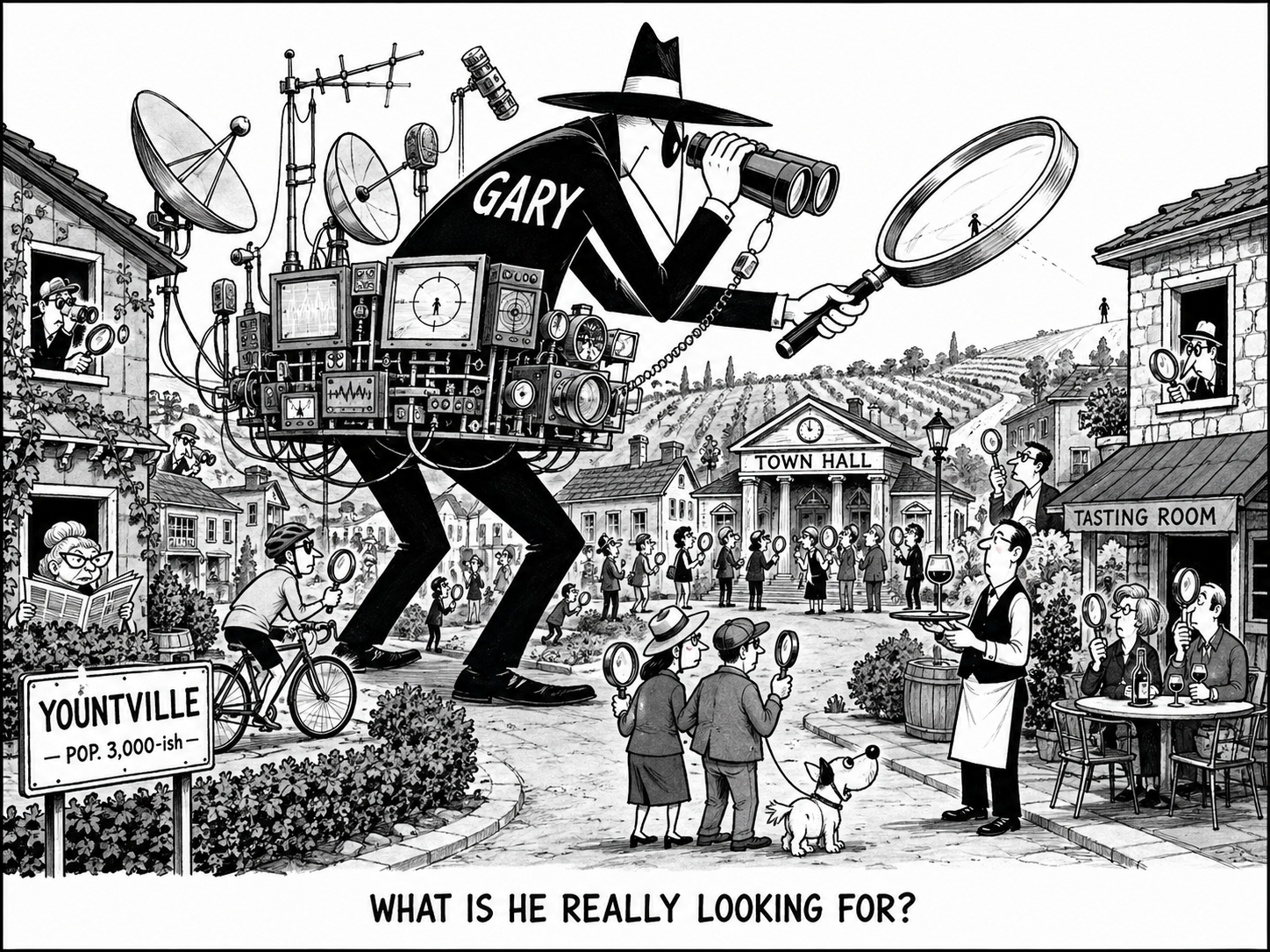
The point is not whether the anonymous complaint ultimately proves true. It is what happened when it was made. A town employee raised allegations about the conduct of an elected official and sent them to public authorities; Gary Jabara’s response was not to answer those allegations, but to threaten litigation, preserve metadata, and announce an effort to identify where the complainant lived. This cartoon distills that reversal: while Gary searches obsessively for one anonymous critic, his reaction has given the rest of Yountville a reason to start looking much more closely at him.
On August 4, Gary Jabara sent an email to every member of the Yountville Town Council and every declared candidate for it. The email announced that his August 13 Sinatra gathering at The Estate Yountville would exclude all of them, and it explained why: an "anonymous and highly political whistleblower complaint" filed after a previous gathering, a complaint he said involved "one of our guests and me." Jabara told the town's elected leadership that his attorney had already filed a request to preserve "any and all email meta-data," and that if the sender proved to live outside town, "we're filing a Jane Doe lawsuit with the public email providers to identify the exact residential address from which the email originated."
Jabara chose to describe the complaint to a dozen public officials during an election season. He chose to characterize its politics, announce litigation over it, and promise a hunt for its author's home address. What he did not do is show anyone the document. The Moon has it, and the Moon's position is simple: a document a man describes to the entire government of this town should not remain a rumor he alone gets to characterize. It is printed below, in full, so that readers can weigh the complaint and the response to it side by side.
How the Moon Holds This Document
A copy of the complaint was forwarded to the Moon, unsolicited, in July. The sending address has been withheld. The Moon does not know who wrote the complaint, will not speculate about who wrote it, and will not discuss its sourcing further. The document is reproduced exactly as received, including its punctuation, its links, and its errors. Nothing has been added, and nothing has been removed, except the address.
The Complaint, Verbatim
From: Yountville Whistleblower <address withheld by the Moon>Date: July 17, 2026 at 12:42:51 PM PDTSubject: Whistleblower Complaint - Public MisconductI’m submitting my whistleblower complaint anonymously because I have no interest in losing my job.The actions described below on the part of Council Member Hillery Trippe taint the entire Yountville Town Council, further damage public confidence in our local government and jeopardize our public employees.I’m filing my complaint with local, county and state authorities in order to safeguard the integrity of Yountville’s public decision-making process and curb the misconduct of a Council Member that undermines transparency and fundamental principles of good governance.The first major red flag went up during public comment at our July 7, 2026 Town Council Regular Meeting, when a public speaker got up to speak about the “former Town Manager’s agreement,” referencing confidential provisions of internal personnel discussions with this particular public employee. At the end of his remarks, the speaker announced his candidacy for Yountville Mayor. You can view these comments starting at 14:26 of the meeting video (https://www.youtube.com/live/lFYRLehGWuc?si=_DFbJEWZgMr7Sr28&t=866)It’s the worst kept secret in town government that it was Council Member Trippe that shared this confidential information with the individual who spoke at the July 7 meeting, and I trust that a Town Attorney investigation will quickly confirm that.The sharing of confidential Town information protected under attorney-client privilege and made available only to current Yountville elected officials violates not only Yountville Town Council Handbook pages 30 and 34, which prohibit redistribution of confidential information, but also violates state laws with significant penalties, including California Government Code section 54963 and, depending on the degree to which such violation includes benefit to “themselves or business interests,” Political Reform Act and Government Code section 1090.On that topic: business interests…I wasn’t invited to the July 9 Fiesta with Friends but was forwarded the email from the party’s host Gary Jabara that smeared multiple Town Council members. The event felt overtly political, coming just two days from the outrageous breach of the Town Council’s attorney-client privilege, so I decided to go and see who came in and out of the party.Thank goodness no one was checking the guest list so I was able to walk right into the party.I personally witnessed Council Member Trippe speak to the 200 guests gathered as if she were the sole representative of the Town Council, railing against the Town Manager and further disclosing confidential details about our internal process of hiring a new Town Manager. She then joined party host Gary Jabara in publicly naming the individual he and Hillery intend to hire as Town Manager in order to advance Gary’s business interests in evicting tenants at Estate Yountville in order to redevelop the property.I grew up here knowing there’s a lot of wealth that comes in and out of our town but I never thought I would see one of our Council Members try to put Yountville up for sale.We know that Council Member Trippe’s conduct crossed the line during the back and forth around Yountville Commons. Multiple of my colleagues have direct knowledge of the political advice she sought from our Town Attorney in order to support the referendum campaign. In multiple meetings, Council Member Trippe also held herself out as an attorney in order to unduly influence Town staff.There are plenty of documentary records, including emails, that can be obtained through the Clerk’s Office. Believe me.I’m also copying all of the relevant authorities since Yountville does not have its own Whistleblower Hotline. If you too have information about wrongdoing by the Town Council Member in question, email your information to the following:Complaint@fppc.ca.govcomplaints@napacivilgrandjury.orgda@countyofnapa.orgwww.calbar.ca.gov/sites/default/files/portals/0/documents/forms/Attorney_Misconduct_Complaint.pdfPlease also consider emailing Town Attorney Gary Bell at gbell@chwlaw.usYountville Is Not For Sale!What the Public Record Supports
The complaint mixes claims that can be checked today against claims that only an investigation can resolve. The Moon has sorted them, and readers should hold the two categories apart as firmly as this essay does.
The July 7 meeting happened as described. The video is a public record, and at the timestamp the complaint cites, a public commenter discusses the former Town Manager's agreement and closes his remarks by announcing his candidacy for mayor. That commenter was Joe Tagliaboschi, now a declared candidate and also since publicly endorsed by Gary Jabara. The video establishes what was said in public and by whom. It does not establish where the speaker's information came from, which is the question the complaint puts to investigators.
The statutes the complaint cites are real and their subjects are what the complaint says they are. Government Code section 54963 prohibits disclosing confidential information acquired in a closed session of a local agency. Section 1090 concerns financial interests in government contracts. Whether either was violated by anyone is precisely the question the complaint asks the authorities to answer, and nothing in this essay tries to answer that.
One correction of vocabulary, applied to this document as the Moon applies it to everyone. There has been no referendum in Yountville. A petition signed by 235 registered voters, roughly a tenth of the town's electorate, suspended the Commons zoning ordinance, and the town-wide election that word implies has never been held. The complaint's phrase "the referendum campaign" refers to that petition effort.
The public record also documents a pattern the Moon reported on August 7. At the August 4 council meeting, Councilmember Hillery Trippe demanded on camera that Town Attorney Gary Bell explain a severance payment she had participated in approving in closed session, a question the Brown Act forbade Bell from answering in public and one that Trippe, of everyone in the chamber, was best positioned to know he could not answer. She cast the lone council vote against the Commons and organized against the project outside the public process. None of that proves the complaint's central allegation, and this essay does not offer it as proof. It is context, on tape and in print, for why this complaint did not arrive in Yountville as a surprise.
What Remains Allegation
Everything else in the document is, as of this writing, an allegation and nothing more. That Trippe was the source of the information heard on July 7 is the complainant's inference, which the complaint itself concedes by asking the Town Attorney to confirm it. That Trippe addressed roughly 200 guests on July 9 as though speaking for the council, that she and Jabara publicly named a preferred candidate for Town Manager, and that the purpose was to advance business interests in evicting tenants at The Estate Yountville to redevelop the property are the eyewitness claims of one unnamed person. The Moon has not verified any of them and does not assert any of them. The complainant states that colleagues have direct knowledge and that documentary records exist in the Clerk's Office. Records held by the Clerk are obtainable by anyone.
The Endorsement
One week after Tagliaboschi announced his candidacy while discussing a confidential personnel agreement, Jabara endorsed him publicly. The sequence is now a matter of documented fact: confidential information surfaced through a mayoral candidate on July 7, and the man now pursuing litigation to unmask the person who complained about it endorsed that candidate within days.
A Note to Other Newsrooms
The documents underlying this essay, Jabara's August 4 email and the complaint as received, are available on request to any news organization, including the Yountville Sun. As of publication, the Sun has reported neither the complaint nor the email its owner sent to the town's entire elected leadership describing his plans to litigate over it.
Where the Series Title Came From
One disclosure specific to this essay. The complaint closes with the sentence "Yountville Is Not For Sale!" Readers will recognize it. The Moon's current series took its title from that line. The author of this publication read the complaint in July, and its closing sentence named what the Moon had been documenting for two months, so the Moon adopted it, the way writers have always taken a good line. The complaint came first. The series title followed. That is the entire relationship between this publication and the complaint's unknown author, and it is disclosed here so that nobody else gets to disclose it first.
What Happens Now
The complaint may be vindicated by investigators or dismantled by them. Either outcome will be news, and the Moon will report it with the same rules applied here. What can be said today is narrower. An anonymous town employee put allegations before four public authorities, and the response of the town's wealthiest business owner was not to rebut a single one of them. It was to preserve metadata, threaten a Jane Doe lawsuit, and promise the town's elected officials that he would find the author's home address. The complaint asks the authorities a question about the conduct of Yountville's government. The response asks the town a question about power. The authorities will answer the first in their own time. The second is on the ballot November 3.
☾
Disclosure: Brendan Kelly served as the Owner’s Design Consultant to the Town of Yountville on the Yountville Commons project. That engagement is complete. He writes and publishes The Yountville Moon as a private citizen.
COMING SOON: THE HISTORICAL FABRIC OF YOUNTVILLE
Exhibit One: Groezinger Wine Cellars
Yountville takes historic preservation seriously.
We take it so seriously that changing a window, moving a sign, altering a roofline, or selecting the wrong shade of beige can become a civic pilgrimage through planning staff, design review, findings, conditions of approval and several opportunities to become intimately acquainted with the municipal code.
Which is why I became curious about the rumor that the upper floor of the old Groezinger Wine Cellars — the landmark generations of residents remember as Vintage 1870 — may be headed toward a considerably grander future.
Say, for example, a ballroom.
I should disclose a professional bias here. I am a licensed architect. I have spent more than three decades working with building codes, historic buildings, structural engineers, fire officials and planning departments. I know enough about the process to understand that an old antique marketplace does not become a ballroom simply because somebody removes the antiques.
Assembly occupancy is a different animal. Suddenly there are questions about how many people can occupy the room, whether the old floors can carry them, seismic capacity, exiting, stairs, elevators, accessibility, restrooms, sprinklers, alarms, emergency lighting and mechanical systems. And when the building happens to be one of Napa Valley’s most important surviving nineteenth-century industrial landmarks, there are additional questions about the California Historical Building Code, design review, historic-resource impacts and CEQA.
Perhaps all of those questions have already been asked and answered.
We intend to find out.
The Yountville Moon has submitted public-records requests seeking the permits, approved occupancies, structural calculations, seismic analyses, fire reviews, inspection records, design approvals, historic-resource determinations, CEQA documents and the complete record behind a previously submitted $2.25 million seismic and life-safety upgrade application for the old winery.
But this series is about something larger than one rumored ballroom.
Owning an important historic building is not quite the same thing as owning an ordinary piece of real estate. Ownership comes with stewardship. These buildings survive because one generation accepts some responsibility for handing them intact to the next.
And that gives the Town of Yountville an equally important responsibility.
A town cannot judge a historic project by the size of the owner’s ambition, influence or pocketbook. It has to judge the proposal on its merits. Is it safe? Is it legal? Does it respect the historic resource? Has the required public process occurred? And, most important, would Yountville apply exactly the same rules if the applicant were somebody else?
That is the test.
Because historic preservation means very little if the rules become flexible when the owner becomes powerful.
And if America really is entering its ballroom era — from Donald Trump’s White House to Washington Street in Yountville — perhaps this is a particularly good moment to remember why we have preservation laws in the first place.
History belongs to the future, too.
