
Congratulations. You Delayed It, #2 The People Behind the Beds
Caring for veterans requires more than beds. It requires people. For years, CalVet and Yountville have documented how the lack of nearby housing makes those people harder to recruit and retain. Yountville had finally begun doing something significant about it. Then a small group led by Gary Jabara delayed a big part of the solution.
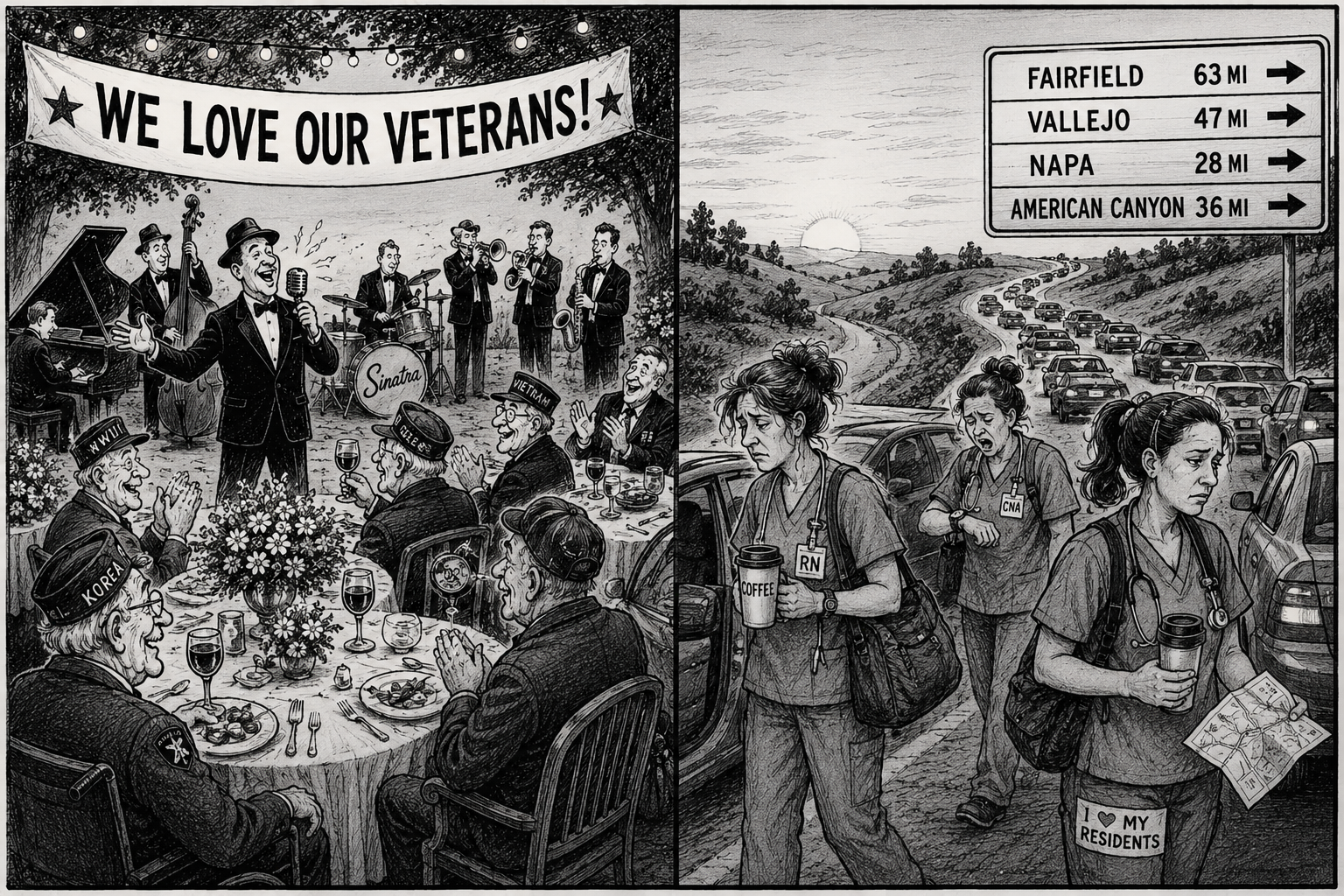
Yountville has no trouble honoring its veterans. The harder work is making room nearby for the nurses and caregivers they depend on every day.
A Wonderful Night for the Veterans
Yesterday the Yountville Sun put a genuinely cheerful story on its front page. Gary Jabara had invited approximately 150 friends, neighbors and veterans to The Estate Yountville for dinner, drinks and an evening of Frank Sinatra performed by tribute singer Jeff Wessman and a six-piece band. Residents of the Veterans Home received a particularly warm welcome. Jabara told them how much he enjoyed having them there and how much he learned whenever he talked with them. There is no reason to be cynical about that affection. The Veterans Home has been part of Yountville since before there was an incorporated Yountville, and its residents deserve every invitation, dinner, concert and glass of wine the town's businesses care to offer them. The veterans had a lovely evening, Jabara had the pleasure of hosting them, and the Sun had the sort of warm community photograph small-town newspapers have been putting on front pages for generations.
Look at the same photograph again after asking one additional question, however, and the evening begins to tell a considerably stranger story. Who will be caring for those veterans when they return up the hill? Not in the sentimental sense, but literally: who will be there for the overnight shift, the morning medications, the transfer from bed to wheelchair, the complicated wound care, the dementia patient who wakes frightened at three in the morning? California has spent hundreds of millions of dollars creating a new 240-bed skilled-nursing and memory-care complex at the Veterans Home, but CalVet has also struggled to recruit and retain the nurses, licensed vocational nurses, certified nursing assistants and other skilled employees required to operate that capacity. Staffing has constrained admissions. A skilled-nursing bed without enough skilled-nursing workers is not healthcare capacity. It is an expensive piece of furniture.
That is the fact that makes the party more than a pleasant society photograph. The veterans are visible; the caregivers on whom their daily lives depend are largely outside the frame, often beginning and ending their workdays many miles from Yountville because they cannot afford to live nearby. That separation did not arrive like a wildfire or an earthquake. CalVet has documented it. Yountville has documented it. The Town adopted housing policies intended to address it, voters dedicated hotel-tax revenue to housing, Town officials spent years working with CalVet on future employee housing at the Home, and Yountville spent roughly two years turning the former elementary school property into a concrete plan that included permanently protected housing for middle-class workers. Then a small group of residents, led prominently by Jabara, gathered the signatures that stopped those approvals. The staffing problem did not stop with them.
That is the juxtaposition this essay asks the reader to hold in mind. It is entirely possible for Jabara's affection for veterans to be sincere and for his political actions to have made one part of the practical work of caring for them harder. The contradiction is not evidence that anyone secretly dislikes veterans. It is evidence of something much more common in civic life: people can care deeply about an outcome while resisting the land use, money, density and compromise required to produce it. Dinner and Sinatra occupy the easy side of that equation. Housing some of the people who will care for those veterans the following morning occupies the difficult side.
The Problem Was Known Before the Party
A Yountville resident does not have to accept that connection on faith, and certainly does not have to take the word of a Commons supporter or the Yountville Moon. CalVet's own planning documents describe the problem in unusually direct terms. The Veterans Homes of California Master Plan 2025 portrays the Yountville Veterans Home as an extraordinarily complex operation: roughly 615 acres, more than one million square feet of facilities, multiple levels of care, aging infrastructure and a location that creates serious workforce challenges. Its staffing data show vacancy rates approaching 29 percent for registered nurses, 25 percent for licensed vocational nurses and nearly 47 percent for certified nursing assistants. Reliance on overtime and registry staffing has become part of normal operations. Those are not abstract personnel statistics. In skilled nursing, the number of qualified people available to work determines how many beds can actually be staffed and therefore how many veterans can be admitted and cared for.
CalVet then connects that staffing problem directly to geography and housing. Its planning work identifies the Yountville location as a critical challenge because the Vets Home is far from where many employees live and the surrounding housing market makes living nearby extraordinarily difficult. Recruitment and retention emerged as keystone issues in stakeholder discussions. Employee housing is therefore treated not as a pleasant perk but as part of the institution's operational strategy. The Master Plan discusses affordable family housing on campus, notes the very small number of habitable employee cottages that remain, and recalls the practical value of having employees nearby during the 2014 Napa earthquake and the 2017 wildfires, when long-distance access to the campus became difficult. The lesson is almost embarrassingly straightforward: a residential healthcare institution that operates every hour of every day is more resilient when at least some of the people who operate it can live within reasonable reach.
CalVet is not claiming that housing alone will cure every vacancy or that every nurse wants to live in Yountville. Wages, state hiring rules, licensing, working conditions and the broader shortage of healthcare workers all matter. The importance of the housing evidence is more modest and more useful. The agency responsible for running the Home has identified distance and housing as material obstacles to recruiting and retaining the people it needs. That should end the peculiar local habit of treating the relationship between housing and Veterans Home staffing as a theory awaiting one more study. The relationship has been studied by the people responsible for the institution, and they have been planning around it for years.
Yountville Knew This Too
The second set of documents belongs to Yountville itself. The Town's 2023-2031 Housing Element does not treat the Veterans Home as an island whose staffing problems begin and end at the state property line. It identifies additional employee housing at the Home as a priority, describes years of discussions with CalVet and the Department of General Services, and estimates that roughly 150 to 200 additional units could eventually be accommodated on the campus. The Town commits staff to continued coordination and identifies water and wastewater capacity that could support substantial residential development there. In other words, Yountville was not ignoring the obvious question of whether California should build housing on those famous 615 acres. Its adopted housing policy was actively trying to help make exactly that happen.
The same Housing Element looks beyond the Veterans Home gate because the Home's employees participate in the same housing market as everyone else who works in Yountville. The Town's analysis describes a community whose economy depends overwhelmingly on people who live somewhere else, while local preference policies and dedicated housing revenue attempt to give people employed in Yountville some realistic access to housing created with public support. The Veterans Home needs nurses and caregivers; hotels need employees; restaurants need cooks and managers; the Town needs staff; public institutions need people who can afford to remain in the region. The occupations differ, but the housing problem is shared. When a community requires labor it has made it increasingly difficult to house, housing policy becomes labor policy, transportation policy and, at the Veterans Home, healthcare policy.
This history matters because it changes the chronology of the present controversy. Yountville did not build a skilled-nursing facility and then suddenly discover that workers might need somewhere to live. Nor did the Commons invent a new social obligation to house people who work in town. The connection had been recognized in state planning, municipal planning, local preference policies and public spending decisions before the petition fight. By the time the Commons reached approval, Yountville was not beginning a conversation about whether middle-class housing mattered. It was attempting to convert years of policy into something physical.
The 615 Acres Are Part of the Solution, Not the Excuse to Wait
It is easy to understand why a resident encountering this issue for the first time looks at the Veterans Home and asks the obvious question: if California owns 615 acres, why doesn't it simply build employee housing there? That is a good question, and the public documents provide a surprisingly satisfying answer. CalVet does want employee housing on the campus. Yountville wants to help it happen. The Housing Element contemplates perhaps 150 to 200 additional units there, and the Master Plan identifies future development opportunities. The people who raised the 615-acre argument were therefore right about an important part of the solution. Where the argument went wrong was in turning a long-term solution into a reason to stop a near-term one.
The Veterans Home is not a reserve subdivision waiting for someone to notice all the empty land. It is a 142-year-old state institution with active healthcare operations, historic resources, roads, utilities, aging buildings and enormous capital needs. CalVet's planning work places significant employee housing within a long sequence of redevelopment that must coexist with the Home's medical mission and infrastructure work. Major projects on state land move on a state timetable measured in years. The need for caregivers does not wait on that timetable. The recruitment difficulty exists now, the new skilled-nursing capacity exists now, and the employees driving in from distant communities are doing so now.
The rational conclusion was never to choose between housing at the Veterans Home and housing at the Commons. Yountville's own documents contemplated both. Future employee housing on CalVet land could directly serve the Home and should be pursued aggressively. Permanently protected middle-class housing on Town-owned land could serve a broader workforce, including Veterans Home employees who qualify, without tying a person's home forever to a single employer. A nurse who changes jobs still needs a home. So does a Town employee, a hospitality manager or a family trying to establish a life in the community rather than merely supplying labor to it. A housing shortage built over decades was never going to yield to one project under one government on one parcel.
The Commons Was the Part Yountville Could Actually Do
That is where the Commons enters this story, and where the photograph from The Estate begins to acquire its uncomfortable second meaning. The former elementary school property was not conceived simply as an apartment project. Roughly 65 percent of the Yountville Commons was devoted to open space, walking trails, gardens, recreation and similar public uses, about 17 percent to roads and parking, another 6 percent to dedicated civic uses, and approximately 12 percent to housing. Housing was integrated into a much larger public landscape because two years of community planning had reached a fundamentally civic conclusion: making some room for the middle-class people who work in Yountville could itself be a public amenity. The Town owned the land, could protect the housing over time and could shape the project around local needs rather than wait for a private development proposal to create a few restricted units as a condition of something else.
The Commons was also important because it was part of the larger housing response Yountville could actually control. The Town could advocate for employee housing on state land, and it did. It could lobby Sacramento, coordinate infrastructure and encourage CalVet to move faster, and it did. What Yountville could not do was command the State to produce 150 apartments on the Veterans Home campus next year. On the former school site, by contrast, the Town controlled the property, the planning process and the approvals. That distinction between what Yountville could encourage and what it could actually deliver became strangely obscured as opposition to the Commons intensified.
There were legitimate arguments about the plan. Some residents thought it was too expensive, too dense, insufficiently parked, architecturally unresolved or simply too ambitious. Those objections deserved to be heard and, where persuasive, incorporated. But by the time the project was stopped, the Town had spent roughly two years in public meetings, design work, environmental review and revision. The practical effect of the petition was not to produce a smaller Commons, accelerate housing at the Veterans Home or replace the project with a less expensive alternative. It stopped the approvals. Two hundred thirty-five valid signatures were sufficient under California law to force the Council to repeal the ordinances or send them to the voters, and the Council repealed them. The problem that had produced the housing effort remained exactly where it was.
Agency matters here. The Commons did not simply become delayed, as though a schedule slipped or a contractor failed to show up. A small, organized group of residents opposed the approvals and successfully stopped them, with Gary Jabara playing a prominent leadership role in that effort. Their reasons were not all the same and their motives should not be invented. They exercised a legal right. But exercising a right does not make the consequences disappear. A significant piece of Yountville's response to a documented housing problem was deliberately interrupted, and no replacement of comparable scale or readiness appeared when it was stopped.
A Town Is Not the Same Thing as a Petition
The intensity of that campaign has also created a misleading impression that Yountville is split neatly in half over whether middle-class workers should have some chance to live in the community. Recent history says something different. In 2018, voters approved Measure S by roughly 74 percent, agreeing to tax hotel guests in order to fund affordable and workforce housing. Subsequent elections produced a Council that continued making housing a priority. The Town purchased the school property, conducted years of public planning and advanced the Commons through repeated public decisions. None of that proves that a majority supported every unit, parking space or dollar in the final Commons plan. It does establish that addressing housing for people who work in Yountville was not a fringe idea imposed on an unwilling town.
The petition deserves the same precision. Two hundred thirty-five signatures were legally powerful, but they were not a townwide vote. They established that enough registered voters wanted the approvals suspended to trigger California's referendum process. The larger electorate was never asked to accept or reject the Commons because the Council chose repeal. That distinction matters in a small town, where a concentrated political effort can quickly acquire the rhetorical status of 'the community.' The petitioners were part of the community and entitled to use the law available to them. They were not the whole community, and their success should not be rewritten as proof that Yountville abandoned the larger goal of housing middle-class workers.
In historical terms, the divisiveness itself is the newer development. The Veterans Home once housed far more employees on its campus, while the civilian town grew beside an institution that supplied jobs, families and everyday economic life. Nobody needed a slogan to explain why the people who cared for veterans might live nearby. Yountville's modern luxury economy and the extraordinary value of its housing have gradually severed that ordinary relationship between work and residence. The political novelty is not the proposition that workers need homes. It is the idea that creating those homes has become sufficiently controversial that nearly every physical proposal can be treated as a threat to the character of the place the workers are needed to sustain.
The People Missing From the Photograph
That is why Jabara's comment at the party is more interesting than it first appears. He said he enjoys talking with Veterans Home residents because he learns from them. There is every reason to take him at his word, and an obvious way to extend the conversation. The next time The Estate hosts the veterans, save a table for several of the people who care for them: a registered nurse, an LVN, a CNA, a recruiter trying to fill vacancies and perhaps an administrator responsible for staffing the skilled-nursing operation. Ask where employees live, what applicants say when they consider a job in Yountville, what makes experienced staff leave and whether realistic housing options closer to the Home would change recruitment or retention. Invite a CalVet planner to explain what can be built on the 615 acres and on what timetable. Invite the Town to explain what it can build on land it controls.
The point would not be to stage a dinner-table ambush in which one side is forced to confess that the other was right. The useful thing would be to put the worker who has been strangely absent from the public picture into the same field of vision as the veteran everyone agrees deserves excellent care. A CNA commuting from Fairfield is not an abstraction called workforce housing. She is a person upon whom the promise made to the veteran depends. The distance between her home and her job is not proof of anyone's moral failure, but CalVet says that distance is part of a recruitment and retention problem. Once that connection is understood, a debate about housing cannot honestly return to treating the worker as somebody else's concern.
There is an irony here worth preserving because it is gentler, and more revealing, than outrage. Yountville is exceptionally good at the visible rituals of appreciation. It knows how to welcome veterans, raise a glass, hire a band and produce a beautiful summer evening. The difficult obligations are less photogenic. They involve zoning maps, budgets, density, public land, long meetings and the possibility that preserving a community sometimes requires allowing it to change. The veterans are easy to honor because everyone can agree on the sentiment. The caregivers force the town to confront what that sentiment costs when translated into daily life.
The Story the Front Page Did Not Ask
The Yountville Sun could have used Jabara's party as the beginning of that larger story. There is nothing wrong with putting the event on the front page. Community gatherings are local news, and a photograph of veterans enjoying Sinatra with their neighbors is a perfectly legitimate record of town life. What is remarkable is the lack of comparable curiosity about the policy story sitting immediately behind the picture. CalVet has published detailed information about staffing vacancies, recruitment, commuting and employee housing at Yountville's largest employer. The Town has adopted a Housing Element that treats Veterans Home housing and broader middle-class housing as related responsibilities. A major local housing project was stopped after a petition campaign in which the host of the front-page party played a leading role. A curious newspaper does not have to take sides to notice the collision of those facts.
The reporting questions practically write themselves. How much of the new skilled-nursing capacity can be staffed today? Which classifications are hardest to recruit? Where do those workers live? How much does distance matter compared with wages and other factors? What is CalVet's actual schedule for meaningful employee housing on the campus? What has Yountville committed to do under its Housing Element? What housing could still be delivered at the Commons, and when? None of those questions requires the Sun to endorse the old plan, oppose Jabara or campaign for the Council. They require the ordinary journalistic curiosity to follow a cheerful photograph into the less cheerful facts surrounding it.
That absence matters because many residents reasonably rely on a local newspaper to do exactly this work. Most people will never read a state master plan or hundreds of pages of a Housing Element unless someone shows them why a particular section matters. When the newspaper devotes its most visible space to the party and almost none to the documented relationship between housing, staffing and the future of the institution being celebrated, the public argument becomes easier to manipulate. People hear that the State owns 615 acres but not that CalVet describes major housing there as a long-term undertaking. They hear that the Commons was stopped by 'the community' but not that the petition contained 235 signatures and no townwide vote rejected the project. The fog is not created by one false statement. It accumulates when the connective tissue between true facts is never reported.
The Resident Who Did Not Know Can Be the Hero
The most important person in the next chapter may therefore be the resident who knew almost none of this before the Commons fight. Perhaps she heard the number of proposed homes and thought it sounded enormous. Perhaps he saw 615 acres at the Veterans Home and reasonably assumed California should solve the problem there. Perhaps she supported the Commons because she generally believed Yountville needed housing but could not have explained what CalVet had actually said about recruitment and retention. None of these people should be scolded for failing to spend their evenings with government planning documents. A healthy town does not require every citizen to become a land-use specialist. It does require enough citizens to become curious when the consequences of a decision become clearer.
For that resident, the documents are useful precisely because they do not demand allegiance to either camp. CalVet's Master Plan explains the staffing and geographic problem from inside the institution. The Yountville-specific planning work explains the enormous complexity of the campus and the long horizon for major new development. The Town's 2023-2031 Housing Element explains how Yountville has understood its own role, including years of coordination with CalVet and the possibility of substantial future employee housing on state land. Read together, they allow a resident to hold several ideas at once: CalVet should build employee housing; Yountville should help; that housing will take time; the workforce problem exists now; and housing on Town-owned land can address part of the same problem without competing with the State's future plans.
A resident can absorb all of that and still dislike the previous Commons plan. She can argue for fewer homes, different architecture, different parking or a different financing strategy. He can insist that CalVet move faster and that Sacramento contribute more. What changes is the quality of the disagreement. The question is no longer whether housing and staffing are connected or whether 615 acres magically remove Yountville from the problem. It becomes a practical discussion about how much housing each public entity can deliver, for whom, on what land and on what schedule. The resident who arrives without a fixed factional identity may be particularly valuable because changing an opinion in response to evidence does not require surrendering a reputation built around the old one.
After You Stop the Plan, the Question Changes
The same freedom does not apply quite as comfortably to the people who successfully stopped the approvals. They remain entitled to every criticism they made, and nobody needs to declare them anti-housing or indifferent to veterans. But the success of the petition changes the civic burden. Before stopping a plan, an opponent can reasonably devote most of his energy to explaining what is wrong with it. After stopping it, particularly when the underlying problem remains documented and urgent, opposition is no longer a complete position. The relevant question becomes what the opponent is prepared to support instead.
If the previous Commons was too large, what scale of middle-class housing belongs on the property? If the unit mix was wrong, what should replace it? If the cost was unacceptable, what public investment is acceptable for housing that remains protected rather than returning to the luxury market? If CalVet's land is still the preferred answer, what should Yountville do during the years required for the State to deliver substantial housing there? If nurses, CNAs, Town employees, hospitality workers and other middle-class people should have some realistic opportunity to live closer to their jobs, where will those homes go? These are not gotcha questions. They are what responsibility looks like after successfully interrupting a public response to a problem that did not disappear when the ordinance did.
The delay itself deserves no romantic gloss. It has not made a single CalVet hire easier. It has not produced one employee apartment on the Veterans Home campus. It has not created a smaller Commons, lowered the cost of a replacement or shortened a nurse's commute. Perhaps a future plan will ultimately be better, but that future benefit cannot be credited to the delay before it exists. For now, the measurable result is simpler: a significant local housing response was stopped and the problem is no closer to resolution.
The Question for Gary Jabara
That brings the story back to the host of last week's party. Jabara's affection for the veterans may be entirely sincere, and the essay becomes weaker if it pretends otherwise. The point is not to catch him performing hypocrisy in the cheap sense of saying one thing and secretly believing another. The contradiction is more consequential. He can genuinely enjoy honoring veterans and still have helped lead a political effort that delayed a substantial housing response intended for the class of middle-income workers upon whom the Veterans Home and the rest of Yountville depend. Sincerity does not erase consequence, and generosity on one evening does not answer the policy problem waiting up the hill.
Jabara also possesses something more useful than a public position. He has influence, business experience, property, resources and an evident ability to organize people. He helped demonstrate how effectively those assets could be used to stop the Commons. The fair question now is how they will be used to help solve the problem that remains. If the old Commons was wrong, help shape a replacement that can actually be built. If employee housing at the Veterans Home is central to his preferred solution, use his influence to press CalVet and the State for a realistic program and timetable while acknowledging that Yountville still needs to act in the meantime. Bring caregivers into the conversation, not merely as sympathetic figures but as workers whose actual salaries, commutes and housing choices should inform what gets built.
The same question belongs, in proportion, to the 235 people whose signatures made the delay possible. They need not apologize for signing a petition, and they need not endorse the old plan. But they should recognize that they helped alter the course of a public response to a documented problem. Having seen the connection between housing and the Veterans Home more clearly, what are they prepared to support now? The answer cannot remain indefinitely that the next parcel, the next financing plan, the next density and the next timetable are also unacceptable. At some point support for middle-class housing has to acquire an address.
Look at the Photograph Again
Now return to the photograph from The Estate. Nothing in it has changed. The veterans are still enjoying a summer evening. The singer is still doing Sinatra. The host is still smiling, and his welcome can still be genuine. What has changed is the reader's field of vision. Just outside the photograph are the nurses and CNAs commuting toward Yountville because the housing market has placed them elsewhere. Behind them are CalVet's vacancy tables and its recommendation for employee housing. Beside those are Yountville's Housing Element, its years of coordination with the State and its commitment to housing middle-class workers. And sitting in the recent past is a Town-owned property where a substantial part of that response had moved from policy into an approved plan before a small group led by Jabara stopped it.
Seen with that context, the party is not offensive. It is poignant. It shows a community performing the part of its obligation that is easy to see and easy to love while the difficult part remains unresolved. Honoring veterans requires almost no disagreement about what veterans deserve. Caring for them forces a community to ask where the people who provide that care will live, what the public is willing to spend, what land will change, how much density is acceptable and whether people who already possess housing are willing to make room for people who do not. Those are harder questions precisely because they convert affection into policy.
Yountville has not run out of information about the problem. CalVet has explained its workforce challenge. The Town has explained its housing strategy. The State's future employee housing and Yountville's local middle-class housing are not rival ideas. The missing ingredient is not another study proving that people need to live within reasonable reach of the institutions that employ them. It is the willingness to choose and support actual places where that housing can be built.
The veterans have been honored. The complimentary meal has been served, the music has played and the summer evening has ended. For Jabara and the small group who helped delay a significant part of Yountville's housing response, the question that remains is more demanding and far more useful: having seen how directly housing affects the people who care for the veterans, what are they prepared to do now to help solve it?
Because the difficult part was never loving the veterans. It was making room for the people who care for them.
