
You're Against the Commons. Do You Even Understand What You're Against?
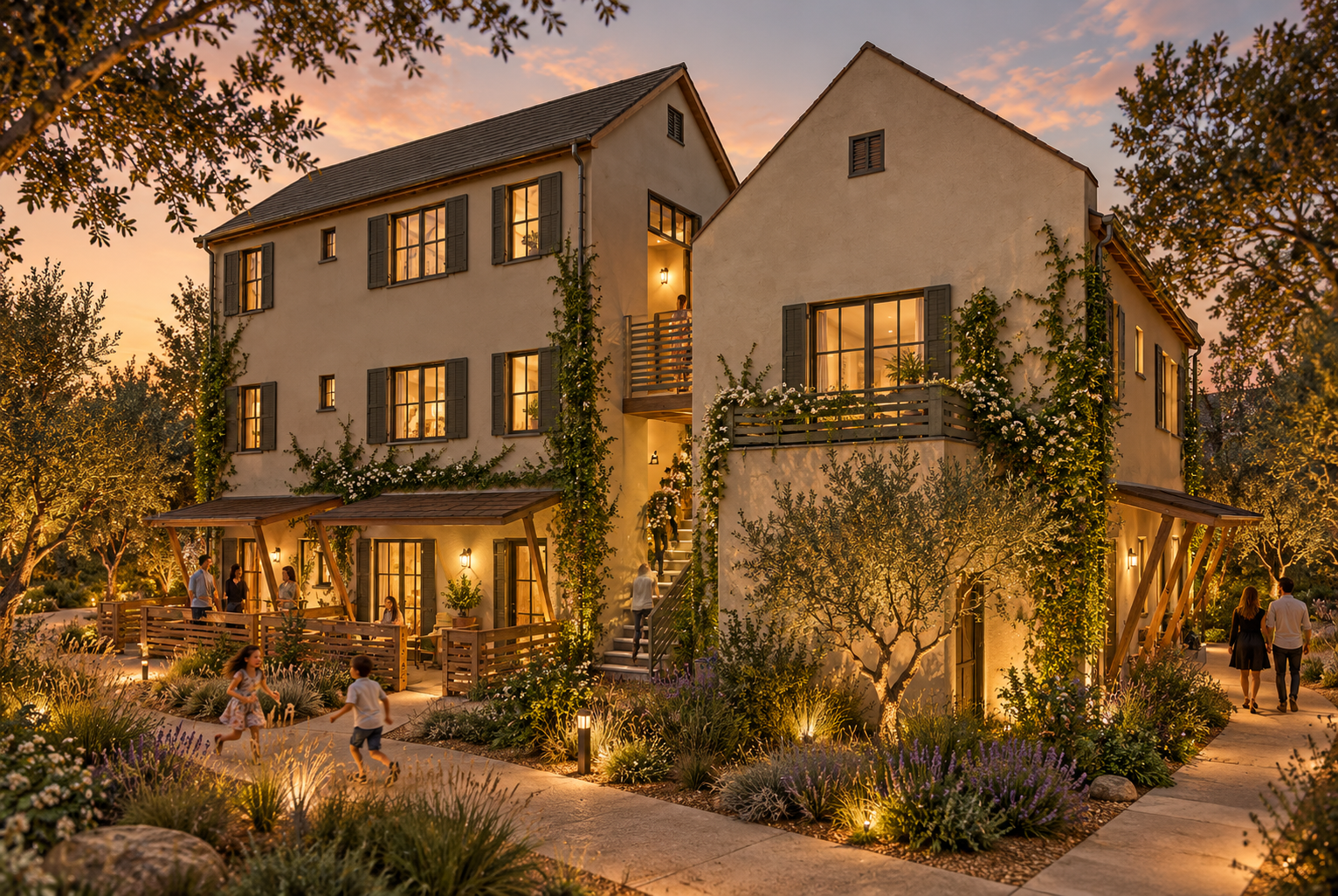
One Building. Six Households. Fourteen Neighbors. This modest Village House is one of 18 buildings envisioned for the Yountville Commons, the product of years of public meetings, community input, architectural design, and financial planning. Behind its six front doors could live the people who care for our veterans, teach our children, clean our hotel rooms, and keep our restaurants running. Before declaring the Commons too big, too expensive, or too much, perhaps we should start by explaining what is wrong with this one building, and who, exactly, we would rather not have living in it.
Six households. Fourteen people. One modest building. Before Yountville decides what it cannot afford to build, perhaps its residents should understand who they are deciding cannot afford to live here.
The Size of a Decision
There is a peculiar advantage to opposing the Yountville Commons. You can be against it without ever explaining what you are against. It is too big, too expensive, too complicated. The $91 million figure ends most conversations before they begin.
That figure was a long-range estimate for building out the entire 7.5-acre former elementary school site over many years, including housing, infrastructure, and public facilities. It was never a check the Town Council was asked to write. The first phase was scoped at about $25 million for five buildings and 40 homes, financed with roughly $5 million in Town cash, about $16 million paid for with Measure S funds, and a revenue repaid from the buildings' own rents. Every later phase would have required its own decision. The difference between a master plan and a construction authorization is approximately the difference between drawing a map of California and buying every house on it.
One Building at a Time
Phasing was the central design decision of the Commons, and it was made deliberately. The conventional way to put this many homes on a site this size is one large structure, with long interior corridors, an elevator core, and parking in a podium beneath it or a lot around it. That approach looks efficient on a spreadsheet. It would also dominate a 7.5-acre property in the middle of a small town, and it commits the full cost, the full height, and the full number of residents on the day the permit is issued.
The Commons divided the housing into small buildings scaled to the houses and inns already in town, each one built, occupied, and evaluated before the next began. A Council unhappy with the first phase could stop. Building small did not mean building cheaply. Each building had to be good enough to stand on its own, because each one would be judged on its own. The site is an abandoned school in the center of town, and every building placed on it has to return that ground to public life at the scale Yountville is known for. It's one of several reasons the full buildout required more than 400 new trees.
Six Doors
The building block in the plan was the Village House, an ordinary wood-frame building of two and three stories, about 3,600 square feet, organized around a single stair. It has no garage, no corridors, and no lobby. Each apartment has a front door to the exterior, with private decks and windows onto the landscape, and each household has one parking space a short walk away.
The six households described here are composites, built from Napa County occupations, regional wage data, and California's 2026 income limits. They are not applicants but their circumstances are not hypothetical.
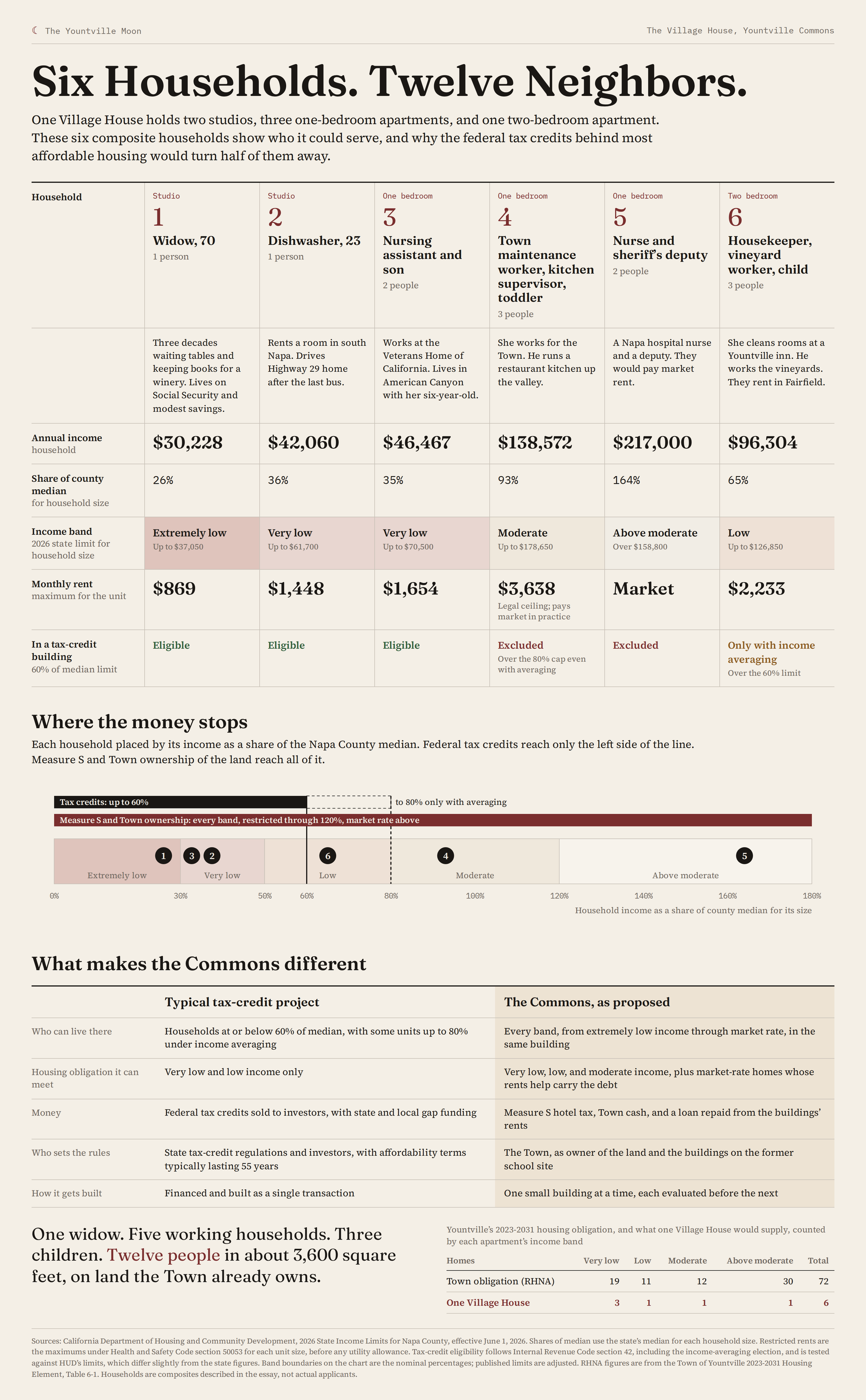
The ground-floor studio belongs to a 70-year-old widow who spent three decades in Yountville, waiting tables and later keeping books for a winery. The sale of her house paid off the loan taken during her husband's illness and helped her two children buy homes outside the valley. Social Security and modest savings give her about $30,200 a year, which the state classifies as extremely low income.
Across the landing lives a 23-year-old dishwasher earning about $42,060. He rents a room in south Napa and drives Highway 29 home after the kitchen closes, because the bus service has stopped for the night.
Upstairs, a certified nursing assistant at the Veterans Home of California earns about $46,467 and is raising a six-year-old son. They live in American Canyon.
Next door are a maintenance worker for the Town of Yountville, her husband, who supervises a restaurant kitchen up the valley, and their toddler. Together they earn about $138,572. That sounds comfortable until one tries to buy a house in a town where the median sale price exceeds $1.6 million.
Across from them are a registered nurse at a Napa hospital and her husband, a sheriff's deputy. They earn about $217,000 and would pay market rent.
Under the roof live a housekeeper at a Yountville inn, her husband, who works in the vineyards, and their child. They earn about $96,304 and rent in Fairfield, where housing takes 44 percent of their income.
That is twelve people, three of them children, in one building on land the Town already owns.
The Ceiling Nobody Mentions
Most affordable housing in California is financed with federal low-income housing tax credits. The nonprofit developers who use them, Burbank Housing among them, have done valuable work across the region. But the credits carry a fixed rule. A tax-credit apartment must go to a household earning no more than 60 percent of the area median income. Under an income-averaging option, some units may serve households up to 80 percent, provided the building as a whole averages 60 percent.
Apply that rule to the Village House. The widow, the dishwasher, and the nursing assistant qualify easily. The housekeeper's family earns about 65 percent of the median for three people, which puts them over the standard limit; they could qualify only if the developer elected income averaging. The Town maintenance worker's family earns about 93 percent of the median and is excluded under either rule. So are the nurse and the deputy.
A tax-credit version of this building would house four of these six households at most, and possibly three. The households it would turn away include the Town's own employee, a kitchen supervisor, a nurse, and a sheriff's deputy. They are the middle of Yountville's workforce, and no other housing program in the valley is designed for them.
Handing the school site to a single tax-credit developer would therefore not be a neutral administrative choice. It would decide, in advance and for decades, that the Commons houses only households below 60 percent of median. The Commons as presented earlier this year was designed to avoid exactly that result. Its income mix was aimed at the households every other program leaves out specifically because the middle class workers serving Yountville and the region have no alternative except longer and longer commute times.
What Measure S Is For
In November 2018, 74 percent of Yountville voters approved Measure S, which raised the hotel tax by 1 percent to support workforce and affordable housing. The Housing Element the state certified in 2024 commits the Town to use the fund for extremely low, very low, low, and moderate-income homes.
The moderate category is the point. Measure S is local money, and it carries no federal income ceiling. It is the only source available to the Town that can serve a household at 93 percent of median as readily as one at 30 percent. Combined with Town ownership of the land, it allows one building to hold restricted apartments across every income category alongside market-rate apartments whose rents help carry the debt.
The state requires Yountville to plan for 72 homes between 2023 and 2031, including 19 for very low-income households, eleven for low-income households, and twelve for moderate-income households. Tax credits can reach the first two categories. The twelve moderate-income homes, for households earning too much for subsidized housing and far too little to buy here, are the Town's to provide. Measure S is how the Commons proposed to provide them.
Counted by these bands defined by local incomes, a single Village House alone would supply three very low-income homes, one of them at the extremely low level, one low-income home, one moderate-income home, and one market-rate home.
What the June Repeal Changed
In June 2026, the Council repealed the Commons zoning rather than send the petition to repeal it to a townwide vote. The property returned to its Public Facilities zoning, under which publicly owned housing remains possible through a conditional use permit. The repeal did not erase the planning, the housing need, or a hotel tax that keeps accumulating for one legal purpose.
Show Us the Alternative
It is entirely possible to support housing for working families and oppose a particular proposal on financial, architectural, or environmental grounds. Those objections deserve to be examined on their merits. They also carry an obligation.
If the building is too tall, say how tall it should be. If six apartments are too many, say whether four would do. If the Town should not own housing, name the arrangement that would house moderate-income workers without Town land and Town money, because the tax-credit market will not.
The Commons had drawings, costs, phasing, and a site. Its alternatives deserve no exemption from the same scrutiny. Until one appears, the people who clean your hotel rooms, care for our veterans, and maintain your parks will keep commuting into towns further and further away from the Town of Yountville. That, too, is a decision about Yountville's future, and the people paying its price are largely the ones with no vote in making it.
☾
Disclosure: Brendan Kelly is principal of Kelly + Morgan Architecture, which served as the Town of Yountville's Owner's Design Consultant on the Yountville Commons. That work is complete. The households described in this essay are fictional composites. The occupational wage assumptions and housing-income categories behind them reflect the 2026 California income limits for Napa County. They are intended to illustrate the economic circumstances of potential residents, not to represent actual applicants or established eligibility determinations.
