
The Candidates and Your Choices - Joe Tagliaboschi: UNFIT
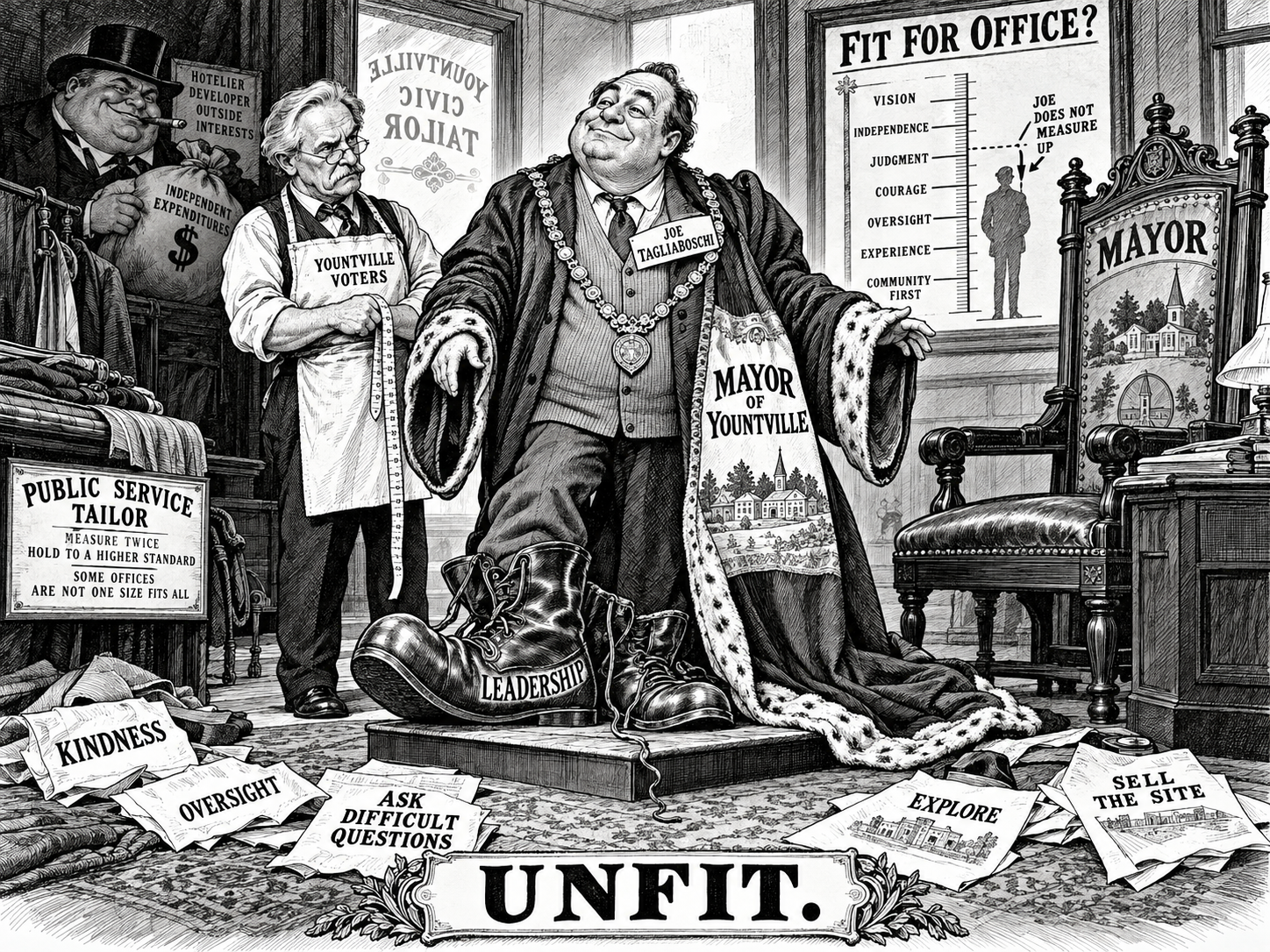
Joe Tagliaboschi arrives to be fitted for the mayor's office armed with promises of kindness, oversight, and difficult questions, but precious little evidence of what he actually intends to accomplish. The voters take his measure while a wealthy hotelier watches approvingly from the shadows, campaign money in hand. The robes of public responsibility hang awkwardly, the boots of leadership are several sizes too large, and the mayor's chair remains beyond his reach. After years in municipal government, the candidate has plenty of experience to advertise but remarkably little vision to show for it. The tailor's verdict is unmistakable: UNFIT.
Early in the public outreach for the Yountville Commons, before there was a site plan to argue about, Joe Tagliaboschi came to our office hours with his conclusion already drawn. The Town never should have bought the old school property, he told us. It should have been sold to a developer. He had no interest in what residents had said in earlier sessions and no interest in a conversation about it.
Mr. Tagliaboschi is now running for mayor on a promise to "restore kindness" and bring "a more thoughtful and inclusive approach to discussions and decisions in town." Voters who remember the version of him that sat across our table may find the new one hard to recognize. His conversion to the virtues of open discussion is remarkably convenient. A man who would not discuss the Commons when discussion was the whole point of the meeting has discovered the virtue of dialogue now that he needs votes.
The developer solution is a curious instinct for this particular man. His 2024 candidate statement refers to "careers in private and municipal organizations" but names no private employer. The employers identified in his public record include the U.S. Navy, the City of Napa, the County of Yolo, the City of Concord, the Town of Yountville and the City of Trinidad. His professional identity has been built overwhelmingly around public service, a background that ought to confer an appreciation for the value of public assets and the obligations that accompany their stewardship. Yet when the Town finally owned a substantial piece of centrally located land, large enough to address some of the housing problems it had studied for decades, his first instinct was to sell it.
That is a revealing place to begin an examination of a man asking voters to put him in charge of the Town.
Nothing to propose
I have read his candidate statements from 2024 and 2026, listened to his remarks at the September forum, reviewed his public comments to the council this summer, and followed the Yountville Sun's coverage of his campaign. I could not find a single original proposal to make Yountville better. Not one program, not one site, not one dollar figure, not one ordinance he would write.
What he offers instead is a vocabulary. His 2026 statement promises that the council will "provide oversight of all our resources." It says his experience positions him "to ask difficult questions." It pledges to "honor our rich history and past while also realizing how important planning for our future is as well." At the forum he called for "healing this community." In July he said he wanted to "discuss differences and get this community back together." Each phrase is unobjectionable, and none of it describes anything a mayor would do on a Tuesday night.
The difficult questions go unstated. The oversight has no object. The plan for the future is to realize that planning is important. A candidate who has spent his adult life in and around municipal government knows exactly what a proposal looks like, and he has chosen not to offer one. That choice is the platform.
This might be merely disappointing in an ordinary election, but Yountville is not approaching an ordinary four years. The Town faces immediate housing obligations, infrastructure decisions, a new town manager, and the unresolved future of one of its most valuable public properties. Its next mayor will be required to make choices that cannot be settled with an invitation to be kinder to one another. Mr. Tagliaboschi has supplied voters with a reassuring description of the atmosphere he hopes to create, without explaining what he intends to accomplish once everyone has settled comfortably into it.
The voters have answered before
Mr. Tagliaboschi has asked Yountville for its votes twice. Both times the answer was no.
In February 2022 the Town Council appointed him to fill a vacant seat. The motion was made by then-Councilmember Marjorie Mohler, the mayor he is now trying to unseat, who cited the value of his institutional knowledge. Another applicant interviewed that night was Hillery Trippe. That fall he chose not to file for the seat he held, then entered the race as a write-in candidate with less than three weeks to go. He received 42 votes. Hillery Trippe and Robin McKee won the two seats. In 2024 he ran again. He received 483 votes and finished third of four, behind Eric Knight and Pam Reeves.
His 2024 and 2026 candidate statements both say he was appointed to the council in 2021. The Town's own newsletter records the appointment on February 1, 2022. It is a small error, but a peculiar one on the only line of his résumé that involves service on the Yountville Town Council.
In January 2025 he became city manager of Trinidad in Humboldt County. He resigned effective August 28, 2025, citing personal reasons, which are his own business. His tenure lasted approximately seven months. That is not proof of poor performance, but neither is it much of an executive record on which to base a campaign for mayor. Voters are entitled to ask what he accomplished there, what he learned, and how that experience informs the policies he would pursue in Yountville. His campaign has offered remarkably little assistance in answering those questions.
Prior electoral defeats do not disqualify a candidate. Neither does a short period in office or a career spent in public employment. But experience is valuable because of what it teaches a person to do. Mr. Tagliaboschi offers the experience as the qualification while leaving the lessons, and the proposed applications of those lessons, largely to the imagination.
The good old days
For most of his seven years as public works director, the masthead of the Town newsletter read the same way. John Dunbar, Mayor. Steve Rogers, Town Manager. Joe Tagliaboschi, Public Works Director. Mr. Tagliaboschi is not an outsider arriving with a fresh understanding of Yountville's problems. He was a senior member of the municipal administration during an earlier period whose priorities and accomplishments deserve examination.
The numbers from those years are in the Town's own Housing Element. Yountville had 3,297 residents in 2000. By 2022 it had 2,829, a loss of about 14 percent, while the town's hotel rooms and restaurants kept the place full every weekend. From 2015 through 2021, the Town issued 30 building permits for new homes. Eleven of the homes built in that cycle were backyard cottages. Two of the 30 permits were for households earning less than 80 percent of the area median income.
The state's target for Yountville in that cycle was 17 homes, so the Town could and did call it a success. This is one of the peculiar achievements of California housing policy. A town can satisfy its assigned numbers while steadily losing the ability to accommodate the people who work in it. Compliance becomes a substitute for ambition, and the annual report looks considerably healthier than the community it purports to describe.
The people who cleaned the rooms and cooked the food increasingly drove in from Napa, American Canyon and Fairfield. Young families found homes elsewhere. The town grew smaller and older while its hospitality economy continued to expand. Nobody needs to accuse Mr. Tagliaboschi of personally creating these conditions to recognize that he was part of the administration responsible for managing a town in which they were becoming entrenched. The question is whether he recognizes that history as a problem requiring a different approach or as an era worth restoring.
The current council, by contrast, purchased the former school property, adopted a Housing Element certified by the state in 2024, and put an actual housing and community plan before the public. Residents were entitled to question its scale, costs, design and priorities. Many did, at great length. Whatever one thinks of the Commons, it was a concrete attempt to address a problem that previous administrations had spent years documenting without resolving.
Mr. Tagliaboschi's contribution to that effort, when he had the opportunity to examine it with the people doing the work, was to recommend selling the property.
What he says now
At the July 7 council meeting, Mr. Tagliaboschi used public comment to scold the council for its "tone and tenor." He said the published list of vendors and expenses for the Commons "creates more questions than it answers." He reminded the room that the Declaration of Independence had only 56 signatures, by way of arguing that a small group can speak for a community. Then he announced his candidacy.
His housing position for the campaign is this sentence: "I think the town should explore all available and viable affordable housing including, but not limited to, the former Yountville Elementary School site." It commits him to nothing. At the September candidate forum he said affordable housing could serve young people, families and seniors. He has not explained what he would build, where, for whom, or with what money.
In public he says explore. At our table he said sell.
The distinction matters because the Town has already spent years exploring. It has held public meetings, surveyed residents, commissioned studies, evaluated alternatives, developed plans, and completed the lengthy process of bringing a significant development proposal through discretionary review. The Commons was not a drawing that somebody sketched over lunch. It was the product of years of public expenditure, professional work, and formal governmental decisions.
A candidate who proposes restarting the exploration ought to explain which information is missing, what questions remain unanswered, how much additional investigation he proposes to purchase, and what he expects to do differently with the answers. Otherwise exploration becomes a pleasantly respectable word for delay, particularly useful to candidates who prefer not to say whether they intend to build anything at all.
How to make $11 million disappear without spending it
Mr. Tagliaboschi also promises to restore "critical reserve funds." The largest recent draw on those reserves was the $11 million purchase of the school site in 2024. That money did not disappear. It bought land, and the Town subsequently invested in the planning and approvals necessary to make that land substantially more useful.
This distinction is apparently difficult for some people to grasp, although anyone who has purchased a house ought to understand it. Converting cash into ownership of real property is not the same as spending the money on something that is consumed. The cash leaves the account, but an asset appears on the balance sheet. Whether the purchase was prudent depends on the property's value, potential uses, carrying costs, and the public purposes it can serve, not simply on the fact that the checking account is smaller.
In development, there is another source of value that is especially important. The right to build something specific on a property can be worth a great deal of money. Land that might accommodate housing someday is different from land for which a government has completed environmental review, established the governing zoning, approved a subdivision, and granted the discretionary approvals necessary for an actual development.
That is precisely why the Commons history matters.
The Town purchased a closed elementary school property whose previous zoning did not permit the proposed housing development as an ordinary, by-right use. The council then undertook the planning and approval process for a mixed-use project accommodating up to 150 housing units under the new Commons zoning framework. The work included environmental review, a tentative subdivision map, and the project's discretionary approvals, including design approval. This was not merely a conceptual proposal awaiting somebody else's permission to become a project. The Town had done the substantial governmental work necessary to turn the former school into an approved development proposal.
That work has economic value. It removes uncertainty, establishes what may be built, defines the conditions under which development can proceed, and allows a prospective development partner to evaluate costs against an actual approved project rather than an assortment of hopeful assumptions. Approvals do not guarantee construction, and construction drawings, financing, permits and other implementation requirements still matter. But a project that has received its discretionary approvals occupies an entirely different position in the real estate market from one that has not.
Mr. Tagliaboschi supported the petition challenging the Commons zoning ordinance. The Town Council subsequently repealed Ordinance 26-539 in June, returning the property to its previous zoning framework. The conceptual planning work did not vanish, and the Town did not abandon its ability to pursue housing. Nor did the repeal somehow erase every drawing, study or other approval from the public record. But the zoning framework necessary to implement the approved development was removed, and with it went the immediate certainty that made the property's development potential economically valuable.
California Elections Code Section 9241 adds another consequence. After repealing an ordinance challenged by a qualifying petition, a city council cannot simply reenact that same ordinance for one year. That is a restriction on reenacting the repealed ordinance, not a permanent prohibition on planning or pursuing other lawful land-use actions. Nevertheless, it imposes a real delay on restoring the particular zoning framework the Town had adopted.
Consider what that means for anyone contemplating the purchase of the property today. A buyer would encounter a site with substantial planning work behind it, but without the implementing zoning that supported the approved development. The buyer would also inherit the political uncertainty demonstrated by the petition campaign. The cost of that uncertainty is not theoretical. Developers account for the time, expense and risk of securing governmental approval when deciding what land is worth. The more approvals remain uncertain, the greater the discount a prudent buyer is likely to demand.
This is why Mr. Tagliaboschi's two positions deserve to be considered together. He wants voters to believe that he will restore the Town's reserves. He also advocated selling a valuable public property and supported the effort that removed the zoning necessary to realize an important part of its development potential. One position concerns recovering public wealth. The other made recovering it more difficult.
He spent seven years as the Town's public works director. He has worked in municipal administration for much of his professional life. These are not obscure principles of development finance that should need explaining to him. If his preferred course remains to sell the property, voters deserve an explanation of how much the Town would receive, what approvals a purchaser would need, and why a sale under the present circumstances would serve the public better than completing or revising the Town's own plan.
A candidate who promises fiscal responsibility should be able to distinguish between spending public money, investing public money, and destroying the value that public investment was intended to create. Mr. Tagliaboschi has given voters no reason to believe he has made those distinctions.
Who is paying for his yard signs
On September 2, The Club Yountville, LLC supplied $25,000 to a political committee called Build a Better Yountville. The paperwork identifies Gary Jabara as the company's responsible officer. On September 15, the committee reported approximately $22,000 in independent expenditures supporting four candidates: $7,300 for Joe Tagliaboschi for mayor and $4,900 each for Hillery Trippe, Jessi Bugden and Jill Turner for Town Council.
These were independent expenditures, not contributions to the candidates. The filings do not establish that any candidate requested the spending, coordinated with the committee, or promised anything in return. That distinction is important, particularly in a campaign already burdened by accusations and insinuations. There is no need to invent an arrangement when the public record is interesting enough on its own.
Mr. Jabara owns The Estate Yountville and more than 300 hotel rooms in town. He backed the petition challenging the Commons zoning and purchased the Yountville Sun in July. His company has now financed an independent political effort to elect a mayor and three council candidates. The newspaper he owns covered Mr. Tagliaboschi's candidacy, and the committee his company sponsors has spent money promoting it. None of these activities is inherently unlawful. Together they demonstrate an unusually extensive interest by a major commercial property owner in the direction of a town whose government makes decisions directly affecting his investments.
The immediate example is Vintage 1870. Mr. Jabara has an application before the Town involving the historic Groezinger Wine Cellar, including the proposed conversion of its second floor to banquet use and changes to the building's east façade. The merits of that application should be determined through the applicable planning, historic-preservation, building and land-use standards. Ownership does not make an application improper, nor does a property owner's political activity establish how any future public official will vote.
But the next mayor and council will have influence over the appointments that shape the Town's Planning Commission and over the broader policies governing land use and preservation. Those responsibilities are not incidental in a town where a handful of large property owners control an extraordinary share of the commercial landscape. They determine whether historic buildings remain subject to meaningful protections, whether hotel expansion is consistent with the community's long-term interests, and whether the people who sustain Yountville's economy will ever have a realistic opportunity to live here.
Mr. Jabara is entitled to advocate for his interests and spend money supporting candidates he prefers, subject to California's campaign-finance laws. Yountville residents are equally entitled to ask why those particular candidates appeal to him and whether their public positions would serve the Town as a whole. The more troubling question about Mr. Tagliaboschi is not whether he has made some undisclosed bargain. There is no evidence presented here that he has. It is whether he has offered an independent governing agenda substantial enough for voters to distinguish his priorities from those of the people spending money to elect him.
A candidate who wanted the Town's largest housing site sold to a developer is now benefiting from independent political spending financed by one of the Town's largest commercial property interests. That does not prove what he would do as mayor. It makes his failure to explain what he intends to do considerably more consequential.
What the job requires
The next mayor inherits real work. The Town has missed two of the Housing Element's three rezoning deadlines, and the third falls in December. The 13 units built in Yountville so far this housing cycle are all market-rate second homes. A new town manager, Heather Abrams, starts October 19 and will need a council capable of establishing priorities, resolving disagreements and making decisions. The Town is planning a one-million-gallon water storage tank, and the Veterans Home needs a steady advocate in Sacramento. The former school property remains a substantial public asset whose future will have to be resolved in a way that acknowledges the housing shortage, the public investment already made, and the legal consequences of the zoning repeal.
None of these responsibilities can be discharged by promising better manners.
Kindness is a virtue in public life. So are patience, civility and the willingness to listen to people with whom one disagrees. A small town has particular reasons to value all of them, since the people arguing at a council meeting are liable to encounter one another at the post office the following morning. But civility is not a substitute for judgment. Listening is not a substitute for deciding. And a pleasant meeting that produces no useful result is still a failure of government, however warmly everyone thanks the chair on the way out.
Mr. Tagliaboschi has made the emotional atmosphere of Yountville's political life the centerpiece of his campaign. He wants to restore harmony, ask difficult questions, provide oversight and honor the past while planning for the future. These sentiments would make an agreeable introduction to almost any civic luncheon in America. They do not constitute a program for governing a town with legal obligations, valuable public property, aging infrastructure, a housing shortage and development interests pressing against the limits of its historic character.
His record presents voters with a candidate who has never won a contested election, whose most recent executive appointment lasted seven months, whose participation in the Commons discussion began with a recommendation to sell the property, and whose campaign has produced remarkably little in the way of specific public policy. He has the benefit of substantial municipal experience but offers almost none of the practical proposals that experience ought to make possible.
There is something almost touching about the campaign's confidence that a return to the good old days will solve the problems the good old days helped leave behind. Yountville was smaller at the end of that era, its workers lived farther away, and its housing production was sufficient largely because the state had asked so little of it. The present council's efforts have been imperfect, expensive, controversial and occasionally exhausting. They have also involved making actual decisions about actual problems, an activity that tends to generate disagreement in communities where disagreement has become synonymous with incivility.
Mr. Tagliaboschi is offering Yountville a familiar municipal temperament, a résumé heavy with government service, and a promise that everyone will feel better once the people currently making decisions have been replaced. What he has not offered is a credible explanation of what he would do with the authority he seeks.
The choice for mayor should not be a referendum on who sounds kindest at a microphone or who most fondly remembers the way Town Hall used to operate. It should be a judgment about competence, independence, priorities and the willingness to make difficult decisions in public. On those questions, Mr. Tagliaboschi has had ample opportunity to make his case.
He has not made a case for being unhappy with the present council. He definitely has not made a case for replacing its mayor.
