
How a Small Minority Is Keeping Yountville Divided.
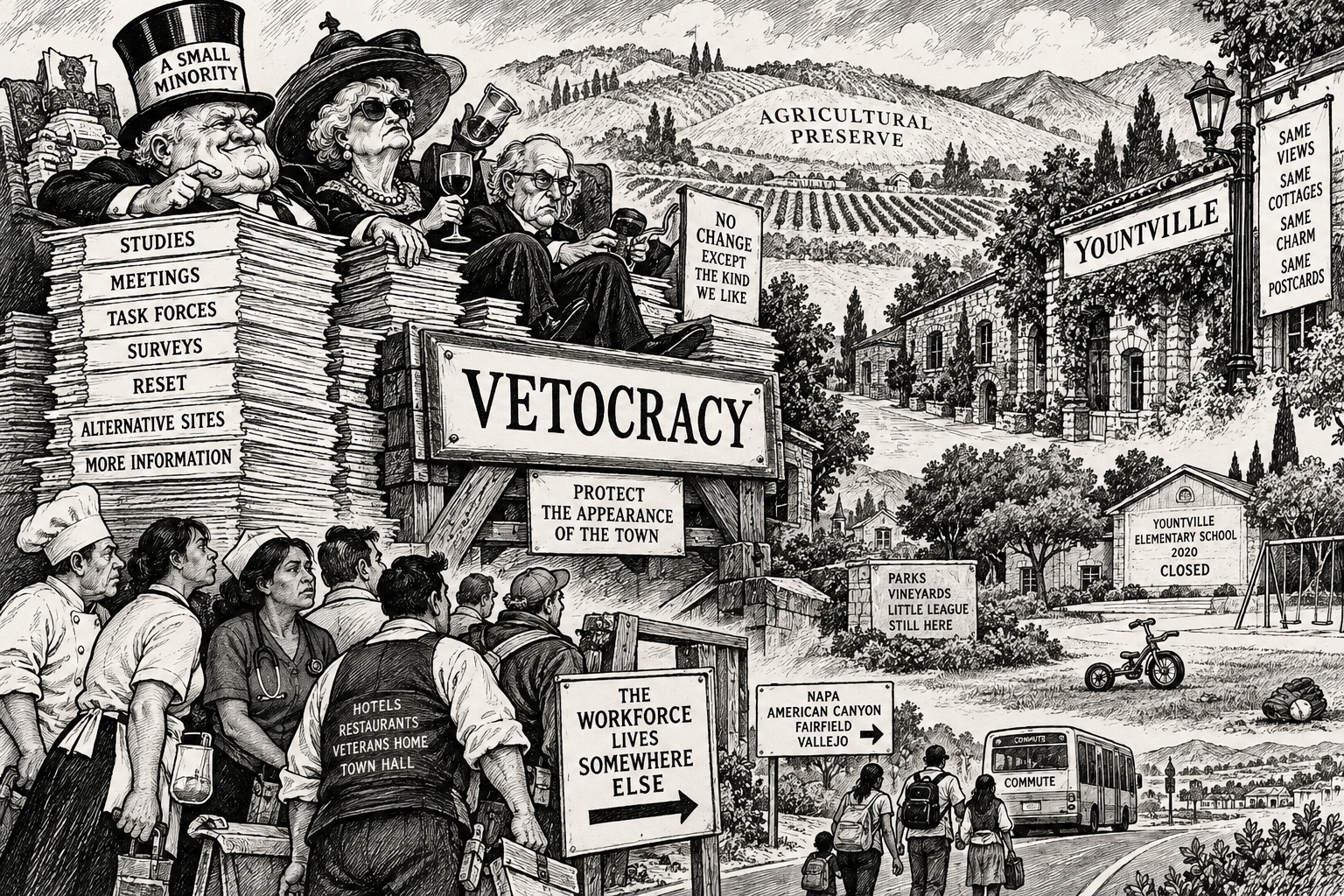
It took 235 signatures to stop workforce housing on land the Town already owns, roughly one tenth of Yountville's registered voters. In 2018, 74 percent of Yountville voters approved Measure S, a 1 percent hotel tax surcharge dedicated to workforce housing. Most of the town voted to fund workforce housing, and a small fraction of it stopped the Town's plan to build it. Next month, the other nine tenths of Yountville get their say.
That gap is the real division in Yountville this fall, and it has little to do with who loves the town more. On one side is a small group that has learned to work the machinery of local government. On the other is the much larger group that approved the money, supported the idea and then went home after dinner. Ballots for the November 3 election begin arriving this week, and they are the first occasion in two years when every voter in town gets counted at once, with equal weight. That alone is reason to look forward to Election Night.
A Name for the Habit
The political scientist Francis Fukuyama has a word for what has happened in Yountville this past year. He calls it vetocracy: a system in which so many people hold so many chances to stop public action that government becomes far better at preventing things than at doing them.
Vetocracy needs no corruption and no conspiracy. It runs on respectable language. More public input, another study, a better survey, a new task force, a professional facilitator, a fresh look at alternative sites. In Yountville this season the favored word is "reset." Each request sounds responsible, and many of them are. The trouble comes when they pile up, because there is always one more question worth answering before anyone acts. Nobody has to stand at the podium and announce an intention to block a project. It is enough to say it would be irresponsible to proceed until the town knows a little more, and then to find the next thing it ought to know.
The Town Changed Anyway
All this caution has not kept Yountville the same. The physical town has been preserved with real success. The community living in it has changed a great deal. The town is much older than it was. Houses cost far more. Working families are scarce. A growing share (+85%) of the people who work in Yountville drive in each day from Napa, American Canyon, Fairfield and Vallejo. In 2020 the elementary school closed for lack of enough children to fill it. The cottages, vineyards, parks and Little League field are all still where they were. The people around them are different.
Vetocracy protects what can be seen. A building can be landmarked, a view defended, a parking space counted, a proposed roofline lowered ten feet. What disappears through inaction leaves no mark. There is no photograph of the family that never moved here, and no plaque on the house that became someone's third residence instead of someone else's only one. Yountville did not prevent change. It decided, without quite admitting it, which kinds of change would be allowed to happen out of sight.
The Preserve and the Houses
For more than half a century the valley has rightly honored the Napa County Agricultural Preserve. The principle was simple. Growth would not sprawl into the vineyards, because farmland is finite and the valley's identity and economy depend on it.
Housing inside Yountville was finite too, and the town paid it far less attention. Over the years a substantial share of it became second homes, now in excess of 50%. Nothing on the zoning map changed when that happened. The porch and the garden stayed put. A house lived in all year by a working family and a house used a few weekends a year by owners who live elsewhere still do very different work for a town.
Meanwhile the town's economy kept needing people. Restaurants and hotels need cooks, housekeepers and managers. The Veterans Home needs nurses and caregivers. Town Hall and the Fire Department and the Post Office needs employees. Yountville never stopped needing these workers. It moved the job of housing them to other cities, which now carry the apartments, the traffic, the schools and the services. Because it happened one sale at a time, it was easy to believe nothing fundamental had changed.
Then the School Closed, and the Town Bought the Land
Housing policy alone did not empty the elementary school, and it would be dishonest to claim it did. Demographics are more complicated. Still, a town known around the world for its food and wine could no longer sustain a grade school, and that deserves more than nostalgia. It happened in a town that had spent decades making it harder for young working families to live here. Yountville can keep its ballfield in perfect condition and still lose the children who would play on it.
The Town's purchase of the school property, 7.5 acres in the middle of town for $11 million, forced a question the town had been putting off. Here was public land, already developed with a number of valuable buildings, central, tied to the town's history and large enough for several uses. If workforce housing could not go there, the people who said no owed the town an answer about where it should go instead.
The answer that came back was not a place. It was more procedure.
Nobody Is Against Housing
The genius of vetocracy is that nobody has to oppose the goal. Everyone can support workforce housing while opposing the particular housing the town is actually able to build. The project is too large, too expensive, too dense or not studied enough. The workers have not been properly surveyed. Another property would be better, CalVet should be approached again, the Catholic Church property deserves another look, the Town could buy existing houses, rent subsidies might work, a professional survey should come first, and residents need one more chance to explain what they want.
None of those ideas is foolish, and most of them are not new. The Commons did not begin with a blank page. It was built on years of the Town's own planning work, and much of what the candidates now propose has already been done, written down and adopted.
The Town's 2023-2031 Housing Element, adopted in June 2024 and found in compliance by the state that August, records the groundwork. Between February and April 2022, Town staff interviewed nine organizations about local housing needs, among them the Yountville Veterans Home, the Chamber of Commerce and the county's housing agencies. In March 2022 the Town held a focus group with local business owners and managers of the largest employers, who told the Town that most of their employees cannot afford to live here. The same document found that 67 percent of the town's vacant homes in 2019 were held for seasonal or occasional use. It already directs the Town to encourage workforce housing on the Veterans Home campus and to put Measure S money toward affordable housing.
Employers have been asked. The Veterans Home has been part of Town housing policy for years. The plan several candidates want to write from scratch already exists, and the Commons was the Town's effort to carry it out. A political system still needs some way of deciding that it knows enough to act. Without one, careful planning and permanent reconsideration look exactly alike.
What the Candidates Said
Several candidates have now explained in writing how they would handle the Commons and other tough decisions. Their answers are worth reading closely, because they reveal how each one understands the line between listening to the public and governing it.
Jessi Bugden wants Yountville to "start fresh." On the Commons she says the Town can "start over and do it right." She proposes new outreach to workers, employers and residents, another review of alternative sites, a look at rent subsidies and buying existing homes, a committee outside the Council to gather ideas, and an advisory public vote before any plan is adopted. She wants a process that "starts with residents instead of ending with them."
Each idea sounds democratic on its own. Together they skip over the last two years entirely. The Commons was not drawn up in secret. The public record shows open houses, focus groups, one-on-one conversations, advisory commission meetings, Council study sessions and separate public discussions of mobility, sustainability, wellness and the dog park. A resident can have opinions that the Town listened poorly, moved too fast or chose the wrong housing program. Those are arguments about how the process went. They are not proof that it never happened. Starting over throws away time, professional work, public participation and decisions already made, and if every contested decision can be sent back to the beginning, the beginning becomes the safest place for government to stay. And “start fresh” is going to be expensive. Somehow that cost never got on her website.
Jill Turner says plainly that earlier listening sessions happened and that many residents, herself included, were not paying attention. That is a candid admission, and nobody should have to attend every planning meeting to be a good citizen. Her remedy is the problem. She proposes statistically significant research among workers, professional surveys of residents, taxpayers and businesses, another look at the Veterans Home and Catholic Church properties, new scenarios, a full business plan and more listening. She also questions whether young workers even want to live in Yountville, noting that Napa is fifteen minutes away and "hardly an onerous commute."
That remark carries a policy inside it. If Napa and a commute is the answer, then she is suggesting that Yountville's plan is for the people who work here to live somewhere else. The cooks, nurses and Town employees remain essential. Only their homes, their children's schools and their evenings belong to another city. There is a second problem as well. If those who missed the first process can restart it by arriving late, planning has no point at which it can end. Somebody always arrives late. Only in Yountville can these people not just arrive late but now want to also run the town.
Hillery Trippe was asked what she would do when her own judgment about the town's long-term interest conflicts with strong public opposition. After listening and explaining her view, she says, she would "tend to defer to the community perspective." She hopes that with enough professional information the Council could reach a decision "acceptable to the community." For the Commons she proposes neutral professional facilitators and a resident and business task force to develop options before the Council weighs them. But then, if she is on the losing part of a vote, she’ll organize a protest against the council decision in private rather than make her case in public. She never misses an opportunity to tell a crowd she’s a lawyer which explains why her answer to every housing question is more discovery.
The difficulty is the goal which none of these challengers want to touch. There is no single community opinion waiting to be discovered by the right survey. Neighbors want peace and quiet. Businesses want cheap employees. Some residents want actual neighbors living in their neighborhood, some want open space, and some want both and argue hard over the proportions. Representative government exists because those interests collide and somebody elected has to choose. When strong opposition by itself becomes grounds for delay, organized opposition holds something close to a veto. The worker driving in from Fairfield holds none. Neither does the couple who might rent a Yountville apartment two years from now, or the child they have not had yet.
Joe Tagliaboschi, running for mayor, has the shortest phrase for all of this. He wants a "total reset." Anyone who has fought with a computer knows the appeal. Towns do not come with that button. Yountville owns the land, the school is closed, money has been spent, studies are done, hundreds of residents took part, plans were drawn, opponents organized, and the zoning was repealed. The state housing obligations remain, and so do the amenities already open on the property. A reset cannot return the town to some untouched starting point, because none exists. It can only mean discarding part of what has been learned and beginning another process from where things stand. That may be a defensible choice but it is a choice with significant costs which he conveniently never addresses.
Other candidates on the ballot have answered the same questions differently. Their answers deserve the same careful read.
What the Commons Already Is
To hear the campaign talk, Yountville spent $11 million on dirt and two years paying consultants to look at it. The Town's own February 2026 report describes something else. Schmitt Hall hosts 15 weeks of youth day camp each year, along with classes, trainings and meetings. The restored Farmstand Garden produced more than 800 pounds of fruits and vegetables in 2025, worked by twelve volunteers. The Farmstand and Coop are open five days a week. Yountville Fit signed up more than 200 members in its first year. The town's first dog park has become one of its regular gathering places.
None of that proves the housing plan was the right size, affordable or politically wise. It does prove the Commons is not a failure. A serious candidate would separate the parts of the Town's work that succeeded from the part that drew a petition. In this campaign the dog park, the gym, the garden and the summer camp have dropped out of the conversation entirely. A total reset, it turns out, comes with a selective memory. The proposal for a new dog park was met with howls of resistance from much of this same crowd. And within a month of it opening, it was one of the town’s most used public amenities. And it remains a small but meaningful lesson in how the Council faced down a small mob and got something done for the residents and visitors of Yountville.
Imaginary Projects Have Excellent Budgets
A project that does not exist is almost impossible to criticize. It has no height, no cost overrun, no trees to remove and no neighbor at the microphone. The housing that might someday rise on Veterans Home land, or church land, or somewhere else in the valley, comes with tasteful architecture, plenty of parking, no traffic and broad support.
Real proposals are less cooperative. The moment designers draws something, the costs and tradeoffs appear, along with residents who want it shorter, want twelve fewer units, want more parking or want less. Somebody wants the project moved somewhere else, at which point somebody else will presumably discover that they live next to somewhere else.
The person proposing something real must defend every flaw in it. The person proposing another round of study can stay loyal to a flawless alternative forever. It is difficult to be accused of designing the wrong building when your preferred building has never been designed.
Who Shows Up
Vetocracy does not need a majority. It needs a motivated group that participates more intensely than everyone else.
A resident who mildly supports a project goes home after dinner. A resident convinced it will ruin the town comes to every meeting, writes every letter, gathers signatures and returns the next Tuesday. That is ordinary human behavior and not a sign of bad faith. But intensity and representation are different things. A council chamber measures who came to the council chamber, and a petition measures who signed it. Neither measures the whole town, and neither counts the people who work here and cannot afford to live here.
The costs opponents fear are easy to see and easy to count: a tree, a parking space, a building height, a changed view. The costs of doing nothing arrive as absence. Another worker adds an hour to the drive. Another house becomes a second home. Another young family decides Yountville is a lovely place to visit and an impossible place to start out. Years later the median age shows up in a report, and everyone treats it as weather. Nobody campaigns for more commuters, an older town or fewer children. Those outcomes simply accumulate from hundreds of reasonable requests to wait.
There is always another reasonable reason not to act today. After enough todays, however, a decade has passed.
Why the Ballot Is Different
This is why the election matters, and why it is worth looking forward to.
Every tool of vetocracy rewards whoever has the most time, money and the most stamina. The meeting format rewards whoever can attend at three on a Tuesday afternoon. The petition rewards whoever can organize a clipboard drive. The public comment period rewards whoever writes the longest letters. The ballot rewards none of that. It gives the resident who went home after dinner exactly the same weight as the resident who never missed a meeting. It counts the retiree who quietly wishes there were children on the street again, the business owner who cannot keep a line cook, and the Town employee who would like to live closer to where she works. For one day this fall the quiet part of Yountville gets to speak at a normal volume.
Opponents called the Commons housing plan too big, too costly and too complicated, and repeated it until the phrase did the work of evidence. The Council did not repeal the zoning because it agreed. When the petition to repeal the zoning qualified, the Council could have sent the question to a townwide vote. Instead it repealed the zoning in June as a gesture of good faith, so the town could have a more thorough conversation about the scale of the housing and the timing of its construction.
The Council has received no credit for that decision. The vetocracy crowd saw it as an opening rather than an offer, and the campaign since has treated a deliberate step back as proof that the entire effort was a mistake. A council that pauses to listen and then sees the pause used against it learns exactly how much good faith this process is willing to reward. The open question is what comes next, and the candidates have told voters, in their own words, how they would approach it. Some want resets. Some want new research, surveys, task forces and facilitated dialogues. Each proposal can be judged on its merits. Voters should also see the pattern they make together.
More process does not automatically produce better government. Sometimes another study finds a fatal flaw, and sometimes public outrage rightly stops a mistake. Democracy needs those possibilities. It also needs a government able to finish what it starts. Every candidate promises to listen, and every candidate means it. The useful question to carry into the voting booth concerns what each one intends to do once the listening is done.
There is nothing wrong with protecting the vineyards, the historic buildings, the parks, the trees and the small scale that makes this town recognizable. Those are among the reasons Yountville is worth fighting over. The error is assuming that preserving those things and preserving a living town are the same job. A living town needs people at every stage of life, including some chance that the person serving dinner or caring for a veteran across the road could also become a neighbor. Keeping that kind of town sometimes means changing the physical one.
Yountville can go on perfecting the machinery that prevents visible change while the invisible changes continue, none of them ever requiring a hearing or a vote. Or it can elect people who will gather what they need, accept that unanimity will never arrive, make a decision and own it. For the past year the town has been divided between the few who had the free evenings and everyone else. This fall the count does not depend on who had the free evening, and the larger group finally gets its turn to weigh in.
Disclosure: Brendan Kelly is the principal of Kelly + Morgan Architecture, which served as the Town's Owner's Design Consultant on the Yountville Commons. That work is complete.
