
Yountville is Not for Sale, #6: You Are Not Invited
Gary Jabara has a Sinatra party, an anonymous whistleblower and, thank goodness, a deep telecommunications background.
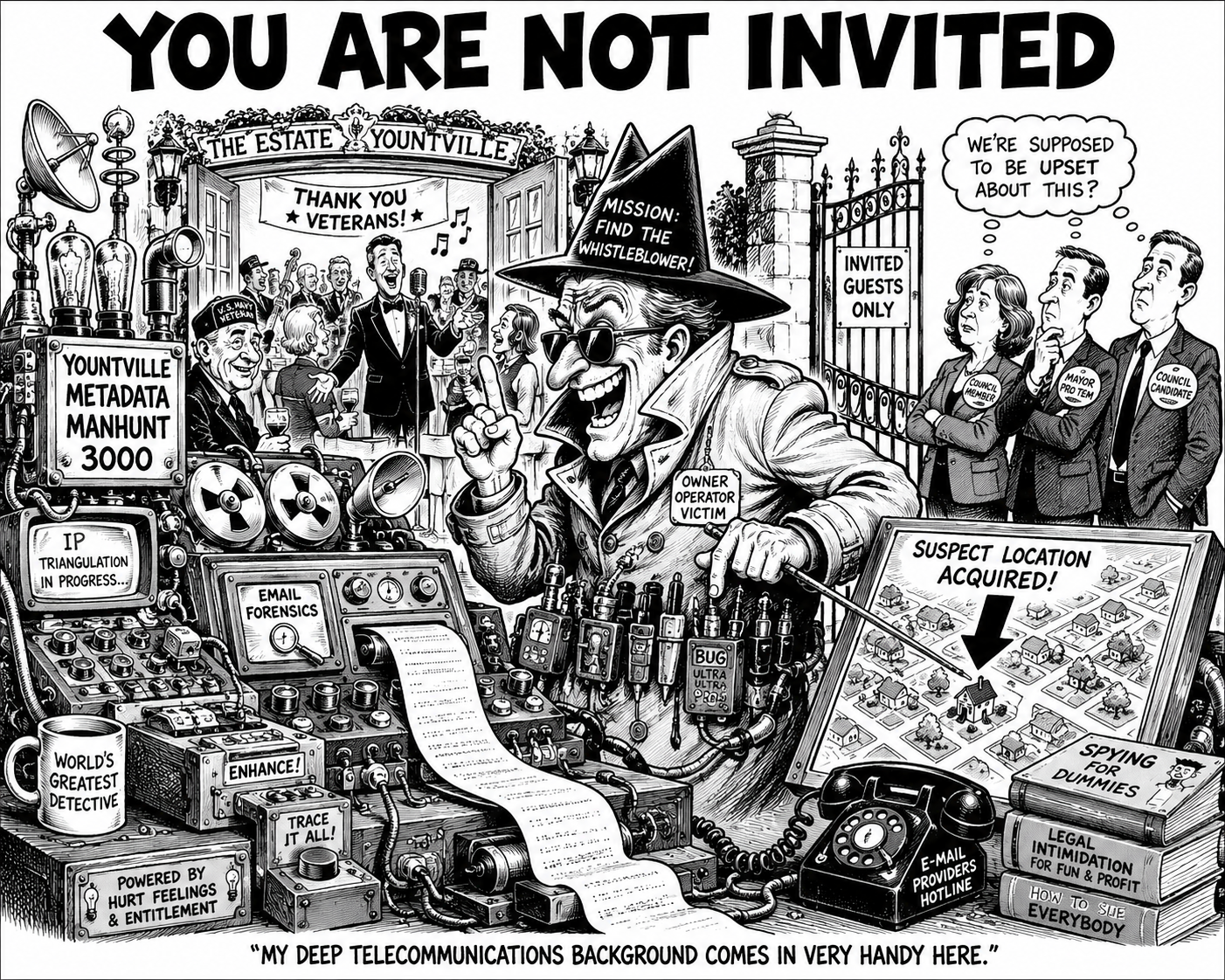
Gary Jabara says his Sinatra party is about friends, neighbors and veterans. But after one anonymous complaint, he informed Yountville’s entire political class that lawyers, metadata and his “deep telecommunications background” are on the case to find the sender’s exact residential address. Nothing says “I welcome a vigorous public debate” quite like hunting down the home address of someone who disagreed with you.
Gary Jabara is having a Frank Sinatra party at The Estate Yountville on August 13, and the first order of business was to notify the entire political leadership of Yountville that none of them may attend. In an August 4 email addressed to "Council Members and Candidates," Jabara explained that the gathering is a private affair for "my friends, neighbors, and our veterans," which is certainly his prerogative. He owns the place. He can invite the entire cast of Ocean's Eleven if he can find them. He adds, in writing, that "anyone not invited will be respectfully turned away." That is a door policy for a Sinatra evening, sent under signature to the town's elected officials. He closes by wishing the people he has just banned "much success in your respective campaigns." It is a gracious note, roughly the way a bouncer is gracious when he hands you your coat. And because the email went to sitting council members and declared candidates about town business, it is a public record. Anyone may request a copy. By last week, few in Yountville needed to.
What turns this otherwise forgettable bit of social sorting into a document worth reading closely is Jabara's explanation for the banishment, because somebody filed what he calls "an anonymous and highly political whistleblower complaint" after one of his previous gatherings, a complaint he says involved "one of our guests and me." Gary, it appears, has been criticized anonymously, and Yountville's entire political class needed to be informed that this aggression will not stand.
CSI: Yountville
Jabara told the Council and candidates that his attorney has already filed a request to preserve "any and all email meta-data" and determine whether the whistleblower email "truly came from an internal city source, as the sender wanted us to believe." The request was filed, according to the email, with "the City," which will come as news to Yountville, a town, though a man cannot be expected to keep track of every municipality he is investigating. If the sender turns out not to live within the city limits of this town, Jabara continues, "we're filing a Jane Doe lawsuit with the public email providers to identify the exact residential address from which the email originated." That is a remarkable amount of litigation strategy to include in an email about a party, and he sent it to a half-dozen politicians during an election season. Most attorneys charge extra to keep a client from doing exactly that. But Jabara apparently worried that his audience might not fully appreciate the technological resources now being brought to bear on the Case of the Anonymous Email. So he added the line that makes the whole thing sing: "My deep telecommunications background comes in very handy here."
Well, thank God for that. Somewhere in America an email provider may soon receive legal papers and discover it has wandered into the crosshairs of a telecom entrepreneur determined to learn from which breakfast nook an unflattering email was dispatched. One imagines a situation room upstairs at The Estate, banks of monitors flickering to life, technicians removing their headsets, and Gary studying a wall-sized map of Yountville, all six blocks of it, while somebody whispers, "Sir, we have an IP address." Perhaps there is a perfectly legitimate legal issue underneath all this, and Jabara is entitled to pursue whatever remedies the law actually provides. The comic achievement is deciding that every elected official and candidate in town needed a briefing on the manhunt, including the detail about the sender's "exact residential address." If anyone wondered why the whistleblower chose to remain anonymous, Gary has now circulated Exhibit A, copied the government on it, and wished it luck in November.
Strangers in the Night, Politicians at Home
Having finished with metadata, lawsuits and residential addresses, Jabara pivots rather abruptly back to hospitality. His gatherings, he explains, "are simply an opportunity for me to spend time with people I enjoy, celebrate our community, talk about the direction of Yountville, and thank the veterans who have given so much in service to our country." This is a lot for one evening: Sinatra, friendship, community, veterans, the future of Yountville and, hovering somewhere over the crudités, the knowledge that the host's deep telecommunications background may come in handy if anybody sends an anonymous email afterward. Guests should assume the metadata is being preserved along with the leftovers.
The politicians, meanwhile, can safely stay home. The Brown Act does not prohibit council members from attending ordinary social events, but a council majority privately "talking about the direction of Yountville" is precisely the sort of sentence that makes a town attorney reach for the aspirin. Jabara describes excluding them as “a very difficult personal decision” forced on him by “the past actions of one individual,” which is a little like banning the fire department from your barbecue and announcing it was one of the hardest calls of your life. Nobody needs to grieve. The Council has a perfectly good place to discuss the direction of Yountville. It has chairs, microphones, agendas and the peculiar disadvantage that the public gets to listen.
The Veterans Get Sinatra. Their Caregivers Get Highway 29.
The veterans are specifically welcome, which Jabara says is his way of thanking people "who have given so much in service to our country." That is a lovely sentiment, and the veterans should enjoy every minute of the evening. But there is an awkward piece of scenery just up the road from The Estate: California is building a $324 million, 240-bed skilled-nursing facility at the Veterans Home while CalVet confronts the considerably less glamorous problem of finding and retaining enough caregivers. CalVet's own master plan for the campus says the high cost of living forces staff into long commutes and leaves critical jobs unfilled. The same plan grades the site against five criteria and gives the Home a failing mark on "hiring compatibility." The state put that in print, with a red X next to it. Apparently even $324 million cannot persuade a nursing assistant's paycheck to become a Yountville rent check.
This would merely be an unfortunate coincidence except for what happened to the most advanced workforce-housing project Yountville had actually managed to produce. The Town owns seven and a half acres within walking distance of the Veterans Home. Voters created Measure S in 2018, with 72 percent approval, specifically to generate money for affordable and workforce housing, and hotel guests supply that revenue. After more than two years and more than 20 public meetings, the Commons could have begun with roughly 30 to 40 deed-restricted homes. Then a petition signed by 235 registered voters, roughly a tenth of the town's electorate, suspended the zoning ordinance, and the project stopped without any election taking place. Jabara's contributions to the campaign against the project sit in the public record, from the cost figures he circulated to the letters his attorneys sent the Town. Nobody ever suggested the Commons would solve CalVet's staffing problems or belong exclusively to Veterans Home employees. It would simply have allowed some of the ordinary people who sustain Yountville, caregivers among them, to live closer to the community they serve. There is something wonderfully Yountville about hosting veterans for a lovely private evening honoring their service while helping stall housing in which some of the people caring for those veterans might actually have lived. The veterans get Sinatra; their caregivers get another hour on Highway 29.
Please Identify One Idea
The episode presents another mystery, and this one may exceed even Jabara’s telecommunications capabilities. For a man eager to "talk about the direction of Yountville," it is remarkably difficult to locate a consequential public idea he actually wants Yountville to pursue. We know what he opposed at the Commons. We know what his lawyers objected to. We know who is not invited to the party. We now know that anonymous criticism is headed for forensic examination. But where is the affirmative idea? Forty workforce homes instead of 126? A different plan for the seven and a half acres? A proposal for Measure S? An actual idea for helping Yountville house the people who work here? Surely somewhere amid the lawyers, hotels, restaurants, newspaper, property holdings and deep telecommunications background there must be one good idea for Yountville that Gary Jabara wants to make happen. Finding it may prove considerably harder than finding the whistleblower.
My Way
The funniest part of Jabara's email is that the anonymous complaint itself is almost beside the point. Maybe it was justified. Maybe it was ridiculous. Maybe its author had good reason to stay unnamed, or maybe the author simply lacked the courage to sign. We do not have to decide any of that to appreciate the spectacle. A person criticized Gary Jabara anonymously, and rather than shrugging, responding publicly or letting his lawyer quietly handle whatever legitimate question exists, he notified Yountville's entire political class that he is coming for the metadata, the email provider and ultimately the "exact residential address," with his deep telecommunications background riding shotgun and the City of Yountville, wherever that is, preserving the evidence. Thin skin is common in politics. Turning it into a press release is rarer.
Which brings us back to Sinatra. Jabara could have chosen Come Fly with Me, but everyone has to get to the airport first, and some of the caregivers at the Veterans Home are still commuting from Fairfield. Strangers in the Night has possibilities, although presumably Gary would want their IP addresses before morning. That's Life counsels a philosophical acceptance of criticism, riding high in April, shot down in May, that the email does not immediately suggest. So there really is only one Sinatra song for a man who owns a large piece of the downtown commercial district, recently bought the local newspaper, worked to stall the Town's workforce housing plan, decides who may attend the private conversation about Yountville's future and now wants to know precisely where an anonymous critic lives.
"My Way."
It is a magnificent song. It is just a lousy form of municipal government.
Disclosure: Brendan Kelly served as the Owner’s Design Consultant to the Town of Yountville on the Yountville Commons project. That engagement is complete. He writes and publishes The Yountville Moon as a private citizen.☾
A closing note for the invited: The Moon was not asked to the Sinatra evening either, which is fair, since nobody here can carry a tune. But the direction of Yountville is a public subject wherever it gets discussed, and any guest who hears an idea worth the town's attention is welcome to pass it along. The Moon does not discuss its sources and, unlike some hosts, has no interest in anyone's residential address. Juicy tidbits only so email me at yountvillemoon@gmail.com
Heads up!: Jabara's email refers throughout to an anonymous whistleblower complaint. The Moon has obtained a copy. On Friday the Moon publishes it in full, and readers can decide for themselves which one is the story: the complaint or the response to it.☾
