
The Candidates and Your Choices - Guest Essay by Matt Chrzanowski
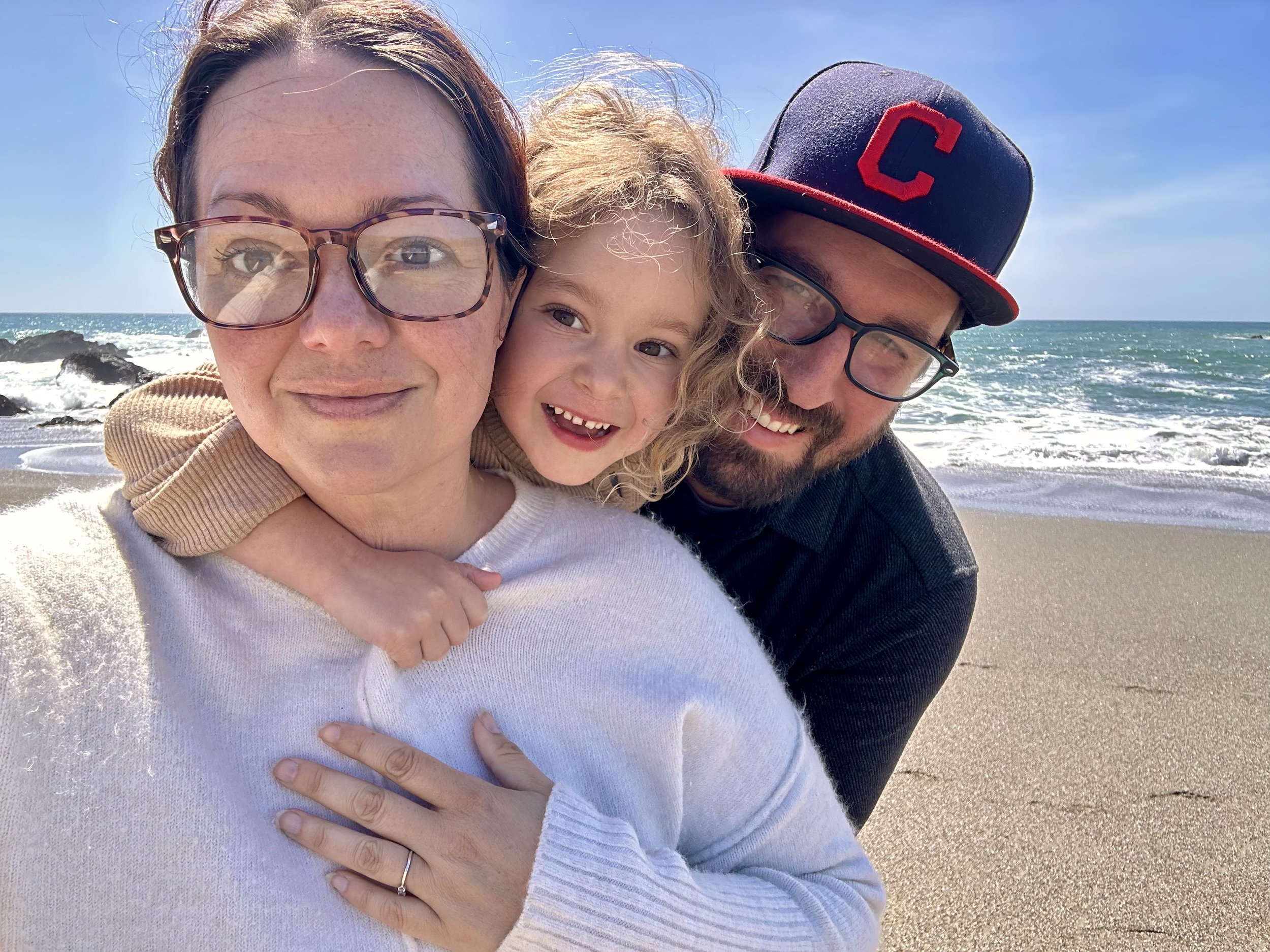
Matthew Chrzanowski with his partner and their young daughter, a reminder that Yountville’s future is not simply about preserving the town you love, but making room for the families who will give it life in the decades ahead. For Matt, the next generation is not an abstract campaign promise. It is growing up right here, and the decisions Yountville makes today will determine whether families like his can continue to call this town home.
The Yountville We Hand to the Next Generation
A Future for Working Families
What happens with the former Yountville Elementary School site will shape the future of our town. The decisions we make now will help determine what Yountville is in 2076. The challenge is to preserve Yountville’s standing as a world-class destination while ensuring it remains a town where ordinary working families can make a home. Those goals are not incompatible; properly managed, each can sustain the other.
I spend my days in research labs and vineyards, working in the industry that supports this valley. In the evenings, I walk around Yountville with my wife and young daughter. I see two sides of the same Napa Valley economy. At home, I see neighbors who love and know each other. I have watched my daughter grow confident telling them about her day and her latest adventures. At work, I see colleagues who commute from places like Healdsburg, Suisun, Middletown, and Antioch, spending hours on the road each day. Some are leaving an industry they love because they can no longer afford to live near it. Both are Yountville. Making this town work for the people who sustain it is why I am running.
From Planning to Building
I support workforce housing on the former elementary school site, on land the town already owns. Yountville has spent years planning for the site’s development, through public meetings, professional studies, reviews, and approvals. The Council’s June repeal of the zoning ordinance did not erase that work, and we should not start from scratch. We should build on what has been accomplished, reconsider what truly needs reconsidering, and move toward a practical, financially responsible plan we can actually carry out.
Getting there will not be easy. A project this complex involves public land, money, housing, density, character, and competing private interests, so disagreement is unavoidable, even after everyone has been heard. A council member’s job is not to eliminate disagreement. It is to understand it, weigh the evidence, explain the reasoning, and decide, knowing that some decisions will disappoint people who took part in good faith. Research works the same way: gather evidence, test assumptions, reach a conclusion, and adjust when the facts change.
Residents have become far more involved in local decisions. Meetings that once drew a handful of people now draw hundreds. The challenge now is to turn that participation into constructive results. Engagement has to lead somewhere, and it has to start with clear communication. We cannot mistake endless discussion for progress, especially when delay falls hardest on the people who cannot afford to live here. As a former teacher and education researcher, I know that teaching is, at its foundation, communicating complex ideas clearly. Budgets, zoning, and project management get complicated quickly, and when people lack clear information, confusion, rumor, and misinformation fill the gaps. People also learn best by taking part, not by sitting through long, information-dense meetings. So every step of the project should come with a communication plan that uses many formats: informal pop-ups, formal workshops, office hours, a simplified online portal, and regular written updates on what has happened and what comes next. Let us close the loop: what we heard, what changed, and why.
What Belongs on the Site?
Workforce housing, supported by shared amenities such as a licensed childcare facility, laundry services, community gardens, and welcoming public spaces, can make Yountville more affordable, connected, and sustainable for individuals, families, workers, and seniors.
The previous Commons plan established an important foundation by dividing the site into parcels instead of one large lot. That allows the town to build in phases and invite competing proposals from developers serving different income groups, all within common design and affordability standards. The town can retain ownership where that serves the public interest, or lease or sell individual parcels with enforceable development requirements. Recorded affordability restrictions and other binding agreements can protect obligations attached to individual housing parcels.
What matters most is who controls the public purposes of the finished development. Ownership, development, and operation are distinct responsibilities. The town should maintain control of shared civic infrastructure and public facilities, using competitively awarded, multiyear operating contracts with measurable obligations. Individual housing parcels may have different developers and ownership arrangements without sacrificing the standards and public benefits of the neighborhood as a whole.
However we move forward, each amenity carries its own costs, so the mix should depend on demonstrated demand, realistic financing, and capable operating partners. Yountville Fit shows what the town and private partners can accomplish together that neither could alone. Childcare is one of the largest expenses facing young families and one of the most difficult community services to establish and sustain. California has previously supported childcare infrastructure through state funding programs, and I would work with our representatives in Sacramento to identify current opportunities while developing a realistic operating model for infant and childcare in small towns like Yountville. If successful, that approach could provide a useful example for other rural communities facing similar challenges.
None of this has to happen at once. Building in phases lets us learn from each step before committing to the next. Each phase should have a well-defined scope, identified financing, and measurable objectives. Before authorizing major construction expenditures for later phases, the Council should publicly evaluate costs and results, confirm available funding, and demonstrate how the next investment advances the larger plan. Planning and coordination should continue in parallel, so that financial accountability does not become another reason for unnecessary delay.
Applying Research to Local Government
Yountville’s work does not end at the former school site. The same approach, which is to test an idea at a manageable scale, measure the results, and expand what works, applies to energy and water, and it is where my training as a chemist can help most. My work now is making winegrowing more resilient to extreme heat, smoke, and disease, so I do not have to imagine what a changing climate does to this valley.
On energy, California’s building standards already demand high energy efficiency and require solar generation for most new residential construction, subject to applicable exceptions. The previous Commons design included all-electric buildings, solar panels, and battery storage to reduce exposure to future energy costs and improve local resilience. Efficient buildings are only one part of the equation. Our town still depends on a regional electric network whose reliability is largely beyond our control. I would focus on where added storage, backup power, and utility partnerships could keep essential services running during outages and public safety power shutoffs, and require that any investment show measurable benefits at a reasonable cost. Calistoga has paired battery storage with hydrogen fuel cells for that purpose, and it is worth studying, though every town’s utility arrangements and costs differ.
On water, leading research on reuse, lower-energy treatment, and smarter monitoring is happening at Lawrence Berkeley National Laboratory and UC Berkeley. As we make our next investments in water and wastewater, I would explore partnerships there and seek state, federal, and research funding for pilots, so that Yountville does not carry the cost alone. A town our size, with the fiscal discipline past councils have left us, is well placed to test ideas at a manageable scale and share what works.
The Next Generation
Underneath all of this is a simple wish. I want my daughter to grow up in a Yountville that remains a real community, not just a beautiful destination kept running by people who have to live somewhere else. That means respecting what earlier generations built while making room for those who follow: listening carefully, making responsible financial choices, relying on sound evidence, and having the courage to act when decisions have to be made. That is what I would bring to the Town Council.
Matthew Chrzanowski is a candidate for Yountville Town Council. He can be reached at mattchrz12@gmail.com or mattchrz.com.
His three-question community survey is available at mattchrz.com and https://forms.gle/sfUDyDgknDtYe4Dq6.
