
The Candidates and Your Choices - Hillery Trippe: UNWORTHY
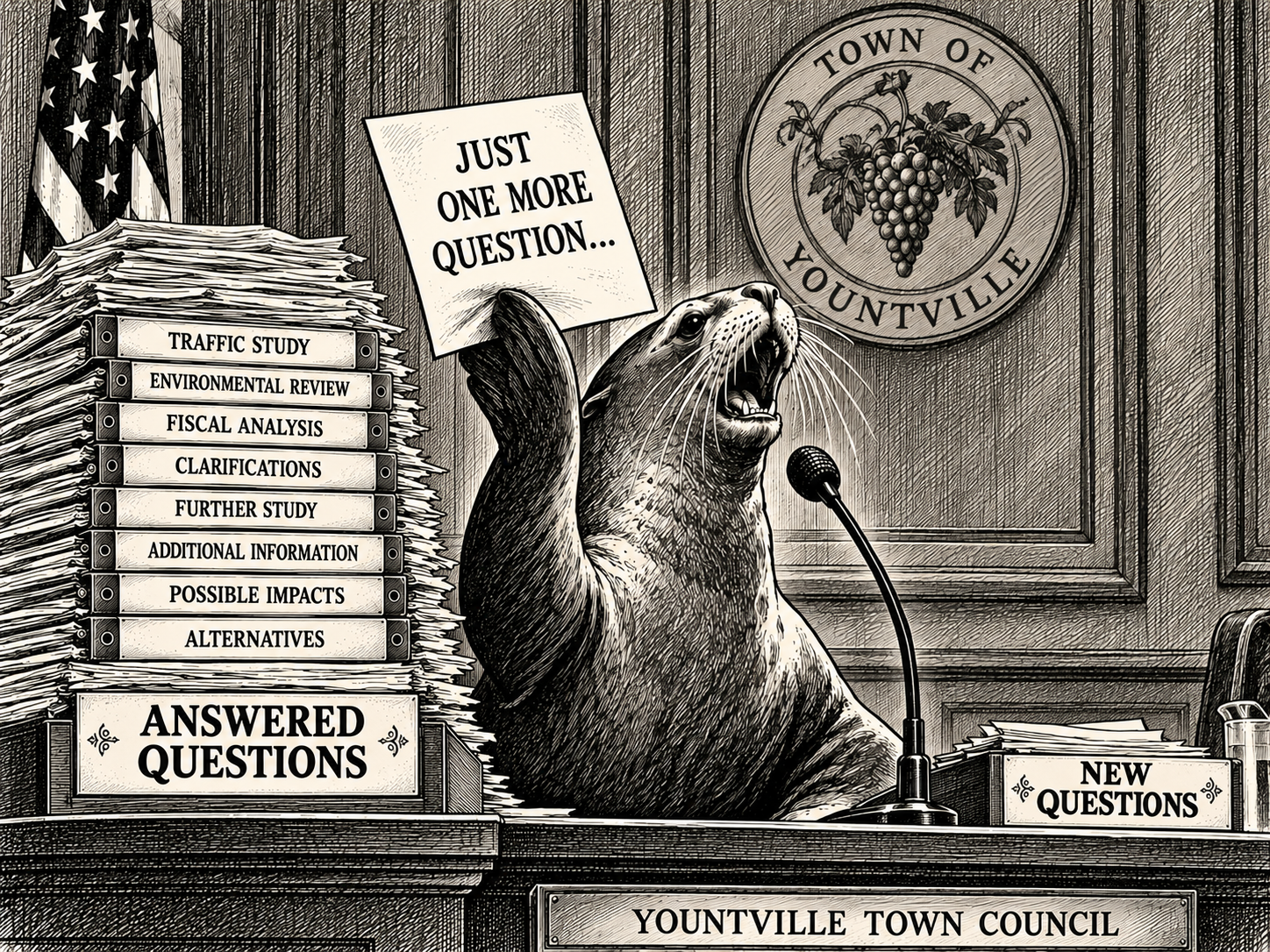
After two years of studies, public hearings, environmental reviews, and answered questions, Yountville's most tireless defender of further inquiry has discovered the one question nobody can answer: How many more questions must be asked before nothing can finally be accomplished?
Gary Jabara has discovered that Yountville was victimized by terrible spending decisions. He has also discovered that the councilmember who voted for them is our last defense against fiscal irresponsibility. There will be pie.
The Victimhood of Gary Jabara
On Wednesday, October 21, Gary Jabara sent Yountville an urgent communication, beginning with the promise that he would “keep this short,” the political equivalent of “I’m not going to make a speech” at a wedding. The letter began with vineyards and lovely Washington Street, passed through a sweeping indictment of municipal government, endorsed several candidates for office, saluted the veterans, and arrived, six exclamation points later, at a pie-eating contest. There was something almost athletic about the transition, as though a man had leapt from the wreckage of municipal democracy directly into a vat of pumpkin filling.
“We’ve been victimized,” Jabara announced, by City Council spending decisions that were “deeply wasteful.” Staff, on the other hand, had been “terrific.” Cal Fire and the Sheriff’s Office were “amazing.” So the town’s professionals are exemplary, the services keep running, and the place is still breathtakingly beautiful, but the citizens are victims. One hesitates to interrupt such a stirring denunciation with a technical question, but victims of precisely what? Which expenditures? Approved by whom? For what purpose? It is possible that Yountville has suffered the first fiscal catastrophe in American history in which the principal evidence is a future baking contest.
Fortunately, Jabara has identified a savior. Councilmember Hillery Trippe, he writes, “consistently asked the hard questions about spending and accountability.” She “often stood alone.” The difficulty, and it is not an obscure difficulty requiring a forensic accountant, is that Trippe voted to buy the former elementary school, voted to approve the Commons conceptual plan, and participated in authorizing the public money spent advancing it. Jabara has managed to make the person who helped approve the spending into the person who tried to save us from it. By this standard, a bank robber who questions the price of the getaway car qualifies as a whistleblower.
The Strange Case of the Woman Who Voted Yes
Yountville bought its closed elementary school in 2024 for approximately $11 million. The closure itself, in 2020, ought to have been the town’s most alarming budget report: a public school with too few children to remain open, in a prosperous community famous for knowing the price of everything. The Town proposed using the seven acres for workforce housing and public amenities. Trippe voted yes to the acquisition. She voted yes to the conceptual plan in March 2025. She participated in the decisions to fund the studies, architects, engineers, hearings, and environmental review needed to get from a handsome idea to a project that could legally be built.
These were not purchases made from the municipal petty-cash drawer while Trippe was out of town. They occurred in public, with Council votes, staff reports, agendas, invoices, and the other artifacts of accountable government. To hear her principal outside champion tell it, however, she was an isolated sentinel looking down from the ramparts upon a spending spree she somehow both witnessed and authorized. Perhaps she had been voting with one hand while heroically interrogating the other.
After roughly 25 public meetings, years of professional work, and revisions to the plan, the final zoning, subdivision, and environmental approvals passed four to one. Trippe voted no. Not one member of the public spoke against the project at those approval hearings. The vote did not make her dishonest or forbid her from dissenting. It did establish something less flattering than the lonely-hero legend: with the same access to information as her colleagues, and every opportunity to persuade them, she had convinced none of the other four. Standing alone is not intrinsically courageous. Sometimes it means everyone else has heard the argument.
The Sea Lion Gets a Council Seat
Trippe’s much-advertised background in risk management is perfectly respectable, and exceptionally useful if the question is whether a university should insure a laboratory against flooding. It is less obviously a philosophy for a town losing its families. Risk has two sides. A housing project might exceed its budget, encounter an engineering difficulty, or require revision. A town that spends another decade not building homes might discover that its teachers, nurses, cooks, housekeepers, and younger families have learned to live perfectly well somewhere else. The first class of risk produces spreadsheets. The second produces an empty school. Apparently one is more frightening than the other.
There is a form of public argument called “sealioning,” named for a cartoon animal who pursues people with exquisitely polite, unending demands for further evidence. One question is answered, giving birth to two more questions, which require a consultant, whose answer must then be studied for its implications. Eventually everyone dies of old age, including, presumably, the sea lion. Scrutiny is necessary; endless scrutiny makes the meeting the accomplishment. Yountville answered questions for years. At some point the Council had to decide whether the town needed housing or an interpretive center dedicated to the history of discussing housing.
A petition later helped force the repeal of the Commons approvals. But the land remained in public ownership, the bills had been paid, and the need for homes had not miraculously dissolved. The repeal was a political victory, not a replacement plan. Those are two different things, though Yountville has become practiced at celebrating the first while quietly deferring the second.
Transparency, Now Featuring a Pie-Eating Contest
This brings us back to Jabara, an owner of substantial commercial interests in town, whose company has supplied significant financial support to the effort to elect his favored candidates. There is nothing inherently improper about a property owner supporting candidates. There is, however, something almost baroque about a powerful commercial figure demanding transparency from Town Hall while offering the public no comparably specific account of what he hopes to see done with the seven acres that Trippe helped the Town buy and then helped prevent it from developing as approved. He has suggested selling the property to a private developer. Which developer? To build what? With whose benefit uppermost in mind? A man who appreciates “hard questions” should love these. We should have a whole evening of them, perhaps between the baking and competitive eating.
Jabara endorses Joe Tagliaboschi for mayor and Trippe for Council, and suggests two possibilities for the other Council seat. Then the indictment of the town gives way to Oktoberfest, which was evidently wonderful, and then Thanksgiving, which will feature baking and pie-eating contests. “Ready, Set, Eat!!!!!!” he writes. It is hard to say what is most striking: the punctuation, the confidence with which political catastrophe becomes a social calendar, or the magnificent assumption that the recipient can move from the collapse of responsible municipal government to recreational pastry consumption without experiencing whiplash.
This is not an argument against pie. Pie is considerably more accountable than most campaign literature; you can see what is in it, and if you dislike the filling you need not vote to keep it for four years. Nor is hospitality a crime. But hospitality is not a housing policy, a crowded Oktoberfest is not an electoral mandate, and a councilmember cannot become the conscience of municipal spending merely because the man paying to promote her says she asked excellent questions about expenditures she approved.
What She Still Owes the Town
Yountville is wealthy, lovely, and losing the ordinary family life that once justified its elementary school. Its restaurants and hotels need workers. The Veterans Home needs caregivers. Those workers largely cannot vote in the town where they spend their days, and their children cannot attend the school that closed for lack of them. None of this makes every housing proposal wise. It makes the duty to produce a credible alternative especially serious for an official who helped begin one, participated in paying for it, and then opposed its completion.
Trippe is asking for another four years. The question is not whether she has the right to dissent; she does. It is whether a record of approving expenditures, attacking their purpose, and leaving the public with the costs and no equivalent plan deserves to be rewarded as exceptional stewardship. Gary Jabara's email accidentally supplies the answer. After denouncing waste, praising the woman who voted for it, and inviting everybody to eat pie, he has produced the perfect campaign document for Hillery Trippe: an endorsement so revealing that her opponents need only circulate it.
The Commons still has land, paid invoices, and a missing generation of families. Jabara has a party to organize. Trippe has questions to ask. Yountville needs somebody capable of answering one. On the evidence of what she has done, rather than what her benefactor says about her, she is unworthy of another term.
Disclosure: Brendan Kelly is principal of Kelly + Morgan Architecture, which served as the Town of Yountville’s Owner’s Design Consultant on the Yountville Commons. That work is complete.
