
Four Exclamation Points and Not a Single Idea!
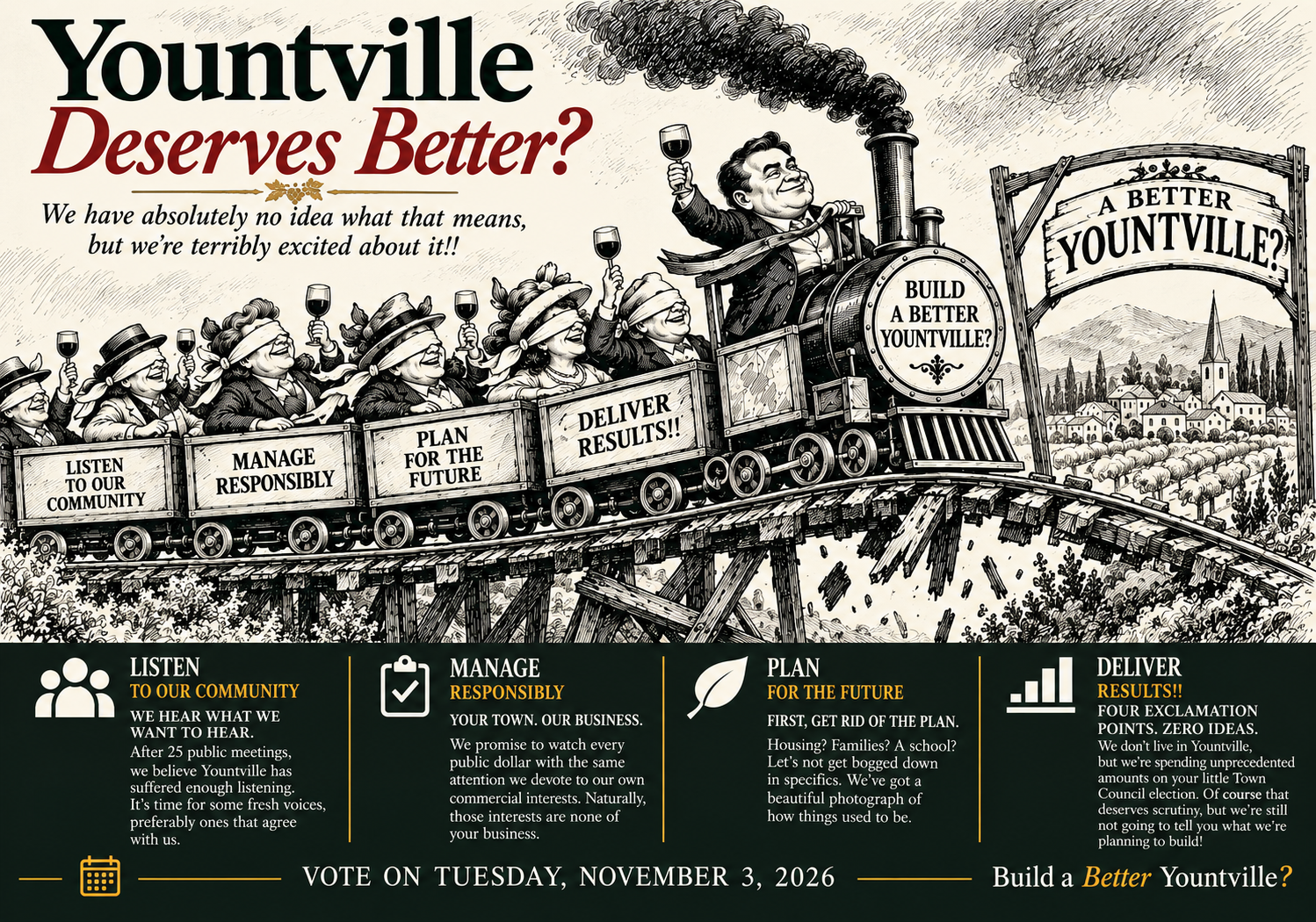
All Aboard the Better Yountville Express! The passengers are blindfolded, the conductor is drinking, the bridge is collapsing, and nobody knows where they're going. But the promises are magnificent, the outside money is pouring in, and everyone is terribly excited!!
Gary Jabara's political committee is spending record amounts but the best part is that has discovered Yountville's historic railroad station, photographed it, and announced that exciting changes are coming. The town is invited to admire the scenery while the details are worked out.
There is a particular kind of political postcard that appears to have been designed for people whose principal intellectual activity is remembering where they left their reading glasses. It arrives on expensive paper, features a reassuring photograph of something old, and speaks in the warm, patient tones ordinarily reserved for explaining to a Labrador that the veterinarian is his friend. One of these arrived in Yountville this week, bearing a magnificent old railroad station, an approaching locomotive, and the declaration “Yountville Deserves Better,” which is an interesting thing to print across a photograph of a perfectly respectable town minding its own business.
On the reverse, someone has written, in the cheerful handwriting of a person who has just discovered scented stationery, “I've heard there are changes coming to our beautiful town. We are so excited!!” The message concludes by encouraging everyone to vote for change, followed by two additional exclamation points, bringing the total to four, a remarkable expenditure of punctuation considering that the entire postcard contains not one identifiable proposal. Four exclamation points and zero ideas. This may represent a new municipal record, although Yountville has lately produced some formidable competition in the field. The postcard comes from Build a Better Yountville, a political committee financed with tens of thousands of dollars from a company associated with Gary Jabara, an Orange County businessman whose Yountville property holdings include the historic railroad depot. The committee is supporting candidates in the November election, promising leadership that listens, manages responsibly, plans for the future, and delivers results. One assumes the rejected alternatives included embezzlement, chronic deafness, reckless improvisation, and sitting in the Council chambers eating paste.
A Brief History of Somebody Else's Railroad Station
The original brick depot was built in 1868, when the Napa Valley Railroad arrived in Yountville and began the considerable business of transforming a small agricultural settlement into a working commercial town. Farmers shipped produce, merchants received goods, passengers came and went, and Gottlieb Groezinger eventually established his winery beside the tracks because, unlike the authors of the postcard, nineteenth-century businessmen generally understood that a transportation system was supposed to transport something. The railroad was an extraordinary investment in the future, requiring engineering, financing, construction, and the participation of people whose names have largely disappeared from local memory. The buildings remain, however, including the original brick depot and the great Groezinger Winery behind it, architectural survivors of a time when Yountville produced things besides memorable dining experiences and credit-card statements requiring medical attention.
The depot eventually became a restaurant. Under the late Michael Chiarello, it operated as Coqueta, a rather sophisticated establishment that demonstrated how a historic building could enjoy a productive second life without pretending it had been constructed for the convenience of contemporary diners. Jabara purchased the property after its conversion, painted the old brick, and reopened it as Clementine. This is a pleasingly efficient sequence of events. A nineteenth-century community builds a railroad station. Generations preserve the building. A celebrated chef helps establish its modern restaurant use. A wealthy investor acquires the property, changes its appearance, and subsequently finances a political advertisement featuring the town's historic railroad imagery as evidence of his commitment to the town. One might reasonably admire the business model. The original builders supplied the architecture, subsequent generations supplied the preservation, and the current owner supplied the postage.
The Building Behind the Postcard
Immediately behind the brick depot stands the Groezinger Winery, a monumental brick survivor of Yountville's agricultural economy, now part of the Vintage 1870 complex. It has endured approximately 150 years of weather, changing ownership, commercial reinvention, and the occasional architectural enthusiasm of people who regard a historic masonry wall as an unfortunate interruption between two potentially profitable rooms. The building is nationally recognized for its historic significance, which makes its surviving brickwork rather more consequential than the decorative masonry surrounding the outdoor fireplace of a recently constructed tasting room.
A proposal involving substantial alterations to the winery, including new openings in its historic brick walls and a large upstairs banquet facility, is presently before the town. This creates a marvelous little architectural tableau. In front stands the historic brick depot, now painted and operating as Clementine. Behind it stands the historic winery, whose masonry may be significantly altered to accommodate a new commercial use. And circulating through town is a political advertisement financed by the businessman associated with these properties, inviting residents to contemplate a beautiful photograph of Yountville's architectural past while promising a better future. The postcard does not mention the winery proposal, although this is perhaps understandable. It is difficult to fit seven proposed openings in historic brickwork between four exclamation points, particularly when the committee has already committed so much space to announcing its excitement.
Four Principles, Suitable for Framing
The committee's political philosophy consists of four propositions so broadly agreeable that they could serve equally well as the mission statement of a retirement community, a regional bank, or a reasonably ambitious bowling league. “Listen to Our Community,” announces the first. Yountville recently spent more than two years listening to its community about the future of the former elementary school. There were approximately 25 public meetings, extensive design work, environmental review, and repeated Council decisions. The town listened so thoroughly that residents could reasonably have expected complimentary hearing aids upon completion of the process. The Commons proposal was eventually overturned after opponents organized against its approvals. The town still owns the property, the school remains closed, and the housing needs that inspired the project remain unresolved. Listening, apparently, is not quite the same as deciding what to do after everyone has finished talking.
“Manage Responsibly,” announces the second principle, without the distraction of a proposed budget or financial program. “Plan for the Future,” declares the third, although the postcard contains no plan. “Deliver Results,” promises the fourth, which is an admirable ambition for a committee whose most visible deliverable is presently a postcard. There is a certain elegance to this method of political communication. By declining to identify a single specific objective, the committee has eliminated virtually every opportunity for anyone to disagree with it. A resident who objects to listening, planning, responsibility, or results would presumably require professional assistance.
The Town in the Gift Shop
Yountville was not created as a luxury destination. It was a working town, populated by farmers, laborers, merchants, veterans, children, and families whose daily lives required buildings that served practical purposes. Its architectural character emerged from those activities, not from a marketing consultant's discovery that weathered brick photographs beautifully beside a glass of Cabernet. Over generations, residents maintained the place through economic changes that eventually transformed it into an internationally celebrated hospitality destination. Restaurants flourished, historic properties acquired extraordinary commercial value, and houses that once accommodated families increasingly became expensive places for people to visit occasionally.
The transformation brought prosperity, but it also introduced a peculiar temptation: to regard the town itself as an inventory of commercially useful assets, its buildings available for adaptation, its history available for branding, and its civic institutions available for persuasion through sufficiently attractive advertising. A town can survive a surprising amount of commercial enthusiasm. What it cannot indefinitely survive is the disappearance of the ordinary community that gives those commercial enterprises a reason to exist. The old railroad station did not become historically important because someone eventually opened a restaurant inside it. It became important because it served the working town that built it. The Groezinger Winery did not acquire its significance by anticipating the modern demand for banquet facilities. It acquired it by helping establish Yountville's agricultural economy. These buildings have already earned their place in the town's history. Their owners are merely the latest people entrusted with their care.
Which brings us to the extraordinary self-confidence required to spend so much money by outside players in a local political campaign, distribute a photograph of Yountville's historic railroad heritage, offer four propositions that would embarrass a fortune cookie, and assume that the residents of Yountville will mistake the entire production for a governing philosophy. The nineteenth-century railroad promoters at least understood that before inviting the public aboard, somebody had to establish where the train was going, what it would carry, and how the tracks would get there. A century and a half later, Build a Better Yountville has supplied the locomotive, the publicity, and four exclamation points, but neglected to identify a destination. Perhaps the committee should consult the old Southern Pacific timetable. At least those people knew the difference between a passenger and someone being taken for a ride.
