
Congratulations. You Delayed It, #3 But Sure, Let's Do Another Study
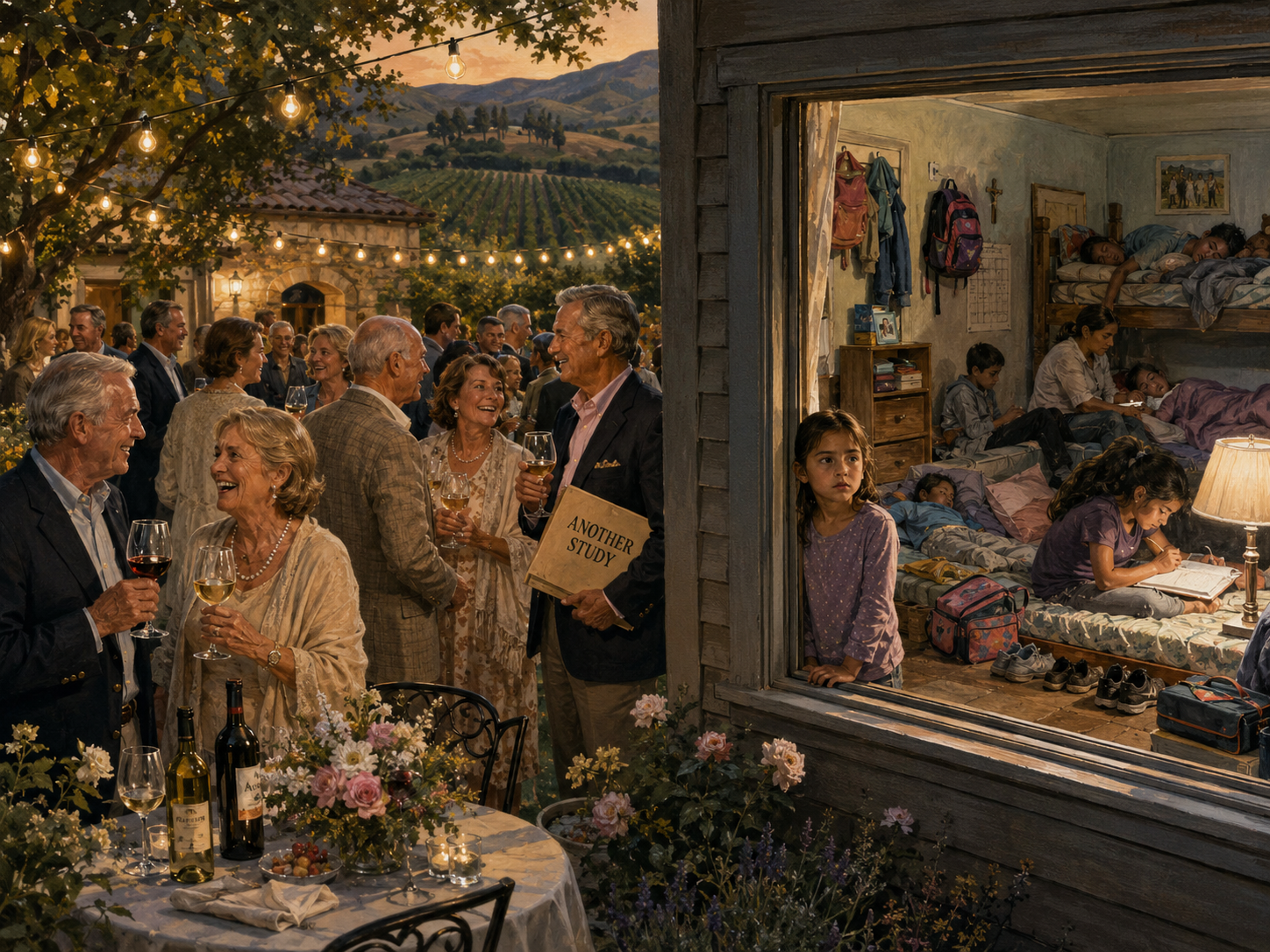
While Yountville raises a glass to itself, hundreds of Napa County children are still sleeping in someone else’s bedroom.
Summary: Napa County schools counted 832 homeless students last year, more than double the figure from five years ago, and four in five of them are living doubled up with relatives or other families. Working from Tim Carl's reporting in Napa Valley Features, this essay sets that number beside the state's new population data, which show every Napa County town shrinking except Calistoga, the one town that opened a workforce housing project. Yountville's planned Commons would not solve the valley's shortage; the point is that no single project would, and that housing gets built one parcel and one phase at a time. The essay argues that after a certified Housing Element, a voter mandate, and years of Council planning, the recurring call for "another study" is not a request for information but a another request for endless delay without addressing such an obvious crisis. It closes by crediting Carl and asking readers to subscribe to his newspaper.
Eight hundred thirty-two children in Napa County's public schools had no home of their own last year. Most of them slept in somebody else's house. A grandmother's back bedroom. A cousin's couch. They got up in the morning, went to class, and gave the front office an address that was not theirs.
Nobody called a press conference. The number sat in a school district file, open to anyone, and for a year it attracted remarkably little attention. The week it finally surfaced in the local press, another paper led with a garden party.
The man who opened the file is Tim Carl. He runs a small paper called Napa Valley Features, mostly by himself, and for the Upper Valley it is one of the few places where somebody still seems willing to read the state spreadsheets, follow the footnotes and tell readers what they actually say. This week it was the children. This column is about what his last two reports say when you set them side by side, and about what those numbers mean for a valley that has spent years studying a problem it already understands.
The children
Napa County schools identified 832 students as homeless last year. Five years ago the number was 369. Four out of five of those children are not living on the street. They are doubled up, meaning their family lost its own place and moved in with relatives or another family. The federal school definition has counted those children as homeless since 2001, so this is not some new trick with words. It is the same definition, and many more children now fall under it.
Most of those families probably would not describe themselves as homeless. They have jobs. A parent may work at a resort, a winery, a restaurant, a school, a hospital or one of the businesses that keep Napa Valley functioning. Many earn too much to qualify for deeply subsidized housing and too little to rent or buy a home of their own in the communities where they work. They are part of the larger population California's housing mandates are intended to keep from being priced completely out of places like Napa Valley. In Yountville, a substantial portion of the housing the state has required the Town to plan for falls squarely in that middle-income range.
Those 832 children go to school in Napa Valley Unified. That is the same district that closed Yountville Elementary in 2020. The Town bought the empty school site in 2024. The Commons was planned on that ground.
The one town that grew
In May, Carl read the state's new population numbers. California shrank. Napa County shrank. Napa city shrank. St. Helena shrank. Yountville shrank the most of anyone, losing 51 people which was a combination of the CalVet population continuing to decline and more existing homes being turned into vacation rentals. One town in the county grew, and it was Calistoga.
Calistoga grew because it opened one building: 78 workforce apartments on Lincoln Avenue, paid for partly by a small hotel tax that Calistoga voters approved in 2018. Hotel guests paid. Working families moved in. The town got bigger. Carl, who has hardly been a cheerleader for the North Bay housing pipeline, nevertheless wrote that the model "functioned as designed."
So here is the county in one sentence. The town that built housing grew, while the towns that did not build enough housing continued to lose people.
The dent
Now comes the part that deserves to be understood clearly.
Suppose the petition to repeal the zoning for the Commons had never been filed. Suppose the Town could build all 75 two-bedroom apartments in the design tomorrow and hand out the keys by Friday. Line up the 832 children from Carl's report in the old school gym. Give an apartment to the first 75 families in line. Then turn to everyone else and explain that hundreds of children are still sleeping in somebody else's house.
That arithmetic is not an argument against building 75 homes. It is the argument for building them. Housing shortages are not solved by discovering one magical project large enough to erase decades of scarcity. They are solved the ordinary way: one parcel, one building, one phase and one town at a time. Calistoga built 78 homes. Yountville proposed 75. Neither number fixes Napa Valley. Both numbers matter.
The Commons was never going to solve the valley's housing crisis by itself. It was going to make a meaningful dent in it. It would have provided homes for middle-class households on land the Town already owned, inside a larger civic project that preserved most of the site for open space, public uses and community amenities. It was designed to be built in phases as financing allowed, adapting over time without bargaining away the quality of the place itself.
That effort did not begin with the Commons. In 2018, Yountville voters approved the measure supporting middle-class workforce housing by roughly 74 percent. That vote established something important: residents wanted people who worked in Yountville to have a realistic chance to live in Yountville. But the vote did not design the Commons, choose the school site or create the plan that followed. Those decisions required a Town Council willing to take the public mandate seriously and turn it into an actual project.
The Commons was the result of that work. The current Town Council took a broad community direction and tried to put it on the ground. It acquired the school site, conducted years of public outreach, commissioned planning and design work, examined financing and infrastructure, and produced a phasable civic plan that included housing as one part of a much larger public place. That distinction matters. Voters supplied the mandate. The Council supplied the vision and did the difficult work of turning an idea into something that could actually be built.
And then 235 signatures, about one voter in ten, put that work on hold last spring.
The oldest trick in the book
There is nothing wrong with studying a difficult problem. Serious public projects should be studied. The question is what remains unknown.
Yountville's Housing Element has been studied and certified. The regional housing allocation has been calculated. Consultants have measured demand. Financing specialists have modeled costs. The Town has spent years on planning, design, environmental review and public meetings. Meanwhile, the evidence outside Yountville keeps getting harder to ignore: the county is shrinking, the one town that recently added a meaningful block of housing grew, and 832 children in the local school district are living without homes of their own.
"Another study" is not a request for information. It is a cynical play to delay building housing that people need, and to delay it indefinitely. Nobody has to say no. Nobody has to identify land, money, buildings or a construction date. You simply say the issue deserves more study. It is the public-policy version of "let's grab lunch sometime." Everyone can agree to it, nobody has to commit to anything, and a year later everyone can be exactly where they started.
A study names no land, commits no money, builds no housing and houses no child. That does not make studies useless. It simply means that after years of analysis, anyone asking for another one should be able to explain precisely what question remains unanswered and what decision the answer will change.
Otherwise, the study becomes the decision.
Yountville has been discussing middle-class housing since well before the school site became available. Its voters endorsed the goal in 2018. The Town Council eventually turned that goal into the Commons through years of planning and public work. Eight years after that vote, the underlying problem has not become more theoretical. It has become more visible.
The children are still sleeping at their aunt's house.
Credit where it is due
Tim Carl is the reason any of this is getting legible to the local population. He did the work. He showed his sources. He read the fine print and told readers what it said. That is what local journalism is supposed to do, especially when the numbers are uncomfortable or inconvenient. This week he added the children to the record. He deserves to be read.
Napa Valley Features runs on subscriptions and little else. If you read one local paper for the Upper Valley, make it his:https://www.napavalleyfeatures.com/. It costs less than the wine you just purchased at the local garden party.
Eight hundred thirty-two children. Seventy-five apartments, on hold. And somewhere this month, a well-dressed person in Yountville will raise a glass and with a smile in her eye, suggest one more study.
Disclosure: The author is an architect and principal at Kelly + Morgan Architecture and served as Owner's Design Consultant on the Yountville Commons for approximately two years. That engagement is complete. He writes here as a private citizen.
Sources: Tim Carl, "Under the Hood," Napa Valley Features, May 14 and September 3, 2026; California Department of Finance E-1 Population Estimates, May 2026; Town of Yountville 2023–2031 Housing Element, Table E-1.
