
Yountville Is Not For Sale #9: Yountville Deserves Better. Better Than This Mailer, for a Start.
A glossy card arrived this week with no candidate, no proposal, and a photograph of a building that does not exist. We read it so you would not have to, though you probably did, after you read the rest of your junk mail.
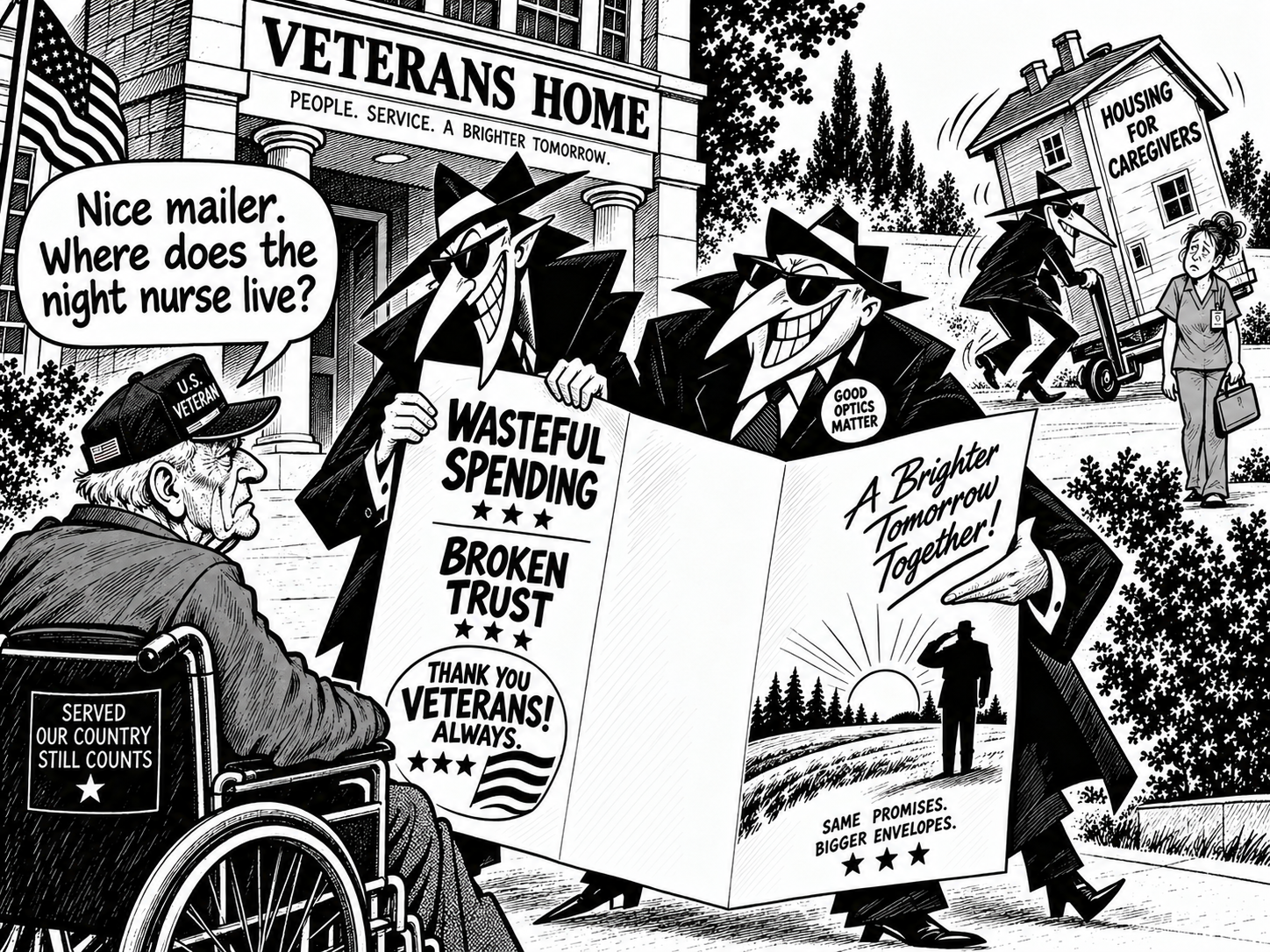
The people behind this mailer are betting that Yountville voters will be impressed by big promises, patriotic slogans, and a thank-you to veterans. They may be underestimating their audience. Veterans and longtime residents have seen plenty of political mail. They know the difference between a false promise and a real plan.
The card in your mailbox
Somebody spent real money this week to put a glossy tri-fold in every mailbox in Yountville, and the least we can do is take it seriously for a few minutes before deciding whether it deserves the blue bin or the black one.
The front announces, in large type, that Yountville Deserves Better. Inside, Wasteful Spending appears in letters big enough to read from across a tasting room, accompanied by four tidy icons of the kind that come free with the software: a dollar sign, a magnifying glass, a clipboard, and two hands shaking. Beneath them are four complaints: wasteful spending, lack of transparency, poor priorities, and broken trust. Each complaint gets one sentence, and each sentence repeats the complaint in more words. Tax dollars should be used wisely. Decisions should be made in the open. Leaders should listen. No member of the Town Council has ever campaigned on a platform of reckless spending, secret government, bad priorities, and deliberate betrayal, so the card is, technically speaking, a list of things everyone in town already agrees with, printed in the colors of a wine you cannot afford.
The building that is not there
The fun begins with the photograph. It shows a handsome timber sign reading Yountville Commons, a smaller sign beneath it reading Community Center, an arrow pointing toward a curving drive, a flagpole, and a lodge with a broad glass gable that looks like what would happen if a ski resort designed a public library after a long lunch. None of it exists. More to the point, none of it was ever proposed. The actual site is the former elementary school on Yount Street, where the old snack shack is now the Farmstand, the old library is now Yountville Fit, the dog park is in daily use, and the remaining school buildings look exactly like what they are, which is old school buildings waiting for their next chapter.
The mailer confesses in the fine print, where California law makes it confess: Ad generated or substantially altered using artificial intelligence. So the principal image on a card accusing the Town of wasteful spending is a computer-generated picture of a building the Town never designed, professionally printed and delivered at bulk rate to every voter in Yountville. If you are looking for a working definition of unnecessary spending, it is glossy, it is two-sided, and it is currently lying next to your grocery coupons.
Below the imaginary community center, the card pauses for something solemn. Thank you to our amazing veterans. Your service. Our gratitude. Always. The veterans are thanked twice, once in italics and once with a decorative star, which turns out to be the full extent of the mailer's policy for them. We will come back to that, because the California Veterans Home is not a prop. It is the town's defining institution, its largest employer, and a place whose future depends on the same housing problem the mailer has reduced to an icon.
Who signed the check
The most revealing part of the card is the smallest. At the bottom it reads: Ad paid for by Build a Better Yountville, Sponsored by The Club Yountville, LLC. Not authorized by a candidate or a committee controlled by a candidate.
That last sentence is doing a lot of work. The mailer names no candidate, endorses no measure, and identifies no proposal. It tells us something has gone badly wrong in Yountville, reminds us to vote on November 3, and declines to say for whom or for what. This is the political equivalent of a man standing in the middle of Washington Street waving both arms and shouting that something terrible is happening. Ask him what, and he gestures at the horizon and says, in effect, you know.
We wondered what The Club Yountville, LLC might be, and the honest answer is that an LLC filing tells the public exactly as much as its organizers are required to tell it. The Moon has already reported at length on the people and the money behind the petition and the broader effort to stop the Commons, and readers can draw their own line from the fine print to the record. We will merely observe that the card's burgundy and gold would not look out of place on a private wine club brochure, and leave the interior decorating to the reader.
The plan nobody wrote down
The larger omission is not who paid for the card but what the card proposes, because it proposes nothing, and that is the entire argument. The complaint is that the Town has spent too much. The implied cure is to stop spending. The quiet next step, the one that never appears on a mailer because it would lose an election, is what happens to 7.5 publicly owned acres in the middle of one of the most expensive small towns in California once the Town decides it has no further use for them.
Yountville bought the school property in 2024 for $11 million. It is flat, served by every utility, central, and rare. A private developer looking at it does not see a creek walk, gardens, civic buildings, and homes for people who work in town. He sees one of the last developable parcels in the Napa Valley. Forty expensive houses are not hard to imagine. A guest cottage behind each one is not hard to imagine. Buyers whose primary residence is somewhere else are the easiest thing in Yountville to imagine, because the town already has more experience with that model than with any other. A developer could build beautiful houses, sell them for extraordinary sums, and make a perfectly rational business decision while adding almost nobody to the number of people who live and work here year-round. That does not make the developer wicked. It means the market has one set of incentives and a town has another.
The people demanding a different future for the Commons never describe that future with the precision they demand of the Town. If the public plan is wrong, they owe the town the replacement. If the site should not stay a civic asset, they owe the town the alternative. If the complaint is spending, they owe the town a sentence about what to do with land it already owns. The card has a clipboard icon instead.
The law that reads the fine print
There is a further problem with the daydream of a future Council quietly selling the place and getting the money back, and the problem is that California wrote a statute for exactly that daydream. It is called the Surplus Land Act, Government Code section 54220 and following, and it governs what a city or town may do with public land it says it no longer needs despite RHNA assessments and the obvious housing crisis throughout Napa County. The law exists because the State does not want valuable public ground converted into private subdivisions before public agencies and middle class housing builders have had their turn. Any candidate proposing that idea should be asked, on the record, whether they have read the statute, and if the answer is yes, whether they enjoyed the part where the State of California takes 30 percent of the sale price as a penalty and the affordable housing requirement stays on the deed anyway.
Before the property could be sold, the Council would have to declare it surplus in public, with written findings. The Town would then issue a formal Notice of Availability through a state-regulated process, and the notice does not go to a broker. It goes to the State, to every public agency in the county, and to every certified housing sponsor that has asked for surplus public land. Somebody would answer, because seven and a half flat, serviced acres in Napa County are not gathering dust. If an eligible party responds, the Town must negotiate in good faith for a prescribed period rather than pretend to negotiate while a preferred buyer waits in the parking lot. Even if negotiations fail, the statute can attach affordability requirements to any later residential development on the ground. The Department of Housing and Community Development reviews the transaction and carries real penalties.
Anaheim learned all of this during the attempted sale of the Angel Stadium property, the most prominent Surplus Land Act fight in California. Yountville is not Anaheim and the Commons is not a ballpark, which is precisely the point. If the State was willing to step into a transaction involving hundreds of millions of dollars and a Major League Baseball team, nobody should assume seven and a half acres of public land in the Napa Valley can slide across a closing table because a future Council changed its mind.
What the land already owes
The school property also carries a history the mailer would rather you forgot. Measure S, the one percent hotel tax surcharge approved by 74 percent of Yountville voters in 2018, was written to address the town's workforce housing problem, and more than $3 million from that fund went into buying the site. The property came from a school district through a public disposition process that itself gave preference to public agencies. After the June repeal of the Commons zoning, the site did not become unregulated dirt waiting for a subdivision map. It remains in a zoning category that permits public and civic uses, including publicly owned housing, through the Town's own land-use process.
The public bought the land, with public purposes attached to the purchase, and it sits under layers of state and local law designed to keep public land doing public work. None of this fits comfortably under a dollar-sign icon, which may be why the dollar-sign icon was chosen.
The woman with the breakfast tray
Now, the veterans. The Veterans Home does not run on gratitude. It runs on people. Nurses, nursing assistants, cooks, drivers, groundskeepers, orderlies, therapists, the aide who helps a man out of bed in the morning and the one who answers the call light at three. Roughly a thousand people work there, and very few of them can afford to live in Yountville. That is not a talking point invented for the Commons. The Town's own housing work documents it, and so does every hiring manager at the Home.
Consider a nursing assistant earning about $20 an hour, or $41,600 a year before taxes. There is no version of the Yountville rental market in which she can live near the people she serves. So she commutes, from American Canyon or Vallejo or farther. She drives in before dawn, spends a shift caring for veterans, and drives home after dark. On the way in she passes hotels where a room costs $821 a night. On the way out she passes houses whose owners will be back on Friday. That is not an accusation against hotel guests or weekend owners. It is the economy Yountville built, and it has consequences.
The Commons was one attempt to face that without handing the school property over to housing alone. The plan used a limited share of the site for homes and kept most of the land for the public: open space, gardens, Hopper Creek, walking paths, civic buildings, and places to gather. The homes were meant for the middle-class people who make Yountville function: teachers, hospitality workers, Town employees, health care workers, and the staff of the Veterans Home. It was not a plan to solve the Bay Area housing crisis. It was not a plan to make Yountville unrecognizable. It was a modest, phased attempt to build some homes for people who work here on land the public already owns, while keeping most of that land open to everyone.
Gratitude, printed
That is why the veterans message deserves more attention than the people who designed it intended. The same political effort that fought the Commons now sends the veterans a printed thank-you while calling the spending that would have housed some of their caregivers Wasteful. The Home does not run on printed gratitude. It runs on the woman with the breakfast tray, the aide at the call light, the nurse on nights, and the maintenance man fixing the wheelchair lift. Every year those workers drive farther to get here, every year they are harder to hire, and every vacant position lands on a resident. The Commons would not have solved that. It was one concrete answer to it. Calling that answer Wasteful Spending on one side of a card and printing Our Gratitude. Always. on the other is not a policy position. It is a bribe made of ink, and the people it is aimed at have been thanked by professionals.
Still waiting for the better idea
The final problem with the mailer is the absence of an alternative. We looked. There is a list of qualities the sender would like in a leader: listens, manages, plans, delivers. Those are fine qualities. There is nothing to manage, no plan, nothing to deliver, and no sign that the sender has sat through a dozen public comment periods or the thankless, unseen work a Council member takes on with the oath of office. If the Town spent too much on the Commons, the card owes us the item it should have skipped. If two years of community meetings, design work, environmental review, budgeting, phasing, and public hearings produced the wrong answer, the card owes us the right one. There was plenty of room for it where the imaginary building went.
This is where the mailer accidentally gets one thing right. Yountville does deserve better. It deserves better than slogans without proposals. It deserves better than computer-generated pictures of buildings nobody designed. It deserves better than the pretense that a hard argument about housing, public land, municipal finance, veterans, and the future of a small town fits under four icons and a burgundy headline. It also deserves elected officials who can be criticized when criticism is earned, because no public project should be above scrutiny. But serious criticism has to do more than name a mood. Sooner or later it has to answer the question every architect, builder, business owner, and homeowner already understands: if not this, then what.
Tired is the strategy
The real danger in Yountville right now is not wasteful spending or broken trust. It is exhaustion. People are tired of the petition, tired of the hearings, tired of the arguments, tired of being told the town they love is about to be ruined or rescued depending on which postcard came that afternoon. Campaigns understand fatigue, because tired voters stop asking the second question. They see BROKEN TRUST in capital letters and assume somebody must know what it means. They see WASTEFUL SPENDING and forget to ask compared with what. They hear that Yountville deserves better and do not notice that nobody has said what better looks like. A tired voter reads four icons, nods, and stays home. That is the plan. It is the only plan on the card.
Go look at the model
The antidote is not another slogan. It is memory. In 2018, nearly three-quarters of Yountville voters approved a tax to help house the middle-class people who work here. The Town bought the school site. Residents spent two years arguing over what should happen there. The plan that came out was not perfect, because no public plan is, but it was real. It was detailed. It was phased. It kept most of the property for civic and public use and allowed a limited amount of middle-class housing to be built in increments as financing allowed. The quality of the place was never negotiable. The pace was, on purpose. That is what planning looks like when a town is trying to solve a hard problem without pretending it can predict the future.
One side of this argument has drawings, budgets, acreage, public meetings, environmental review, financing studies, a phasing strategy, and an actual piece of land you can walk across this afternoon. The other side has mailed every voter a picture of a building that does not exist. That does not make the Commons plan right in every particular, and it does not make every critic wrong. It does set a useful minimum standard for the next seven weeks. Anyone who wants Yountville to choose a different future should have the nerve to describe it.
Keep the mailer if you still have it. Then go to Town Hall and stand over the site model. Compare the two. One is the product of two years of public argument, compromise, design, revision, and civic work by your neighbors. The other was generated by a computer for people who would rather you stayed tired and indifferent. This town has already decided what it wants to be. It voted for it, bought the land for it, and drew it. On November 3, the only thing left is to stop apologizing for it and vote for the people who will start building it.
☾
Brendan Kelly's firm, Kelly + Morgan Architecture, served as the Town's Owner's Design Consultant on the Yountville Commons project. That scope is complete. The Yountville Moon is independent, free to everyone, and accepts no advertising or fees. The Moon will be reporting on the Candidates Forum on September 21.
Thank you to the hundreds of people reading, including the three of you who disagree with us. Disagreement is not the opposite of community. Indifference is. Stay informed. Read the Moon.
