
What Yountville Is Really Voting On
Gary Jabara can throw all the parties he likes. The consequential business of Yountville will happen later, under fluorescent lights at Town Hall, when he asks permission to significantly alter a landmark building that has defined this town for 156 years.
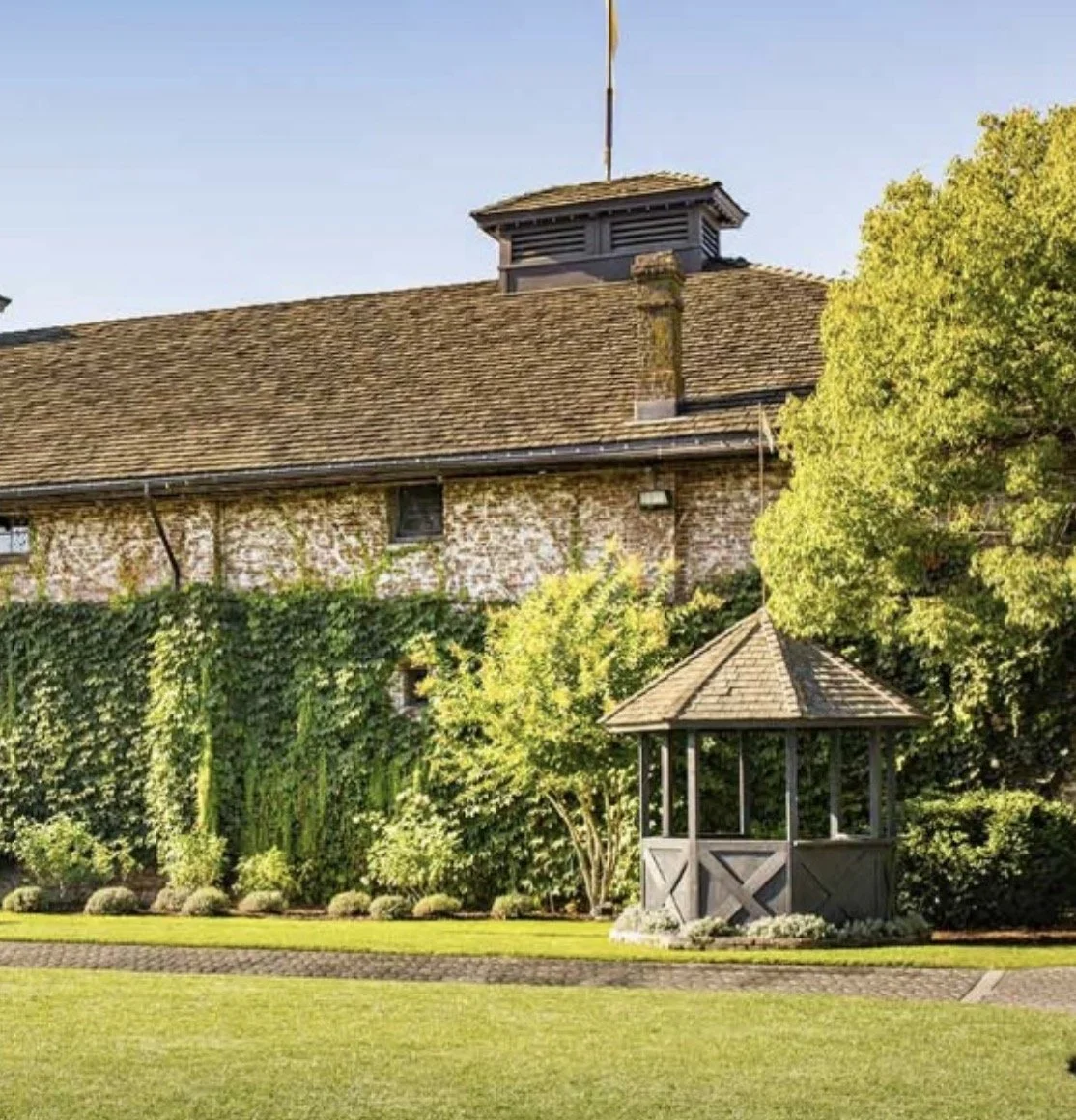
The building is not merely old. The Groezinger Wine Cellars has been listed on the National Register of Historic Places since 1982, recognized for its significance to architecture, commerce and industry in the Napa Valley.
There is an old political expression, so old that we inherited it from Rome, about keeping the population content with bread and circuses. The idea was not that food and entertainment were bad. Romans presumably enjoyed a good afternoon out as much as anybody. The point was that spectacle could become a substitute for citizenship. Keep people fed, entertained and pleasantly occupied, and they might pay less attention to the considerably duller places where power was actually being exercised.
Yountville has developed its own rather more agreeable version. There are dinners, concerts, grape stomps, cowboy parties, invitations to veterans and, most recently, Oktoberfest. There is bratwurst. There is beer. There is music. There are photographs afterward of neighbors having a wonderful time together. Gary Jabara has every right to throw these parties, and the people who attend them have every right to enjoy themselves. I hope the bratwurst is excellent.
But bread and circuses were not invented because bread was sinister or circuses were unpleasant. They worked precisely because both were enjoyable.
The consequential question in Yountville this fall is therefore not whether Gary Jabara throws a good party. It is not even, ultimately, whether you like Gary Jabara. It is what happens after the music stops, the folding tables disappear and several hundred people who have spent a pleasant evening together go home. Because sitting quietly in the middle of the property Jabara now controls is one of the most important historic buildings in Yountville, and an application has been submitted proposing to change it in ways that deserve vastly more public attention than any campaign party has yet received. His application to turn Vintage 1870 into a ballroom is a public document and can be found here on the Town website. Every resident who cares about this Town should take a moment and look at the materials.
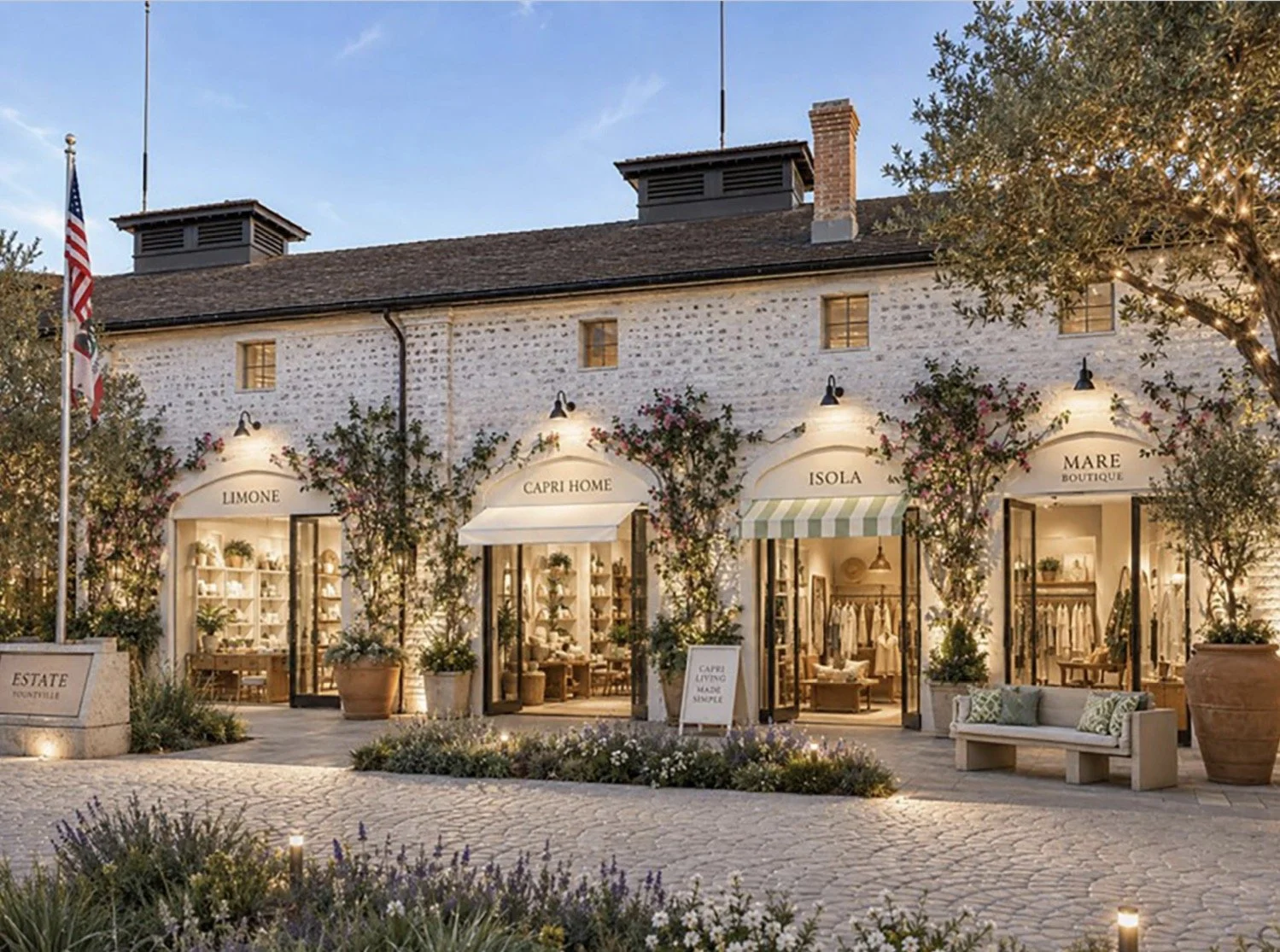
The Groezinger Wine Cellars survived 156 years without needing to pretend it was a Mediterranean shopping village. The proposal cuts new arched storefronts through its historic masonry, closes original winery openings, and turns one of Yountville’s most authentic buildings into a backdrop for luxury retail. This is the picture Gary Jabara has officially submitted as part of his application to alter Vintage 1870.
Again, that building is Vintage 1870, the historic Groezinger Wine Cellars, listed on the National Register of Historic Places in 1982. And what happens to it will not be decided at Oktoberfest.
It will be decided by local government and the state of California as to how the Historical Building Code is used or not used to modify this important landmark.
Before there was a Yountville to sell
Walk down Washington Street and look carefully at the long east wall of Vintage 1870. Do it before anyone changes it.
The brick has been there since 1870. It is not decorative brick pasted onto a commercial building to make the place look old. It is the building. Gottlieb Groezinger, a German-born wine merchant, established one of California's substantial early winery operations there. The surviving cellar was part of a working agricultural complex that included a distillery, barns and stables, a creamery, a steam plant and a family residence. Wine was produced there under successive owners until the middle of the twentieth century.
The architecture tells you what the building did. The walls are thick because wine cellars had to stay cool. The east elevation is mostly solid because holes in a wall admit heat. Its small windows sit high in the masonry to help with venting. The large working openings are elsewhere, where barrels and equipment had to move. None of this was designed by a branding consultant. Nobody in 1870 was wondering how the wall would look on Instagram. The appearance of the building emerged from its work, its climate, its materials and the accumulated intelligence of people who knew how to make wine in Napa Valley without air conditioning.
That is why the wall is beautiful.
It is also why changing the openings changes more than an elevation. A historic industrial building is a document. The relationship between masonry and opening, solid wall and door, tells us how the building worked. Erase enough of that evidence and the document may still be standing, but we have edited its sentences.
The Groezinger Wine Cellars were listed on the National Register of Historic Places in 1982 for their significance in architecture, commerce and industry. Today the Town itself identifies the property as one of Yountville's National Register historic resources.
That designation came after perhaps the most important chapter in this story, because the building survived not because somebody preserved it under glass, but because a few people figured out how to give it another life.
What the Montes understood
By the 1960s, the winery was finished. The property was an enormous obsolete industrial complex in a little agricultural town with a few hundred residents, the Veterans Home up the hill and almost none of the restaurants, hotels or visitor economy we now regard as inevitable.
Nothing about what happened next was inevitable.
In 1966, Ray and Nancy Monte sold their cattle herd and part of their own property and bought approximately 22 acres of the old winery. Their partners were Ruth and Jim Wagner, Pam and Mike Soper, and Mortimer Bennett. They gave the place a name that acknowledged rather than disguised its origin: Vintage 1870.
The work was grubby before it was glamorous. Industrial debris had to be hauled away. The Monte children helped clean the place. There was no luxury-hotel market in Yountville waiting to reward them and no established destination economy assuring them that boutiques and cafés inside an abandoned winery would succeed. This was a family and a few partners putting their own money into a difficult old building because they believed the building itself was worth something.
In 1967 they brought Don Schmitt and his family from Fresno to help develop and manage the new project. Sally Schmitt opened the Vintage Café there and later the Chutney Kitchen. Vintage 1870 opened in 1968 with a handful of stores and two cafés. Sweet n Sassy became Yountville's first clothing store. A wine shop followed. Jean Phillips eventually operated The Little Dress Factory there. The complex became one of the earliest major visitor-oriented developments in Yountville, before the luxury hotels and before this town became internationally identified with eating and drinking well.
The Schmitts eventually carried the same idea farther up Washington Street. They found another old working building, a former French steam laundry, adapted it into a restaurant and kept the building's name. The French Laundry opened in 1978, long before Thomas Keller arrived on the scene.
It is difficult now to imagine Yountville before any of this because the lesson proved so successful that we mistake the result for destiny. Old agricultural buildings became restaurants. Old industrial buildings became shops. Their imperfections became assets. People came here precisely because Yountville did not look as though it had been invented last Thursday by a hospitality company from Orange County.
That inheritance began with people who understood a wonderfully simple rule: you could change what happened inside an old building without changing the story the building told outside.
The remarkable thing they did not do
This is the part of the Vintage 1870 story that matters now.
The Montes radically changed the use of the Groezinger complex. They converted wine production into retail and restaurants. That is adaptive reuse in its purest form. But they did not decide that an old wine cellar needed to look more like a shopping center in order to become one.
They did not cut a picturesque succession of new arched storefronts into the long east wall. They did not invent architectural history. They did not transform an industrial building into someone's idea of a Mediterranean village. They did not ask the building to pretend that it had spent the nineteenth century selling resort clothing.
They changed the economy inside and preserved the evidence outside.
That distinction is one reason the building could subsequently be placed on the National Register. The official listing records a nineteenth-century winery whose contemporary uses included restaurants and specialty stores. In other words, the new commercial life did not disqualify the old building. The commercial life helped save it.
That is the paradox preservation gets right when it works. The choice is almost never between freezing a building in 1870 and allowing it to participate in 2026. Old buildings survive by being useful. The difficult and intelligent work is finding new uses that can inhabit the old architecture without requiring the architecture to lie about what it was.
For more than half a century, Vintage 1870 has demonstrated that this can be done.
Now compare that history to what is being proposed.
The wall
There are two images at the start of the essay, and in a sense the whole issue fits between them.
One is the Groezinger Wine Cellar as Yountville knows it: weathered brick, ivy, high square windows, long stretches of masonry, a utilitarian roof, cupola and chimney. The other is a rendering submitted with Gary Jabara’s current application. The wall is presented as a much more conventional retail frontage. New arched openings appear in the historic masonry. Shop windows glow from inside. The old industrial wall has been made more accommodating to contemporary merchandising.
A sandwich board in the rendering says, “Capri Living Made Simple.”
It is an unexpectedly useful caption because it explains the problem better than a hundred pages of architectural vocabulary could. The proposal is no longer asking the retail operation to adapt itself to the historic building. The historic building is being asked to adapt itself to the retail operation.
The applicant's own historic analysis identifies the masonry walls, their pilasters, the small first-story windows and the historic working openings as character-defining features. That is architectural language for the things that make this building unique. The pattern of wall and opening is not incidental decoration. It is the evidence of how the cellar functioned.
The proposal creates new openings where the historic building did not have them while closing original openings elsewhere. That is a curious approach to preservation. The doors that tell the truth disappear and doors that tell a more commercially convenient story appear in their place.
Once 1870 brick is removed, it is removed. The applicant's historian acknowledges that future restoration would involve filling the openings with matching brick. Matching brick may be excellent brick. It may be indistinguishable to most visitors. But it will not have been laid there in 1870. There is a difference between restoration and replication, and there is no preservation technique yet invented that can manufacture another 156 years.
This is not an argument that the building can never change. It is an argument that changes to a National Register property should begin with the building rather than with the merchandising plan.
Main Street, Disneyland
There is a familiar architectural trick in Southern California. Take some fragments of historical vocabulary, clean away the inconvenient messiness of actual history, make every storefront inviting, make every opening picturesque, coordinate the finishes, and produce something more emotionally satisfying than an actual old building ever managed to be.
Disneyland's Main Street does it brilliantly.
But Main Street works because it never had to survive a harvest, hold wine barrels on a 100 degree day or make payroll. It is a stage set of collective memory. Its job is to look more convincingly historic than history itself.
The danger at Vintage 1870 is the opposite process. We have an authentic building and risk turning it into the stage set.
That should bother people across every faction in Yountville because authenticity is not merely an aesthetic preference here. It is one of the foundations of the town's economic value. Millions of visitors can buy expensive dinners, wine, clothes and hotel rooms in new buildings anywhere in California. One reason they come to Napa Valley is that the commercial experience still occurs among evidence that something was here before the visitors arrived and it was unmistakably connected to the working landscape that remains protected. More protected perhaps than the historic industrial buildings that made it so valuable for succeeding generations.
If we gradually convert that evidence into just more pleasant shop fronts, we will eventually discover that Yountville can be built anywhere.
And upstairs, a ballroom
The storefronts are what people will notice from Washington Street. The larger economic purpose of the proposal appears upstairs.
Gary Jabara proposes an event or banquet space on the second floor, with a commercial kitchen, bar and associated lobby areas. The project materials describe the need for an indoor venue capable of accommodating events currently served by temporary facilities. The submitted calculations contemplate assembly occupancies numbering in the hundreds. That creates a second issue that should be considered entirely independently from whether anyone likes the storefront design: structure.
This is an old unreinforced masonry building in earthquake country. The application materials reviewed for this essay name a structural engineering firm, but the submission described here contained no completed structural survey, seismic evaluation, strengthening drawings or comprehensive explanation of what interventions would be necessary to accommodate the proposed assembly use.
That matters because structural reinforcement is not invisible magic. Strengthening historic masonry can involve anchors, diaphragms, frames, shear elements and connections between walls, floors and roofs. Those things may be entirely achievable. They may even be beautifully done. But nobody can responsibly determine their preservation impact before knowing what they are.
Yountville should want the ballroom question, the structural question and the historic-preservation question considered together rather than considering altering the historic exterior and discovering the difficult parts afterward.
The Napa Valley has already received its reminders about unreinforced masonry. Earthquakes do not care about AI renderings.
Now we can talk about the election
This is where the November election becomes relevant, but perhaps not in the way campaigns normally encourage us to think about elections.
Yountville elects a mayor and two council members on November 3. The Town's candidate list includes Marjorie Mohler and Joe Tagliaboschi for mayor and multiple candidates for the two council seats.
A political committee called Build a Better Yountville has filed independent-expenditure reports with the Town. The committee is sponsored by The Club Yountville, LLC, associated with Gary Jabara, and has spent money supporting candidates in the current election. The Town publishes those filings separately from the candidates' own campaign reports, an important distinction because an independent expenditure is not the same thing as a candidate contribution and does not establish coordination or any promise of a favorable future vote.
Those limitations matter. Nobody should write a candidate's future vote before the candidate casts it. Nor does political spending, by itself, prove why somebody spent the money.
But the public does not have to ignore the institutional relationship staring it in the face.
Gary Jabara is not merely somebody with opinions about Yountville government. He has substantial commercial property interests in Yountville. An application affecting Vintage 1870 is now before the Town. Land-use decisions can determine what a property may contain, how intensively it may operate and what physical alterations may be made to it. The Town Council also has an appellate role in planning matters; the Town expressly informs applicants and opponents that decisions of the Zoning and Design Review Board or Planning Department may be appealed to the Council.
That makes council membership consequential to every large property owner in town, not just Gary Jabara.
It is therefore perfectly legitimate for voters to ask candidates something much more specific than whether they favor “business” or “preservation,” two words broad enough to conceal almost any position. What standards would they apply to alterations of a National Register property? How much original historic fabric are they prepared to sacrifice for an updated commercial use? Would they require structural impacts to be understood before approving architectural changes? What does compatibility mean when a use does not fit neatly within an existing zoning category? What evidence would they require before making those findings?
Those are not gotcha questions. They are the job.
Bratwurst is easier
And now we return to Oktoberfest.
Community parties are easy to understand. You arrive. Someone hands you something to eat. A band plays. You run into people you know. Veterans are welcomed. Somebody says a few words about community. At the end everybody agrees that Yountville is a lovely place.
Municipal government is the opposite. It is documents, findings, structural calculations, zoning language, environmental rules, appeals, public testimony and occasionally several terrible hours in uncomfortable chairs while people argue about six feet of setback. There is no band. Nobody hands you a beer when you enter Town Hall. The reward comes years later when you walk down a street and realize that the place still feels like itself.
That is why bread and circuses remain such a useful warning two thousand years after Rome.
The danger is not that the person providing the bread is secretly poisoning it. The danger is that consuming it is so much easier than governing yourselves.
Gary Jabara is entitled to be generous. He is entitled to entertain his neighbors, support candidates, advocate for his property and make the strongest case he can for changing Vintage 1870. The people who oppose those changes are equally obligated to make their case from facts rather than suspicions. But Yountville's residents have a different obligation. They have to pay attention after the party.
The inheritance
Think about the unlikely chain of people who had to exercise restraint for this building to reach you intact as a landmark building.
Gottlieb Groezinger built a working winery in 1870. Generations used it for the thing it was built to do. When that economy changed, Ray and Nancy Monte saw value where other people might have seen demolition. They sold cattle, invested their own money, cleaned the old winery with their children and gave the building another purpose. Don and Sally Schmitt helped create something inside those walls that had scarcely existed in Yountville before. Their experiment helped establish the commercial culture from which modern Yountville eventually grew.
The remarkable feature of that history is not that nobody changed anything. Everybody changed everything. They changed the use. They changed the businesses. They changed the economics. They changed Yountville itself.
What they did not casually change was the building that made the place different.
Ray and Nancy Monte sold their cattle to save an obsolete winery when there was no obvious fortune to be made from doing it. Fifty-eight years later, nobody has to speculate about whether the gamble worked. Vintage 1870 sits on Washington Street in one of the most valuable hospitality towns in America. The building that once looked economically obsolete became economically irreplaceable. That is the inheritance sitting before the next Town Council.
The question is not whether Yountville must remain frozen in 1870. The Montes answered that question in 1966. It plainly does not. The question is whether the next generation possesses the same intelligence about change that the previous generation demonstrated: new uses without invented history, new prosperity without erasing the evidence of the old economy, and commercial ambition disciplined by the understanding that certain things become valuable precisely because nobody can build them again.
This election will eventually be over. The signs will come down. The committees will file their final forms. The bratwurst will be eaten, the beer will be gone, and the campaign parties will become photographs. Someone will be mayor, two people will take council seats, and the intensely personal arguments of 2026 will begin their migration into local history. What will not disappear is the authority those people will hold over the future of Yountville, including decisions about one of its most important historic buildings.
Gary Jabara has made his political preferences public. He has backed candidates, spent money to support them, and at the same time advanced plans affecting the National Register-listed Groezinger Wine Cellars. There is no need to speculate about a hidden motive when the relevant facts are already in public view: he owns the property, he wants changes approved, and he has chosen to participate aggressively in the election of the officials who may ultimately sit in judgment of land-use questions affecting that property. That does not tell us how any candidate will vote. It does tell voters exactly why the composition of the next council matters.
The question before Yountville is therefore not abstract and it is not merely political. It is whether the people elected in November will treat the Groezinger Wine Cellars as an irreplaceable historic resource whose alteration demands extraordinary care, or whether they will be more receptive to remaking it around the commercial ambitions of its current owner. Residents do not get to vote directly on the proposed openings in the brick, the ballroom, the seismic work or the preservation findings. They vote for the people who may eventually decide those things.
That is the real ballot measure.
By the time the public understands what has been lost, the campaign will be long over. The brick will not grow back. The original openings will not reappear. A National Register-listed building can survive a change of ownership, a change of use and even a change of economy, as the Montes proved more than half a century ago. What it cannot survive indefinitely is a succession of irreversible decisions made by people who fail to understand why the building mattered in the first place.
The election lasts one day. The council it produces will exercise power for years. The Groezinger Wine Cellars have already survived for more than a century and a half. Whether the next chapter preserves that inheritance or alters it permanently will be decided not at an Oktoberfest table, but in the votes cast at Town Hall by the people Yountville chooses to put there.
That is what is at stake in Yountville. Do you see it now?
Disclosure: Brendan Kelly is principal of Kelly + Morgan Architecture, which served as the Town's Owner's Design Consultant on the Yountville Commons project. That work is complete.
