
DOESN’T ANYONE WANT TO DEBATE?!
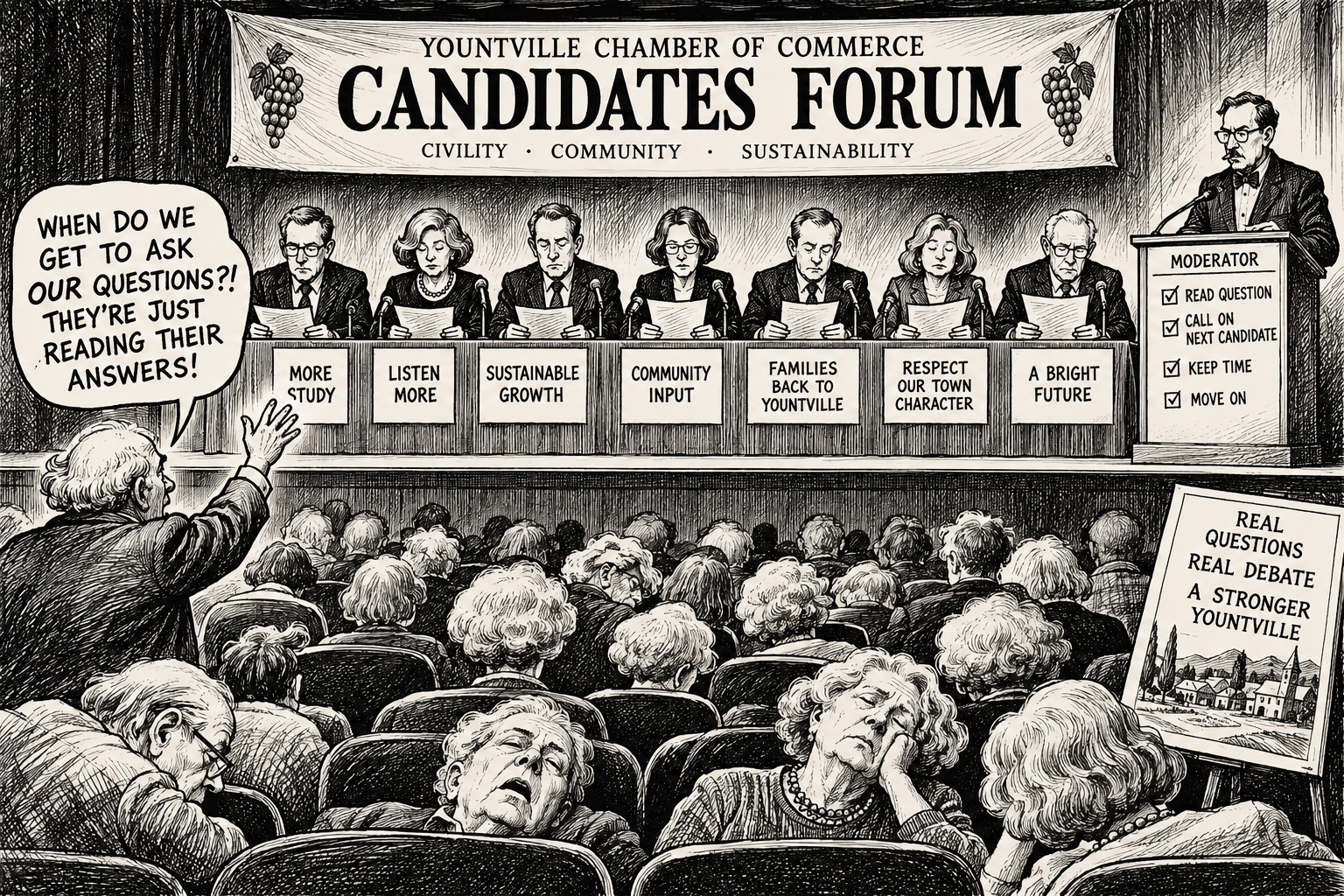
The cartoon captures the evening’s only unscripted moment, when a frustrated resident finally stood up and asked why a “Candidates Forum” offered 250 voters no opportunity to question the candidates, challenge their assumptions, or hear them actually debate.
Two hundred and fifty people came to hear seven candidates discuss the future of Yountville. What they got was an evening of platitudes and cliche answers to prepared questions, delivered with no opportunity for anyone to challenge anything.
There is a perfectly good word for what happened Monday night at the Yountville Chamber of Commerce Candidates Forum, but unfortunately that word is not forum. A forum is, by definition, a place or meeting for open discussion, debate and the exchange of ideas. What roughly 250 Yountville residents were given instead was seven candidates seated on a dais, answering questions they had received in advance, frequently by reading answers they had prepared in advance. The moderator read each question, reminded everyone whose turn it was to answer first, kept the clock moving, and then proceeded to the next question. It was orderly, civil, fair and almost completely incapable of revealing how any of these people might respond when confronted with an argument they had not rehearsed.
That distinction matters because nobody came to the Community Center Monday night to see whether the candidates could complete their homework. We came to learn something about the people asking us to entrust them with the government of Yountville. We wanted to hear what they believed, certainly, but we also wanted to see how strongly they believed it, whether their assumptions survived scrutiny, whether they understood the policies they were criticizing and whether they could respond intelligently when somebody sitting six feet away disagreed with them. There were seven candidates on that stage. Surely somebody disagreed with somebody about something. For nearly two hours, however, you could have been forgiven for wondering.
The Only Unscripted Question Came From the Audience
The evening’s most revealing moment occurred about three-quarters of the way through the program, when a gentleman in the audience finally stood up and interrupted the proceedings. He wanted to know when the people in the audience would be allowed to ask questions. His frustration was obvious and, judging by the reaction around the room, hardly unique. The candidates were simply reading their prepared answers, he complained, while everybody else was sitting there waiting for an opportunity to ask them some tough questions. It was the first genuinely spontaneous moment of the evening, and for about thirty seconds the Candidates Forum suddenly became an actual forum.
He was politely told to sit down. There would be no questions from the audience. If he wanted to question a candidate, he could approach that person individually after the program was over. The Chamber had apparently provided cards on which people could suggest questions, but that is not remotely the same thing as allowing a voter to stand up, address all seven candidates and ask something that nobody had been given three days to prepare for. Nor is cornering a candidate beside the cheese tray afterward a substitute for asking a question in front of 250 other voters who might be interested in hearing the answer.
The Chamber undoubtedly had sensible reasons for imposing structure on the evening. Seven candidates are a lot of people to manage. Time is limited. Fairness matters. Nobody wants one candidate monopolizing the microphone or two candidates turning a civic event into cable television. But there is an enormous amount of territory between a food fight and an oral examination where everybody received the questions in advance. A competent moderator can ask follow-up questions, challenge an unsupported assertion, invite another candidate to respond and still maintain perfect civility. That is, in fact, what moderators are supposed to do.
The Interesting Question Is Usually the Next One
Consider the question about the relationship between the Town Council and Yountville’s new Town Manager. Every candidate gave some version of essentially the same answer. The voters elect the Council, the Council establishes policy and direction, and the Town Manager administers the organization and implements the Council’s policies. This is all perfectly correct. It is also approximately what one would expect anyone running for Town Council to know before filling out the paperwork.
The interesting question was the one nobody asked next. What happens when the Council establishes a policy and a small but determined group of voters hates it? At what point does listening become reconsideration, and at what point does reconsideration become abandonment? How should an elected official weigh the testimony of fifty angry people at a Council meeting against months of public meetings, professional analysis, adopted plans, state requirements and the interests of hundreds of residents who did not show up that night? When should a Council member compromise, when should a Council member change his or her mind, and when should an elected official politely tell an angry room that representative government occasionally requires making a decision not everyone likes?
These are not academic questions in Yountville. We just spent two years arguing about the future of the former elementary school property. The Commons went through workshops, surveys, advisory meetings, Planning Commission hearings and Town Council proceedings before the implementing zoning ordinance was adopted. A petition was then circulated against that ordinance, the Council ultimately repealed it, and the property returned to its previous zoning framework. Whatever anyone thinks about the Commons, the petition or the Council’s decision, this town has just lived through a nearly perfect case study in the tension between representative government and organized opposition.
Seven people who want to govern Yountville were sitting together on one stage. That was the moment to ask them what they had learned from it. Instead, we moved on to the next prepared question.
Before We Order Another Study, What Exactly Don’t We Know?
Housing produced much the same problem. Several candidates talked about the need for more information, more listening, additional surveys or further study before the Town makes consequential decisions. There is nothing inherently wrong with any of those things. Government should have good information before spending public money or adopting policy. But “we need more study” is not yet a position. It is the beginning of another question, and that question should have been asked Monday night.
For example, has the candidate actually read Yountville’s Housing Element? The Town already has a state-certified Housing Element, adopted after an extensive public process, containing demographic data, housing inventories, constraints, projections, policies and an analysis of the housing needs Yountville is legally obligated to address. If that information is inadequate, what precisely is missing? What survey has not been conducted? What question remains unanswered? What information would cause the candidate to support one policy rather than another? How much more time should the Town spend collecting it, and what happens to the problem while everybody waits?
That is not a gotcha question. It is the difference between an aspiration and a governing philosophy. “I want more information” sounds responsible until somebody asks what information you need. “I want more community input” sounds wonderfully democratic until somebody asks how much input is enough to permit a decision. Yountville has become extremely good at asking for another conversation. At some point somebody has to explain how the conversation ends.
The Most Important Exhibit Was Sitting in the Audience
At some point Monday night I stopped watching the candidates and looked around the room. The turnout was impressive. Approximately 250 people had left their houses on a Monday evening because they cared enough about Yountville to listen to seven people explain why they should be entrusted with its government. In a town this size, that is meaningful civic participation and something worth celebrating.
But the other thing that was impossible not to notice was the age of the audience. This was an elderly room because Yountville is an elderly town. A substantial share of the population lives in protected senior housing, including the Veterans Home and the mobile home parks, and the demographic imbalance has become one of the central facts about Yountville’s future. The 2020 Census counted 3,436 residents in Yountville, of whom 2,295 were 65 or older. The median age was 74. There were only 187 residents under the age of 18. Those numbers are not an argument against older residents. They are an argument for taking seriously what happens to a town when the generations behind them are disappearing.
This is where the familiar promise to “bring families back to Yountville” deserves more than approving nods. Bring them back from where, and put them where when they arrive? The elementary school that served this community for more than a century closed in 2020 after years of declining enrollment. Housing prices have climbed beyond the reach of most working families. Much of the workforce serving Yountville’s hotels, restaurants, wineries, shops and public institutions commutes into town every morning and leaves again every night. Meanwhile, a significant portion of the housing stock functions as second residences, homes that may be beautifully maintained and enormously valuable but do very little to put children in classrooms, customers in the grocery store on a Tuesday morning or year-round neighbors on the sidewalk.
A real candidates forum would have put those facts on the table and asked the seven people onstage what they intend to do about them. If you want families to return, what housing policies are you prepared to support that would allow families to live here? If you oppose additional density, where should those homes go? If you believe the market will provide them, what evidence supports that belief? If second homes are contributing to the hollowing out of the year-round community, is that simply the inevitable consequence of Yountville’s success or something local government should try to address? There may be seven different answers to those questions. Wonderful. That is why there were seven chairs on the stage.
Everything Is Sustainable Until Somebody Has to Choose
If there was one word that united the candidates Monday night, it was sustainable. Tourism should be sustainable. Housing should be sustainable. Development should be sustainable. Town finances should be sustainable. Yountville itself should presumably be sustainable. By the end of the evening, sustainability had been invoked so often that it had ceased to describe a policy and had become a verbal comfort blanket. Nobody is running for office on a platform of unsustainable government.
The problem is that governing begins precisely where these agreeable words stop being useful. Yountville wants to remain a quiet small town while supporting an extraordinary hospitality economy. It wants the people who work here to live nearby while resisting the amount and type of housing many of them could afford. It wants young families while possessing some of the most expensive real estate in the Napa Valley. It wants thriving restaurants and hotels without the traffic their employees and customers create. It wants historic preservation, open space, workforce housing, convenient parking, fiscal restraint, beautiful architecture, low density and very little visible change. Every one of those goals is defensible. They are also not always compatible.
That is where politics becomes interesting. The real question is not whether a candidate supports housing, sustainability, families, fiscal responsibility, small-town character or civility. Of course they do. The question is what happens when preserving one of those things makes another one harder to achieve. Which priority gives way? How much change is acceptable? Who pays for it? What evidence would change your mind? Those are the choices elected officials actually make, and those are the choices voters deserve to hear candidates argue about before filling in the little circles on their ballots.
Instead, we heard a great many statements with which almost nobody could possibly disagree. It was the civic equivalent of seven restaurant menus promising that the food will be delicious.
Disagreement Is Not Incivility
There is an understandable reason communities shy away from genuine political debate. American politics has provided enough examples of disagreement degenerating into ugliness that the words civil discourse now appear in almost every conversation about local government. Yountville has had its own unpleasant moments during the last several years. Nobody should want more personal attacks, jeering from audiences or accusations about motives masquerading as arguments about policy.
But civility does not require agreement, and decorum does not require boredom. In fact, the ability to disagree respectfully may be the most important test we could impose on somebody asking to sit on the Town Council. A candidate should be able to say that another candidate has misunderstood the Housing Element, underestimated a financial risk, exaggerated a problem or proposed something that simply will not work. The other candidate should be able to answer. A moderator should be able to notice when somebody has avoided a question and politely ask it again. None of this requires shouting, humiliation or personal attack. It requires adults who know the difference between challenging an argument and attacking the person making it.
There are major policy decisions in front of Yountville. The former elementary school property remains unresolved. The Town has housing obligations it cannot simply wish away. The population is aging. The year-round community is shrinking relative to the economic machine built around it. The Veterans Home faces its own enormous questions about staffing and the future of its residents. Businesses need workers. Workers need somewhere to live. Residents want to preserve the qualities that made them love Yountville in the first place. These interests overlap, but they are not identical, and pretending that enough listening sessions will eventually cause everyone to agree is not civic harmony. It is avoidance.
Politics is the process we invented to resolve exactly these kinds of disagreements. It is the public discussion, negotiation, resolution and implementation of policy among people who often want different things. There is nothing shameful about that. What matters is whether the arguments are informed, whether the participants are honest about the tradeoffs and whether everyone accepts that losing an argument occasionally is part of living in a democracy.
Let Them Think in Public
I will be profiling the candidates individually in the Moon over the coming week, and there were answers Monday night that deserve closer examination. Some were thoughtful. Some raised questions that I want to pursue. Some contained assumptions worth testing against the Town’s own documents and history. The candidates deserve to have those positions presented carefully rather than reduced to a few impressions from one evening.
That is also why Monday night was such a missed opportunity. I went there hoping to learn something I could not learn by reading seven questionnaires. I wanted to discover which candidate could hear an unexpected argument, absorb it and formulate a response. I wanted to know who understood the difference between a campaign promise and an implementable policy. I wanted to hear somebody explain why another candidate’s proposal would not work, followed by that candidate explaining why it would. Most of all, I wanted the people asking to govern Yountville to demonstrate that they could think in public, because governing is largely the experience of discovering that the question you prepared for is not the one that arrives.
The next Council will not receive Yountville’s problems several days in advance with suggested talking points attached. Residents will be angry about things nobody predicted. Budgets will collide with ambitions. State mandates will interfere with local preferences. Businesses will seek approvals. Neighbors will object to them. Housing decisions will produce opposition. Consultants will disagree. Staff will recommend something unpopular. New information will arrive after somebody has already taken a position. Council members will occasionally discover that the person sitting beside them sees the same facts and reaches the opposite conclusion.
Those are not unfortunate interruptions to governing. They are governing.
Which brings us back to the gentleman who stood up Monday night. His interruption was probably not contemplated by the evening’s program, but he inadvertently asked the question that exposed the weakness of the entire event. Two hundred and fifty residents had come to a Candidates Forum because they wanted to hear seven prospective leaders discuss the future of their town, and he simply wanted to know when the people who actually live here would get to ask them something difficult.
He was told he could talk to them afterward.
Next time, give him the microphone.
