
Yountville is Not for Sale, #4, Villain of the Week.
A cynical magic trick is running in Yountville every week. Here is how it works, and who is performing it.
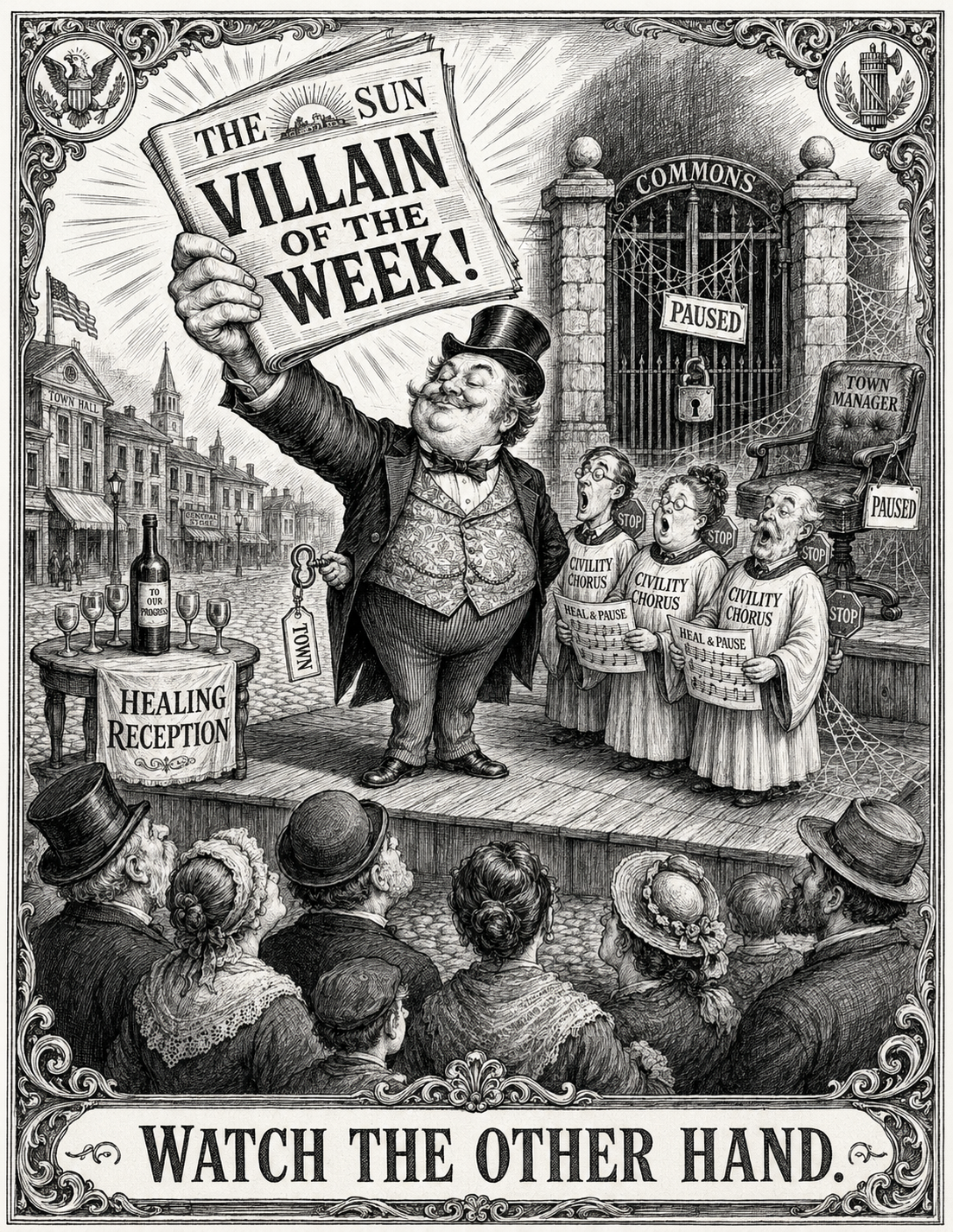
Every week a new villain above the fold. The key isn't his yet. That is what the waving is for. The right hand sells the scandal. The left hand is still reaching. November decides what it closes on.
Here is how a magic trick works. The magician gets you to watch his right hand, waving, snapping, pointing, while his left hand does the trick. The waving hand has a name: misdirection. The waving hand exists for one reason, so you never look at the hand that matters.
Yountville is watching a magic trick right now. The trick runs every week, and the town’s only newspaper is performing it.
Start with who owns that newspaper, because ownership explains everything that follows. The Yountville Sun was purchased this spring by Gary Jabara. Jabara owns a hotel here. Jabara has been the loudest opponent of the Commons, the project seventy-two percent of Yountville voters agreed to fund back in 2018. Jabara is not registered to vote in this town. And Jabara bought the paper three months before an election that will decide who is mayor and who holds two of the five council seats.
An election is coming, and the man with the most to gain from that election now owns the only printing press in town. Hold onto that fact. Jabara’s ownership is the left hand. Everything else you are about to read is the right hand, waving.
The waving hand, week by week
One week, the villain is Brad Raulston, the town manager who resigned this spring to care for his wife after a car accident. The Sun printed Raulston’s severance payment down to the penny, $150,380.96, and presented that number like evidence of a crime. The Sun never told you the ordinary truth about the payment, so here is that truth, explained slowly, because the truth matters.
The document Raulston signed is called, in the Sun’s own reporting, a “resignation agreement and release of claims.” Those last three words, release of claims, are the whole answer. A release of claims means the departing employee promises, in writing, forever, never to sue the town for anything. Towns pay money for that promise. Every city in California pays for that promise, because a signed promise is cheap and a lawsuit is not. This year alone, St. Helena paid its departing city manager about $457,000. Calistoga’s former city manager collected over half a million dollars. Yountville paid the smallest amount in the whole valley, to the only manager who left voluntarily.
That is the “scandal.” Any lawyer in California would confirm every word of the last paragraph in a thirty-second phone call. The Sun has now run two stories and a published letter about this severance, and in all that ink, the Sun never once called a lawyer to ask. Ask yourself why a newspaper wouldn’t want its own question answered.
The next week, the villain is the council itself. Residents appeared at the August 4 council meeting demanding answers about that same severance payment. Where did those residents get their alarm? From the Sun’s July 30 story. Who reported their alarm as fresh news two days later? The Sun, on August 6, citing itself as the source: “as reported in the Sun on July 30.” Read that cycle again, slowly. The newspaper strikes the match. The newspaper reports the fire. The newspaper sells you coverage of the smoke. Every week a new villain on the front page. Every week, the same owner behind the front page.
The councilmember who played along
Now to that August 4 meeting, and to Councilmember Hillery Trippe, because what Trippe did there deserves to be understood step by step.
Trippe is an attorney, as Trippe frequently reminds this town. Keep her legal training in mind through what follows, because it means she cannot claim she didn’t know what she was doing.
Separation agreements like Raulston’s are discussed by the council in closed session, the private meetings the law allows for personnel and legal matters. Trippe sits in those closed sessions. Trippe is a member of the council that made this agreement. And the state’s open meeting law, the Brown Act, forbids everyone in those sessions, Trippe included, from revealing what was discussed there.
Now watch what Trippe did with all that knowledge. She turned to Town Attorney Gary Bell, on camera, and demanded Bell explain why the severance was paid.
Trippe already knew why the severance was paid. She was in the room where the agreement was made.
Trippe also knew, as an attorney, that the Brown Act forbids Bell from answering her question in public.
So Trippe’s question was never a question. It was a trap, set for the cameras. Bell did his job, the same job Bell has done well for this town before, including being the first town official to push back on Gary Jabara’s threats in plain legal terms. Bell protected the town, protected a former employee’s privacy, and declined to answer, exactly as the law requires him to. And the video shows exactly what Trippe’s trap was built to produce: the town’s own lawyer, refusing to explain, looking to the untrained eye like a man hiding something. Bell was not hiding anything. Bell was following the law. Trippe knew that better than anyone else in the chamber, because Trippe is the one with the law degree.
One more detail completes the picture of that afternoon. Minutes before setting her trap, Trippe lectured her council colleagues from the official handbook, reminding them that members must not question one another’s motives. “We need to walk the talk,” Trippe said. Then Trippe stood up the town’s attorney in front of the cameras to suggest her own council was concealing wrongdoing, wrongdoing that Trippe personally knows does not exist, because Trippe was in the room.
Remember one last fact about Trippe. She cast the lone council vote against her colleagues on the Commons, and she organized against the project outside the public process. There is a word for reading the handbook aloud and then doing the opposite ten minutes later. Readers can supply that word themselves.
The rest of the cast
The letter the Sun published on August 6 came from resident Jill Turner. Turner’s letter asks whether Raulston “really quit,” and one sentence later, Turner’s letter refers to “this untruth.” Stop and notice what happened between those two sentences. No untruth has been demonstrated by anyone, anywhere. A question went in. An accusation came out. The Sun printed Turner’s letter directly beneath the Sun’s own article, and asked Turner no follow-up questions.
At the same August 4 podium stood Joe Tagliaboschi, echoing Turner’s letter and asking the council to pause its search for a new town manager. Remember Tagliaboschi’s request, because Tagliaboschi has since declared he is running for mayor. Follow the logic of what Tagliaboschi asked for. He asked the council to leave the town’s top administrative job empty until after the election. Tagliaboschi is a candidate in that election. Tagliaboschi was asking the council to hold the chair open for whoever wins, and Tagliaboschi intends to be whoever wins.
And Eric Appel, who led the petition that stopped the Commons, told the council that his petition was “democracy in its most direct form.” Here is the civics lesson the Sun will not print. A petition is not a vote. Under California law, Appel’s 235 signatures, about ten percent of the town’s voters, did exactly one thing: paused the project and forced the council to choose, either repeal the zoning or hold a town-wide election and let all the voters decide. That town-wide election has never happened. In the five months since the petition, Appel’s side has never once asked for that election. Think about what that silence means. If Appel’s side truly believed most of Yountville stood with them, a town-wide vote would be their first demand, not their last. The pause was the prize.
Even Appel admitted, on the record at the August 4 meeting, that the Commons had “good aspects” worth reviving. Which aspects? Appel has never said.
Your town, your move
Now step back and look at what this cast has actually built. Count the pauses. They paused the Commons, the project seventy-two percent of you voted to fund. Now they want to pause the search for a town manager, so the town sits leaderless through the election one of them is running in. Pause the housing. Pause the hiring. Pause the town. And through every pause, the same soundtrack plays: civility, healing, getting back to basics, poured generously at the wine receptions while the newspaper that manufactures the division reports on the division with a straight face.
So ask the question that ends the trick. In all these months of pausing and preaching, what has any of them contributed? Not one idea for the land. Not one plan for the housing. Not one proposal for the seniors, the workers, the parks, the budget, or a single street in this town. Not one day’s honest work toward the well-being of Yountville. Stopping things is not service. Complaining is not a plan. And civility from the people who profit from the chaos is not civility. It is anesthesia.
H.L. Mencken wrote that democracy is the theory that the people know what they want, and deserve to get it good and hard. Dear Yountville voter: in ninety days you will get democracy, good and hard. The filing deadline is this week. The names will be printed in a newspaper owned by Gary Jabara. Read every name and ask one question: what has this person ever proposed for Yountville? If the answer is nothing, you know what the candidacy is. It is one more pause, dressed up as a plan.
The seventy-two percent were the town’s voice once. Be it again. Show up, ask for the work, and vote for the people who have done some. Because if you sleep through this one, you will get exactly the government this cast has planned for you.
And you will deserve it.
Disclosure: The author served approximately two years as Owner’s Design Consultant on the Yountville Commons project, a scope now complete.
