
Yountville is Not for Sale, #5, Six Candidates and the Fight Over What This Town Becomes
The filing period is over. Six people want three of the five seats that will govern Yountville. The election is not really about the Commons. It is about whether Yountville remains a town, or finishes its conversion into a luxury resort whose workers, caregivers and next generation are expected to live somewhere else.
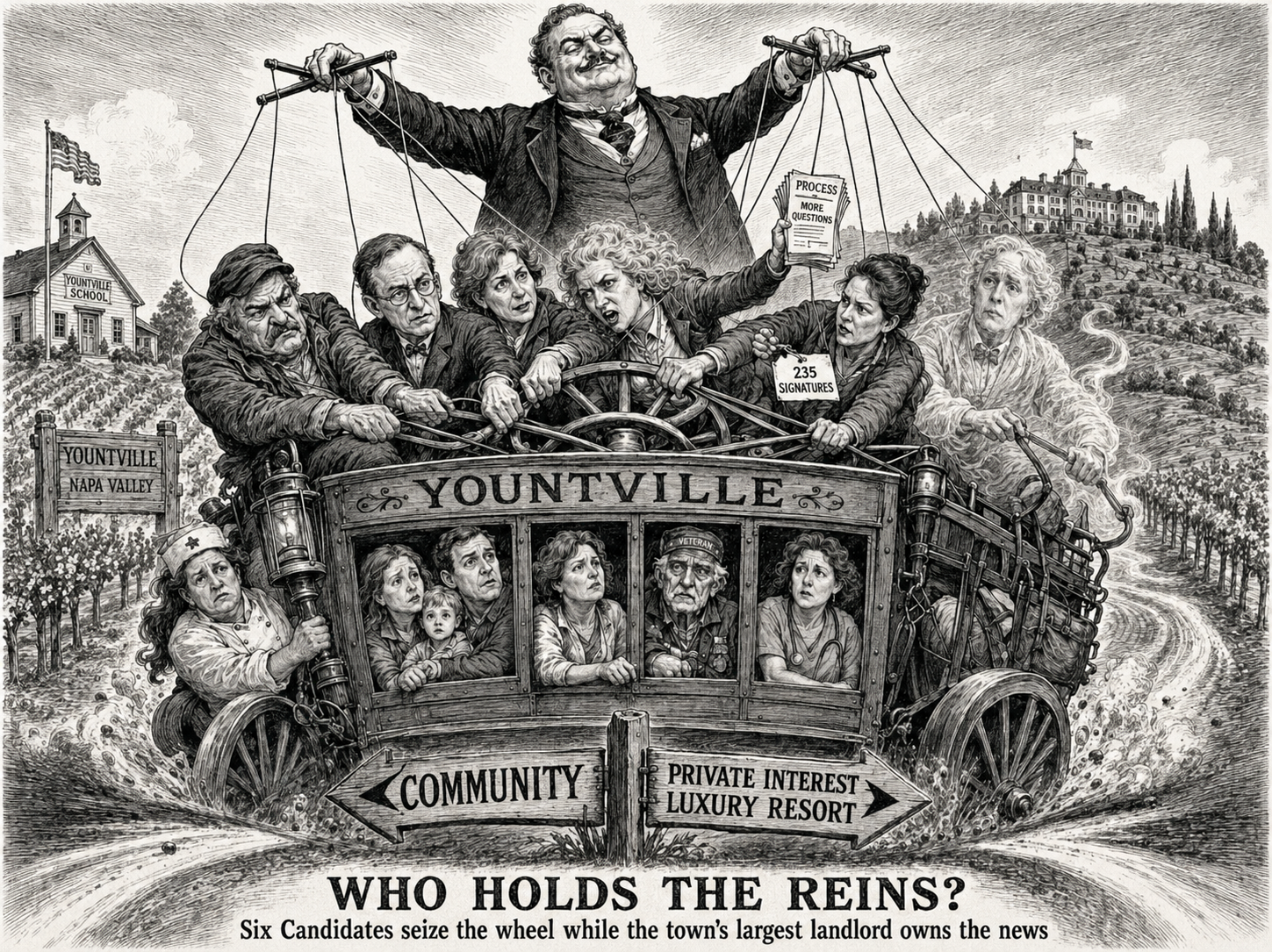
Six candidates are fighting for three seats—and the wheel. Above them looms the question that will shadow this election: how much influence should Yountville’s largest commercial landlord, now also owner of the town’s newspaper, have over where the town goes next?
The filing period closed Friday, and Yountville finally has its cast. Mayor Marjorie Mohler is running for reelection against Joe Tagliaboschi. For two Town Council seats, Robin McKee and Hillery Bolt Trippe are running to keep theirs, while Jessi Bugden and Matthew Chrzanowski are asking voters to put them there for the first time. That means three of five votes on the governing body are in play at once. In most places, that would be the beginning of a municipal campaign. In Yountville, it is the first chance the entire town has had to answer the question that has been hiding underneath a year of arguments about housing, budgets, petitions, public records, resignations and civility: who is actually going to control the future of this place?
The temptation will be to describe this as an election about the Commons, because the Commons supplied the drawings, the dollar figures and the public meetings around which the political factions formed. That would be too easy. The Commons was the occasion. The deeper argument was already waiting for it. Yountville is an extraordinarily valuable little piece of California in which agricultural preservation has successfully prevented suburban expansion, tourism has successfully generated enormous wealth, housing has consequently become extraordinarily scarce, and the people needed to operate the place overwhelmingly live somewhere else. The Town acquired seven acres in its center and proposed using a portion of them to create permanently deed-restricted workforce housing under public control. For the first time in the town’s history, Yountville was not merely regulating what private owners wanted to build. It was deciding what the public itself needed to own.
That is when the fight became ferocious.
Follow the Power, Not the $91 Million
The political genius of the opposition was to turn a long-range buildout estimate into a bill arriving tomorrow morning. Councilmembers were being asked to understand both the ultimate opportunity presented by seven acres of public land and the first practical phase that could actually be financed and built. Those distinctions disappeared almost immediately. The number $91 million became “the project,” the project became an imminent financial catastrophe, and every question about the future of Yountville became a referendum on whether Town Hall could be trusted with money.
There were legitimate cost questions. There always are when government proposes something ambitious. But the fiscal outrage has always contained a strange omission: Yountville voters had already decided where a substantial portion of the money was supposed to come from. In 2018, nearly three-quarters of them approved Measure S, a one-percent tax on hotel guests dedicated to affordable and workforce housing. The people paying that tax are principally the visitors consuming Yountville’s luxury economy, not the local homeowners whose property values have soared along with it. The basic public bargain was unusually elegant. Tourism helped create the housing pressure; visitors would contribute to easing it. The Town would use that money not to subsidize another luxury development but to preserve land and housing for the people who actually work here.
Once you understand that, the argument over the Commons looks less like an argument about the municipal purse and more like an argument about municipal power. Yountville already owned the land. Voters had already created a dedicated revenue stream for affordable and workforce housing. The Town was not simply proposing to spend that money and watch it disappear. It was trying to convert public revenue into a permanent public asset: land, housing and long-term affordability that would still belong to Yountville after the first financing package was forgotten. In Napa Valley, where land and real estate have been extraordinary engines of wealth for generations, that should have been the obvious aha moment. The Town Council was trying to do what every successful property owner in the valley understands instinctively: use capital to acquire and improve an asset that becomes more valuable over time.
That changes the entire frame. Workforce housing was not merely a social expense. It could be public infrastructure and public wealth at the same time; a place for workers to live, a hedge against future housing costs, and an intergenerational asset created with money voters had specifically entrusted to the Town for that purpose. For once, Yountville was not waiting for a hotel owner, restaurant operator or private developer to decide what use produced the best return. It was in a position to decide for itself what kind of return mattered which is the definition of good governance.
And that is an important change in who gets to decide.
Gary Jabara Is on the Ballot. His Name Just Isn’t Printed There.
Gary Jabara’s name does not appear among the six candidates, which should not prevent anyone from noticing how much of this election now revolves around his influence. He has become by far the most consequential private commercial landowner in commercial Yountville, controlling hundreds of hotel rooms, restaurants and major properties, including two historic landmarks that define the physical identity of the town. He became one of the loudest private critics of the Commons. He participated in the political campaign against the Town’s approach. Then, just before an election determining three of the five seats on the Council, he bought the Yountville Sun, the town’s local online newspaper.
None of that proves that Jabara controls a slate of candidates, and the Moon should not pretend proof exists where it does not. But neither should Yountville behave like a village in a fairy tale where everyone politely agrees not to notice that the man buying much of the commercial center has also bought the newspaper while becoming deeply involved in the politics determining what his property and the public land beside his holdings will become. If this were happening in Chicago, Boston or San Francisco, nobody would regard the ownership structure as impolite conversation. They would call it power.
Gary Jabara made his fortune in wireless infrastructure and then spent hundreds of millions buying commercial real estate. Good for him. But Yountville is entitled to ask a different question now: what beautiful civic thing has he ever built here that did not also belong on his balance sheet? His model is private ownership, private return and increasingly private influence over public decisions. That is not stewardship simply because somebody pours free wine while explaining it.
Which brings us back to Brad Raulston. What exactly did Raulston do to so enrage Jabara that, months after his departure, the newspaper Jabara now owns is still excavating a six-month severance agreement as though Woodward and Bernstein had finally reached Yountville? Raulston’s real offense may have been considerably less cinematic: he helped lead a Town government that was acquiring public land, using voter-approved hotel taxes to create permanent public assets, and asserting that Yountville’s future did not have to be dictated by whoever could extract the highest private return from it.
Maybe that has nothing to do with Jabara’s interest in the story. But somebody ought to ask.
A newspaper does not have to lie to protect its owner. Sometimes it only has to be incurious.
That is what elections are for.
The Two With a Record of Building
Mayor Marjorie Mohler and Councilmember Robin McKee enter the campaign with something none of the rhetoric can erase: a public record of trying to use government to create mandated workforce housing. They did not merely agree that housing was important. They voted through the hard parts: land acquisition, planning, zoning, financing assumptions, design and public conversations. Because eventually public policy has to leave the council chambers and become a physical thing.
Mohler’s great political weakness may also be one of her strongest governing qualities. She is not a natural salesman. She is an analyst, a retired scientist who spent a professional career at places including Genentech, and she tends to believe that if the public is given enough facts it will eventually arrive at the same conclusions she has reached after studying them. Politics does not always reward that faith. But Yountville does not need a mayor who can merely identify the mood of the room. It needs one capable of understanding municipal finance, housing law, state mandates, public infrastructure, regional government and the implications of decisions that will outlive everyone currently sitting at the dais.
McKee’s record is less technocratic and more rooted in the peculiar economy Yountville actually has. She knows hospitality, has served the town through appointed and elected roles, and supported the effort to create workforce housing even while questioning costs and details. That distinction matters. The test of a councilmember is not whether he or she can identify flaws in a proposal; nearly anyone can do that. The test is whether flaws become reasons to improve something or excuses to make sure nothing happens.
Mohler and McKee do not need immunity from the Commons “mistakes” because the central mistake was not theirs. The Council insisted that the full cost picture be presented in public before it had even begun the harder work of testing assumptions, separating the ultimate buildout from a viable first phase, trimming scope and deciding what was actually worth building. That is what responsible public process is supposed to look like. Instead, the largest number was seized on as though it were a construction contract, the petition arrived before the Council had a chance to interrogate the proposal, and the zoning was ultimately repealed before that process could mature. Ambitious public projects get slowed, challenged, redesigned and phased all the time. Welcome to the California housing crisis. The lucky part for Yountville residents is that the story is not over. The land is still public, the funding through Measure S still exists, the state mandate still needs to be satisfied, and this election gives voters the chance to decide how the story ends.
Hillery Trippe: The Outlier
Hillery Trippe is the easiest candidate to understand because she has spent the last year making herself the outlier. She opposed the Commons when the Council voted 4–1 to move it forward, then effectively refused to accept the loss. Since then she has carried the arguments of commercial and hospitality interests into the chamber wrapped in the respectable language of “process,” “more information” and “fiscal responsibility.”
Her alternative has remained wonderfully weightless. The Commons should cost less. A private developer should somehow build it. There should be more study. Somebody else should have a better idea. That is not a housing plan; it is a wish list with no land, no developer, no financing, no affordability covenant and no date when anybody actually gets a key.
The more important issue for Yountville residents is that Trippe lost the policy argument inside the public debate of the Council and then helped fight it outside the Chamber until the policy was stopped. Fine. Politics permits that. But own it. Do not spend the campaign pretending you were merely the lone adult asking prudent questions while other people mysteriously organized themselves around exactly the outcome you wanted. If you helped stop the Town’s housing strategy, tell voters what you intend to replace it with.
Trippe has become the Council’s clearest carrier of a larger idea that deserves to be dragged into daylight this election: prosperity is not sovereignty. Yountville’s hotel owners, restaurateurs and major commercial landlords create enormous value and deserve a strong voice in the town. They do not get extra votes because their tax bills have more zeros. Yet Trippe repeatedly behaves as though the concerns of those interests deserve another round of litigation after the elected Council has already made its decision.
She seems to approach the dais less like one of five people hired to govern than like the lawyer for a disappointed minority shareholder. Every vote can be appealed. Every answer invites another interrogatory. Every defeat apparently comes with a motion for reconsideration.
Eventually a councilmember has to do something considerably harder than object. She has to govern.
Joe Tagliaboschi: The Old Grievance Candidate?
Joe Tagliaboschi deserves more respect than caricature. He served in the Navy. He spent years working for Yountville, eventually as Public Works Director. He knows the town’s pipes, streets and physical systems in a way few candidates ever will. He was appointed to the Council once and has repeatedly tried to win a seat again in his own right. That is a substantial public biography.
But a long history with Town Hall can produce something besides expertise. Tagliaboschi increasingly sounds like a former employee who has an argument with the institution he once served. His recent public comments have concentrated on the failures of present leadership and on delaying important decisions, including the selection of a new town manager, until after an election in which he himself hopes to replace the mayor. There has long been talk in town that he resented not becoming town manager himself. Unless evidence establishes that, it should remain a question rather than an accusation. What voters can see without rumor is a candidate whose political identity appears increasingly defined by dissatisfaction with the people now running the organization where he once worked. Did I mention that he was endorsed publicly by Gary Jabara?
For a Navy veteran running for mayor of the town that contains the largest state Veterans Home in the country, the revealing question is not whether Joe Tagliaboschi knows how to maintain public infrastructure. He does. The harder question is whether he knows how to create anything new. Keeping streets, pipes and public works functioning is important; governing through a housing crisis requires imagination, coalition-building and the ability to turn competing interests into something real. Tagliaboschi’s instinct too often seems to be the opposite: preserve what exists, object to what is proposed, and then hand the difficult part to some hypothetical private developer, some future state program, some other agency, some cheaper project that has no site, no financing, no timetable and, conveniently, no one actually responsible for producing it. That is not a plan. It is civic outsourcing by wishful thinking. Yountville does not need a mayor whose answer to every hard problem is that somebody who has not yet appeared will eventually solve it. It needs one who can assemble the people already here and make something happen.
Jessi Bugden: From Nowhere to the Ballot
Jessi Bugden is perhaps the clearest example of how abruptly the political terrain has changed in Yountville. Until the Commons fight, she had little visible public footprint in Yountville government mostly because she has lived here for just a few months. Suddenly she became the organizer associated with the 235-signature petition that suspended the Commons zoning. Her husband, Eric Appel, appeared publicly in the same opposition movement, criticizing the Town’s financial approach alongside Gary Jabara. A few months later Bugden is running for Council. What a coincidence!
Bugden and Appel also held their wedding at The Estate Yountville, Jabara’s hotel property. That fact alone proves nothing about politics. People get married at hotels. But this is a town of fewer than three thousand people, not Manhattan, and the instinct to pretend relationships do not exist because acknowledging them might appear impolite is one of the ways small-town power escapes examination. Bugden was part of the political movement Jabara strongly supported. Her husband spoke publicly in the same cause. Now she wants one of five governing votes. What has she created in her past life that somehow will convince the voters of Yountville to put their trust into this new arrival? Voters are allowed to ask who encouraged her candidacy, whose advice she seeks, where she differs from Jabara and what she intends to build now that she has demonstrated she can help stop something.
That last question is the important one. The petition did not prove that Yountville rejected the Commons. It proved that 235 voters, roughly ten percent of the electorate, wanted the ordinance stopped unless the broader electorate approved it. The broader electorate never got that opportunity because the Council repealed the ordinance. Bugden’s campaign therefore begins with a genuine political accomplishment but an incomplete governing record. She helped produce “no.” A council seat in Yountville requires an answer to what comes after it.
Matthew Chrzanowski: Who?
Then there is Matthew Chrzanowski. Perhaps he will turn out to be thoughtful, independent and exactly the sort of younger candidate Yountville needs. At the moment, however, he is the political equivalent of an unopened envelope. No Council record. No commission record that has surfaced. No notable letters. No sustained public participation in the disputes that have consumed the town. No visible political history from which voters can infer why he has suddenly concluded that he should become twenty percent of Yountville’s governing body.
That vacuum naturally produces suspicion in a town where political alliances form quickly. Is Chrzanowski another independent citizen who simply decided this was his moment? Was he encouraged to run by people hoping to change the Council majority? Does he have relationships with Jabara or the Commons opposition that have not yet become public? Those are questions, not conclusions. The cleanest way to answer them is for Chrzanowski to introduce himself with some specificity. Who asked him to run? What does he think should happen at the school site? What is his position on Measure S, workforce housing, the Veterans Home staffing problem, the mobile-home parks, public ownership and the role of the Sun’s owner in town politics? If he is nobody’s candidate but his own, saying so should be easy.
The Election Is Not About the Commons
This is the fact everyone should keep in mind for the next ninety days. The Commons is not on the ballot. Its old zoning is gone. Its particular design can change. Its cost can change. Its phasing can change. The next Council can build something smaller, smarter and less expensive.
What cannot change is the underlying choice: what kind of town will Yountville be?
Yountville can continue becoming a place whose principal economic purpose is to receive wealthy visitors and protect expensive residential assets while nearly everyone who works here drives in from somewhere else. There is no law against that. It may even be the most profitable future available. The school is already gone. Fewer young families can afford to replace the ones who once sent children there. Restaurant workers can commute. Hotel workers can commute. Town employees can commute. Nurses can commute. Who really cares? The Veterans Home can be told to solve its staffing problem on its own state property. Mobile-home residents can be told that rising costs are simply the price of remaining in a luxury town. More luxury residences can produce more wealthy part-time residents who will enjoy Yountville intensely during the weeks they are here.
And if that is the future people want, they should at least have the courage to say so out loud. Some already have.
And naturally, all those commuters and visitors will require more parking.
Taken far enough, Yountville becomes a cruise ship permanently moored among the vineyards: beautiful decks, superb restaurants, expensive cabins, immaculate landscaping, and an enormous crew that arrives every morning to make the experience possible before going home somewhere else at night. The passengers may love the ship deeply. They may spend generously while aboard. But nobody mistakes a cruise ship for a town.
The alternative is not to pave the vineyards, destroy Yountville’s character or resurrect every detail of the Commons. It is to recognize that preservation must include people as well as buildings and landscapes. The Veterans Home needs enough nearby caregivers to make full use of the extraordinary facilities California is building for veterans. Read the studies for yourself. Yountville has become very good at commissioning studies, requesting more studies, and then behaving as though the existence of another unanswered question is proof that nothing can yet be done. There is at least one regular at public meetings who seems to believe the cure for every housing decision is another study. If she spent as much time reading the Town’s Housing Element as asking the Council to commission the next one, she might have to invent a new reason for delay. Mobile-home residents need a reasonable chance to remain part of the community they already inhabit. Hospitality workers and public employees need at least some path from commuter to resident. Younger people need a foothold from which they might eventually become the older people arguing about Yountville thirty years from now. A town that successfully preserves every historic structure and every agricultural view while losing the capacity to replenish its citizenry has preserved a stage set.
The Seventh Candidate
This is why Gary Jabara may be the most important person in the election who is not running.
The question is not whether he has the legal right to buy hotels, restaurants, historic properties or a newspaper. He does. The question is what happens when those economic interests begin translating themselves into political influence over the five people who control public policy. If Jabara wants a different future for Yountville than the one Mohler and McKee have been pursuing, he should say what it is. More privately developed housing? Fine. Where, how much, and how long is it affordable? More luxury residential development? Say so. More parking? Explain why. Employee housing controlled by employers? Explain what happens when the worker changes jobs. Veterans Home housing? Explain why the State’s solution to one employer’s staffing needs should excuse the civilian town from housing the rest of its workforce.
The same questions belong to Trippe, Tagliaboschi, Bugden and Chrzanowski. If their positions happen to coincide with Jabara’s, that does not make them puppets. But independence cannot consist merely of denying influence. It becomes visible when a candidate tells a powerful ally no.
Maybe Gary Jabara has a vision for Yountville. So far, we mostly know what he didn’t want. He did not want the Town building publicly controlled workforce housing on public land. He did not want Yountville using its own housing money to create an asset that would outlive the next development cycle. Which raises an awkward question for the people who make his hotels, restaurants and resorts work: do his employees understand how little room there seems to be for them in the Yountville he is helping shape once their shift ends? And do his guests understand that the luxury experience they are buying depends on a workforce that is increasingly expected to arrive from somewhere else, serve the town beautifully, and then disappear again at night? Maybe that is the plan. Maybe it isn’t. But if you own a large piece of Yountville’s economic engine and now own the newspaper that covers its politics, “I didn’t like the Commons” is no longer much of a civic vision. It is time to tell the town what you do want.
The answer will tell voters more than ten glossy mailers.
Everyone Gets the Same Questions
This is the beginning of the election season, not the end of the argument. In October, the Yountville Moon will invite all six candidates to sit down individually for recorded, on-the-record interviews. They will not be asked for campaign slogans or three-minute biographies. They will be asked what they intend to do with the former school, how many workforce homes Yountville should actually create, what Measure S should pay for, what protections mobile-home residents deserve, how the town’s housing decisions affect staffing at the Veterans Home, and where they believe the line belongs between commercial influence and public authority.
The same basic questions will go to everyone. There will be follow-ups. The interviews will be published so readers can judge the answers rather than rely on somebody else’s characterization of them. Candidates who have records will have to explain those records. Candidates who helped stop things will have to explain what they would build instead. Candidates who have arrived with almost no public record will have an opportunity to create one. And every candidate will get a very simple test of independence: tell Yountville something important on which you disagree with Gary Jabara.
By October, nobody should be able to say they were surprised by the questions. Between now and then, the Moon intends to spend the election season establishing the facts those questions are built on. Then the candidates can answer them in their own words, on the record, with the voters listening.
Wake Up, Yountville
By the time those interviews begin, Yountville should understand what is actually being decided. For the last year, its political factions have been encouraged to stare at separate pieces of the same problem. Veterans Home residents worry about care. Mobile-home residents worry about fees. Homeowners worry about property values and neighborhood change. Hospitality businesses worry about employees and costs. Workers worry about commuting. Older residents worry about losing the Yountville they remember. Younger people mostly disappear from the conversation because few can afford to get into it.
The easiest way to control a town like this is to keep those groups convinced that their interests are separate.
They are not.
A town with enough permanently affordable housing to help retain a Veterans Home nurse is also a town with a better chance of retaining a restaurant manager, public employee or young family. A government willing to protect mobile-home residents from displacement is expressing the same basic belief as a government willing to preserve deed-restricted workforce housing: that not every square foot of Yountville has to migrate eventually toward the person capable of paying the highest price for it. A town willing to keep public land public is saying that some assets should be measured by what they make possible rather than what they would fetch.
Those are choices about values, but they are also choices about power.
And now there are six people asking to exercise that power.
Mohler and McKee have records voters can inspect. Trippe has a record that deserves much closer examination. Tagliaboschi has decades of history with Town Hall and an increasingly adversarial posture toward its present leadership. Bugden went from political obscurity to organizing the petition that helped halt the Town’s housing strategy and then directly onto the ballot. Chrzanowski has arrived almost entirely undefined. Over all of it hangs the influence of a man who owns more of Yountville’s commercial center than anyone else, opposed the Town’s direction, and now owns the newspaper through which many residents will learn about the election.
That is not a conspiracy theory. It is the field.
“Yountville Is Not for Sale” is not a declaration the Moon gets to make for the town, and it cannot mean that private enterprise is unwelcome or that nothing should ever change. The phrase asks something much more fundamental: who gets to decide what Yountville is for? Is this principally a luxury destination whose highest civic duty is protecting the environment in which visitors and increasingly wealthy property owners enjoy themselves, while the workforce lives elsewhere? Or is it still a town, a place with enough room for veterans and caregivers, owners and renters, retirees and workers, people who arrived forty years ago and people who might arrive next year?
For months, a small number of people have behaved as though that question had already been answered. It has not. Three of Yountville’s five governing seats are now on the ballot. For the first time since this fight began, the whole town gets to decide.
Disclosure: The author served approximately two years as Owner’s Design Consultant on the Yountville Commons project, a scope now complete.
