
How Yountville Learned to Share Everything Except the Town Itself
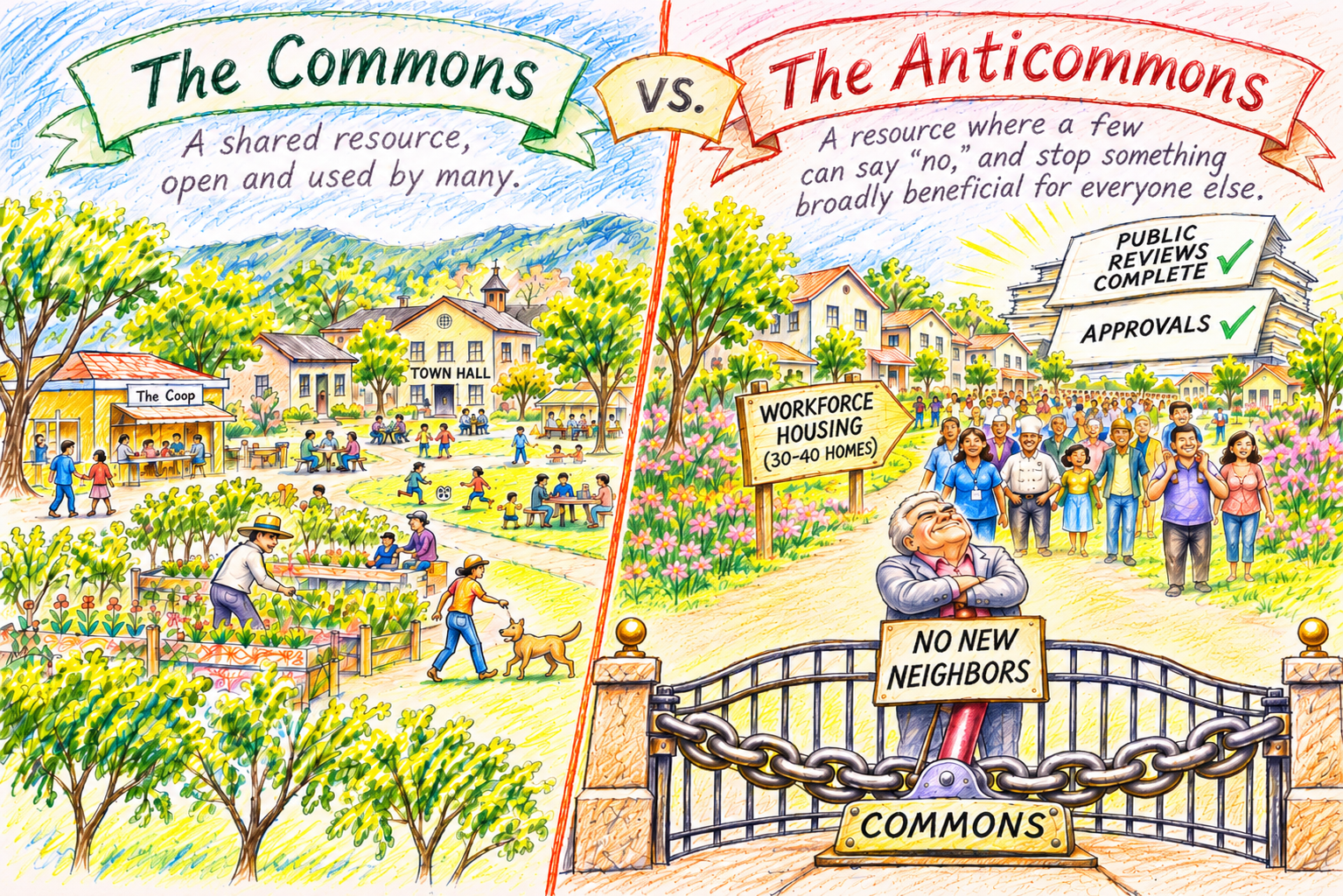
The Commons vs. the Anticommons. For the last few years, Yountville has transformed its former school property into a place for everyone, with gardens, recreation, civic facilities, and gathering spaces. But when the Town proposed adding homes for a few dozen working households, a small minority used its power to stop what years of public planning and approvals had set in motion. The tragedy of the anticommons is that a community can have the land, the resources, and the will to accomplish something worthwhile, yet still be stopped by those who would rather keep the gate locked.
The Robber Barons of the Rhine
In medieval Germany, the surest way to get rich was to build a castle above the Rhine and refuse to let anyone pass. The local nobility had discovered that commerce was a splendid thing, especially when someone else did the work and paid for the privilege. They built towers, stretched chains across the river, and charged tolls to the merchants moving goods between towns. The neighboring barons knew a good idea when they saw one and put up chains of their own. Before long, floating a barrel of wine downstream took the resources of a minor kingdom and the patience of a modern California planning applicant.
Every one of them thought he was being perfectly reasonable. Each baron controlled only his own stretch of river. Each toll had some local justification, and each castle was a substantial investment its owner was understandably anxious to protect. Added together, all that reasonable self-interest made the river steadily less useful for the job rivers have done since roughly the invention of water. Merchants lost money, and so did the towns. Eventually the barons lost money too, because there was less commerce left to tax. The Rhine had become a very efficient system for protecting individual interests at the expense of everyone who depended on it.
In 1998 the legal scholar Michael Heller gave this a name: the tragedy of the anticommons. Most of us learned about its better-known opposite in school. In the tragedy of the commons, a shared resource is ruined because everyone uses too much of it. The anticommons is what happens when too many people hold the power to stop a resource from being used at all. One of Heller’s many examples was the empty storefronts of post-communist Eastern Europe, where would-be merchants couldn’t open shops because the rights to occupy and operate the buildings were split among competing authorities. The stores sat empty, the customers stood outside, and everyone holding a veto could congratulate himself on having used it.
I’ve been thinking about those barons lately, mostly when I drive past the Yountville Commons. There are no castles overlooking the property, though a few nearby buildings might qualify on their assessed values alone. Nobody has stretched a chain across Yount Street yet, although I wouldn’t rule out a committee to study the appropriate chain material. What we have instead is a small town that spent nearly a century turning an old school property into a remarkable collection of shared public amenities, and then discovered that letting a few middle-class workers live there was the one act of generosity that needed practically everyone’s permission.
The School That Became a Town
The story starts in the late 1800’s, when Yountville built a grammar school on the property. It was a modest building for a modest community, built when the main worry about children was finding enough classrooms to hold them. In 1928, they built a more modern one but it was still the Grammar School. By the 1950s the school had outgrown that building, so the town did what towns once did when they had more children than room. It built an even bigger school. That 1928 building became Town Hall, which put municipal government on the same ground where generations of local children had started their education.
There was something quietly optimistic in that decision. The town didn’t abandon a sound building just because its first purpose had ended. It gave the building a new one and brought civic life closer to the center of town. The children moved into larger quarters, the Town moved into the old schoolhouse, and the property began turning from a school campus into something more interesting. As far as I know, nobody called it a commons at the time. They were too busy making one.
For many years the arrangement worked. Children went to school, residents did their business at Town Hall, and the grounds held the ordinary activities of a small American town: baseball games, school gardens, playgrounds, and the countless unremarkable events that make up community life. Nobody had to explain why these uses belonged next to each other. Being close together was part of what made them useful, and the buildings took on meaning from the lives lived in and around them. It was an entirely sensible arrangement, which may be why it would be so hard to propose from scratch today.
Over the following generations, the town changed. It got wealthier, its houses got more valuable, and its population got older. Families with children became a smaller share of the community, and the school that once needed a bigger building eventually didn’t have enough students to stay open. In one of those reversals that would seem heavy-handed in a novel, a town that once ran short of classrooms because it had too many children ended up with a school property to reuse because it had too few. The children hadn’t vanished from California, of course. They were growing up in places their parents could afford.
A Rather Successful Experiment in Sharing
In 2024 the Town bought the 7.5-acre property from the school district for about $11 million. It was a rare chance to keep a large, centrally located piece of land in public hands instead of letting it pass into the private real estate market. There were open questions about the long-term future of the site, but the Town didn’t wait for a perfect master plan before putting it to use. It started with the buildings and grounds already there, an approach the people who turned the grammar school into Town Hall years earlier would have recognized.
The old school library became Yountville Fit, a local health club. That neatly reverses the usual educational arrangement, in which children are encouraged to exercise their minds and told repeatedly not to run in the library. The multipurpose building became Don and Sally Schmitt Hall, home to children’s camps, classes, meetings, and community events. A building that once served the daily needs of schoolchildren still serves the recreation and social life of the whole town. These were not glamorous transformations. They are the kind of practical adaptation that makes public property more valuable over time.
The abandoned school garden had an even more remarkable revival. Under the direction of the celebrated local farmer Peter Jacobsen and a dedicated group of volunteers, the neglected beds went back into cultivation. The volunteers grow vegetables and herbs for the community and donate the harvest rather than sell it. Their produce supplies the Farmstand Café at The Coop, which occupies the former Little League snack shack. There is something entirely Yountville about a baseball concession stand turning into a café stocked from a garden tended by one of the Napa Valley’s most respected farmers. In another town, the snack shack might have reopened with a new freezer and slightly better nachos. Here it acquired a farm-to-table philosophy.
Part of the baseball field became Yountville’s first dog park, an amenity so well suited to the town’s current demographics that it’s a wonder it took this long. Yountville now has a good many more dogs than children, and the dogs appear to have the stronger constituency. They have their own fenced facility, clearly posted rules, and an appetite for neighborhood socializing that would put most public outreach meetings to shame. The dog park is called Canine Commons, so at least one segment of the population has accepted the idea of shared public space without demanding an environmental impact report on the meaning of the word.
Taken together, these changes make an impressive small experiment in civic imagination. A library turned into a health club and a multipurpose room into a community hall. A neglected garden now feeds people, the snack shack has become a café, and a ballfield is where the town’s dogs conduct their complicated social affairs. None of it required destroying the neighborhood or discarding its history. The Town simply recognized that public property can serve different public purposes as a community changes.
The Town gave the whole property a name, Yountville Commons. One might have thought that would be the least controversial part.
The Dangerous Business of Naming Things
It turns out the word Commons has become a political provocation. Throughout this election season, several candidates and opponents of the housing plan have pointedly called the property the former school site. That is technically accurate, in the same way Town Hall is the former grammar school and The Coop is the former Little League snack shack. Each description is historically correct and curiously selective. It names what the building used to be and declines to acknowledge what it has become.
Someone has even filed a public records request asking how the property came to be called Yountville Commons, as though the Town had quietly conferred a hereditary title on 7.5 acres of municipal real estate. I would dearly love to know what the requester expects to find. An unauthorized naming ceremony, maybe, held after midnight by planning staff in ceremonial robes. A secret memo showing that the word Commons was smuggled into the municipal vocabulary by outside agitators. Or, most alarming of all, evidence that someone at Town Hall looked at a collection of shared public facilities and called them what they were.
The Town’s own explanation was much less mysterious. In August 2024, public works staff described the property as land that belongs to the community, whose future would affect the entire town, and said that made Yountville Commons an appropriate name. The announcement came with improvements to the site, including the opening of Canine Commons and the conversion of former school facilities to new uses. It was a practical description of a civic place taking shape, nothing more.
Names matter, though, especially when a town is arguing about its future. Calling the property the former school keeps it safely in the past, defined by something that has ended. Calling it the Commons implies a continuing public purpose, something that belongs to the town and can change with its needs. The first name leans toward nostalgia and the second toward what might come next. Neither changes the legal status of the property, but which one a person prefers says a good deal about how that person understands what is at stake. It is hard to imagine a more literal expression of the anticommons than a political fight over whether the public may call its own public property a commons.
The Moment the Commons Became Controversial
For all the argument about the property’s future, the Town had already accomplished a good deal. Residents worked out at Yountville Fit and children went to camp at Schmitt Hall. Volunteers worked the garden, customers gathered at The Coop, and the dogs had their own small republic behind the fence. The old school had become a lively collection of public uses, tied to the Town Hall that had occupied the original grammar school for generations. It was exactly the kind of incremental, imaginative reuse preservationists usually applaud, and the Town had good reason to be pleased. Then came the proposal to add housing.
It was not an apartment tower, a gated enclave for visiting billionaires, or a speculative resort. The long-term plan called for modest workforce housing woven in among the existing civic uses, gardens, paths, and public spaces. The first phase contemplated 30 to 40 homes. The range was deliberate. The plan used form-based design, which fixes the size, shape, and placement of the buildings and leaves the number of homes inside them to depend on the mix of smaller and larger units. The same buildings could hold more households or fewer, which let the first phase begin housing some of the middle-income workers who serve Yountville and increasingly can’t afford to live there. The buildings were designed at neighborhood scale, with simple forms and shared outdoor space instead of the usual apartment blocks marooned in asphalt. The idea was to extend the logic of the Commons.
The library could become a gym and the multipurpose room a community hall. The snack shack could become a café, the ballfield a dog park, and the abandoned garden a productive agricultural enterprise. Everyone understood those changes as improvements to the public realm and as proof the Town was making good use of its investment. The prospect of a few dozen households introduced a new and far more alarming kind of public benefit: people who might actually live there. And about 2 weeks after a 4-1 vote authorizing the updated zoning that would allow homes to be built on the former school site, a few residents who had avoided the years of public hearings started to notice what was happening.
The distinction is revealing. They are comfortable sharing amenities with people who already belong to the community, and less comfortable when sharing means making room for people who don’t belong yet. A dog park serves the existing population, and so do a gym and a café. Workforce housing would serve future residents, people whose names aren’t on the voter rolls and whose opinions haven’t been folded into the familiar social arrangements of the town. They are hypothetical neighbors, which makes them far easier to oppose than real ones. Nobody has to explain to a hypothetical neighbor why there is no room for her.
Opponents raised the familiar questions about cost, parking, density, and scale. Those are legitimate subjects for public discussion, and no proposal should escape scrutiny because its intentions are good. But the Town had spent years studying the property, holding public outreach, reviewing environmental effects, and refining the plan. The housing proposal did not appear one morning under a tarp. It was discussed in public, examined by consultants, and approved through the ordinary machinery of municipal government. Discovering afterward that the machinery produced a result you dislike doesn’t mean the machinery failed. It means you dislike the result. California, with its customary generosity toward procedure, had provided a way to start over.
The Ghost of 1911
In 1911, California voters adopted the Progressive Era reforms that still shape the state’s politics: the initiative, the recall, and the power of voters to challenge a law their representatives had passed by gathering 10% of voters signatures against it. The reforms were meant to give ordinary citizens a way to confront powerful institutions and interests that had stopped answering to the public. That last power was a real democratic innovation, since voters no longer had to accept whatever their representatives enacted. It came out of an era when the railroads exercised extraordinary influence over California politics, and reformers believed direct democracy could act as a counterweight.
More than a century later, that machinery arrived in Yountville. After a contentious council study session in early February, a small group of residents began collecting signatures on a petition to repeal the Commons zoning ordinance. By March 5 they had the 174 signatures required to qualify it, 10 percent of the town’s registered voters. One voter in ten, without a single ballot being cast, could set in motion a legal process capable of suspending a major land-use decision.
There is a fine historical irony in using a Progressive Era reform, designed partly to check concentrated power, to stop a public effort to house working households. The reformers of 1911 would recognize the democratic principle at work. They might be surprised to find it applied to the question of whether a former elementary school should house nurses, chefs, municipal employees, and other members of the middle class. The robber barons of the Rhine had chains, and California’s reformers gave us petitions. Both are perfectly legal, and neither guarantees the river keeps moving.
The petition did not prohibit housing on the property, and it did not force the Town to give up the Commons. Once it qualified, the ordinance was suspended and the Town Council had two choices under the law: repeal its own ordinance or put it on the ballot. The council repealed it, which returned the property to its previous zoning. No vote was ever held but the one on Nov 3 will effectively decide its fate. The Town still owns the land, the existing amenities kept operating, and the need for workforce housing stayed exactly where it was before anyone circulated a petition. What disappeared was the immediate legal path to carrying out the adopted plan.
This is the anticommons at work. Nobody has to seize public land, knock down a building, or announce that working people are unwelcome. All it takes is enough people with enough procedural power to interrupt the process by which a shared resource might serve a wider public. Everyone can say they support housing in principle, as long as it is the correct housing, in a suitable location, at an acceptable cost, with adequate parking, agreeable architecture, and something close to unanimous support. No proposal can meet all those conditions at once, so the principle stays intact and the housing stays unbuilt. Under those circumstances a person can support workforce housing forever. It is a remarkably durable political position.
The People Who Are Not in the Room
Local housing debates have a structural problem that gets surprisingly little attention. The people who already live in a town have the political rights and social connections to shape its future. They go to meetings, sign petitions, run campaigns, and vote. The people who might live there if more housing existed have none of those advantages. They aren’t neighbors or constituents yet, and often the community deciding whether they can ever join it doesn’t know they exist. Except in Yountville where it is obvious that the hundreds of people who arrive here everyday to keep the town’s businesses running are literally parking on the streets in front of their homes.
The result is an odd democratic imbalance. Current residents decide whether prospective residents may become current residents, and the prospective residents are mostly absent from the proceedings. Others have to represent their interests, usually through arguments about housing policy, labor shortages, or economic necessity. Those arguments are valid, but they are a poor substitute for a person at the microphone explaining what a modest home near work would mean for her family. The people most affected by exclusion are often the least able to take part in the decisions that keep it in place.
Yountville’s prosperity makes the imbalance especially sharp. The town has some of the most celebrated restaurants and hotels in the region, staffed by a workforce that mostly lives somewhere else. It has extraordinary public amenities, a substantial tax base, and an enviable reputation for keeping up its physical surroundings. Meanwhile the ordinary middle-class household that once might have bought a modest house in town is increasingly priced out. A three-bedroom ranch house that served one family for decades can now fetch a price that appeals to someone shopping for a second home, and the seller has every reason to accept. The market is doing exactly what markets do when desirable property is scarce.
There is nothing immoral about buying a second home, and nobody who works in Yountville expects the purchasing power of the wealthiest people who visit it. The question isn’t whether a dishwasher should be able to dine at The French Laundry or a hotel employee should be able to buy an estate. It is whether a town with Yountville’s resources can make room for some of the people who want to live where they work. That is a much more modest ambition, though it has somehow gotten tangled up in arguments about socialism, property rights, and the impending collapse of civilization.
The original grammar school served a community that expected its children to live nearby. When more children arrived, the town built a larger school, and when the town needed municipal space, Town Hall moved into the original building. Each generation adapted the property to the community it had become, and the present generation has inherited the same responsibility under different circumstances. The problem today isn’t finding classrooms for children who are arriving. It is finding homes for families who may otherwise never arrive at all.
The Price of Keeping Everything Perfect
One of the most attractive features of the anticommons is that its costs are almost invisible. A proposed building has a price tag, a construction schedule, and a set of drawings that can be criticized in great detail. An unbuilt building has none of those inconveniences. Nobody gets an invoice for the housing that was never built, the workers who keep commuting, or the young families who settle somewhere else. The costs are spread over years and miles, piling up quietly in the lives of people unlikely to attend the next Town Council meeting.
That gives the status quo a remarkable political advantage. Its consequences are familiar enough to pass for natural conditions, while the consequences of change get presented as risks requiring exhaustive analysis. We can price out the first 30 to 40 homes, but we rarely calculate the cost of not building them. We debate how many parking spaces future residents will need and seldom consider how many miles those same residents will drive if they keep living outside town. A proposed building’s shadow gets studied with great care, while the longer shadow of a town losing its capacity to house ordinary households goes unmeasured.
None of this is an argument for careless development. Yountville should keep demanding good architecture, thoughtful landscaping, sound financing, and careful stewardship of public money. Those standards helped make the town what it is, and there’s no reason to drop them. Standards are supposed to improve what we build, though. They aren’t supposed to grow into an endless catalogue of reasons to build nothing. Past a certain point, the pursuit of perfection works against the very qualities we say we are protecting.
The Commons plan tried to work within those standards, with a neighborhood of modest buildings and shared spaces that could sit alongside the civic amenities already in place. Its design could be refined, its financing examined, and its phasing adjusted. Because the Town kept ownership of the property, it retains a great deal of control over how the site develops. Most communities trying to create workforce housing would envy that position, especially those working on land already held by private developers.
Yountville owns the land and has the need, the resources, and the institutional capacity to act. What it has struggled to put together is the political agreement to use those advantages. Michael Heller would recognize the predicament immediately.
The Commons Is Already Here
The most hopeful fact about Yountville Commons is that it already exists. It isn’t a set of drawings waiting for construction or a slogan invented to sell a housing plan. It is a real place: Town Hall in the original schoolhouse, a health club in the old library, a community hall in the former multipurpose building, a working garden, a café, and a dog park. Residents use these places every day, mostly without a thought for the complicated history that made them possible. The buildings changed and their purposes evolved, and the property became more useful because the town let it change.
The housing plan was meant to continue that tradition by adding one more use to a place already defined by several public purposes sitting side by side. A few dozen households would diminish the meaning of the Commons no more than turning the library into a gym diminished the meaning of the old school. The addition would simply acknowledge that a town’s public life includes the people who live there along with the facilities they visit. Homes belong in a commons as much as gardens, gathering places, and paths do, because the people in those homes are part of what gives the shared spaces their purpose.
That is the distinction the political fight has obscured. The Commons was never only a housing project, though housing was always central to its long-term purpose. It was an attempt to work out how a valuable piece of public land could keep serving a changing town. That effort started long before the Town bought the property in 2024, and it will go on long after this election. What remains to be seen is whether the next chapter gets written with the same practical generosity as the earlier ones.
The people who turned the original grammar school into Town Hall didn’t preserve the building by insisting it stay an empty school. They preserved it by giving it a new public purpose. The garden volunteers honored that ground’s history by pulling the weeds, working the soil, and planting vegetables, and they invited others to help make it productive again. The same principle applies to the rest of the property. Preservation at its best is the art of letting something valuable stay useful as the world around it changes.
There’s a lesson in this for the candidates asking voters to trust them with Yountville’s future. A council member can protect the town without treating every new resident as a threat to its character. Listening to the public is part of the job, and so is making decisions. Respecting the past doesn’t require pretending the property still belongs to an institution that left it years ago. The old school is part of Yountville’s history. The Commons is part of its present, and its future is still an open question.
The River Still Runs
I keep coming back to those barons on the Rhine, each guarding his stretch of river against the intolerable possibility that someone might float past without permission. They weren’t fools. They understood their immediate interests perfectly well, and many probably thought of themselves as conscientious guardians of their communities. What they missed was that the prosperity of the whole valley depended on something larger than the sum of their tolls. The chains eventually came down, and the reason wasn’t that the river belonged to nobody. Its value depended on connecting people, and the chains kept them apart.
Yountville faces a much gentler version of that dilemma. Nobody proposes to erase its history, tear up its neighborhoods, or give away what makes it beautiful. The question before the town is whether those qualities can extend to a few more people, including some who already contribute to its prosperity every day. The Commons offers a way to answer with modest homes, gardens, paths, and shared civic space instead of one more declaration of good intentions. It won’t solve the Napa Valley’s housing problem, but it could show something that has become rare: a successful community willing to share a little more of its success.
I believe Yountville can do it, partly because it has been doing it for nearly a century. The original school became Town Hall, the larger school became a set of public amenities, and the abandoned garden became a place where volunteers grow food for their neighbors. The town made each of those changes out of confidence that it could change without losing itself. The next one needn’t be any different.
The 7.5 acres in the middle of town remain in public hands. The community cares deeply about its future, and the chance to welcome some of the people who want to join it hasn’t gone anywhere. The schoolchildren of 1928 could hardly have imagined the town that grew up around their little grammar school, and we can’t know what Yountville will look like a century from now. But the Town’s voters can make choices that leave the next generation room to belong here, rather than forcing it to admire the town from somewhere else.
The tragedy of the anticommons is that a community can get so good at protecting what it has that it forgets what those things were for. The hope of the Commons is that Yountville already knows another way. Its history is full of buildings that found new purposes, public spaces that took on new activities, and people who saw a chance to make something useful together. The garden is growing, and the dogs are having a wonderful time. Nobody has circulated a petition against the dogs. Yet.
Disclosure: The author served as Owner’s Design Consultant on the Yountville Commons project for approximately two years. That scope of work is complete. He writes here as a private citizen.
