
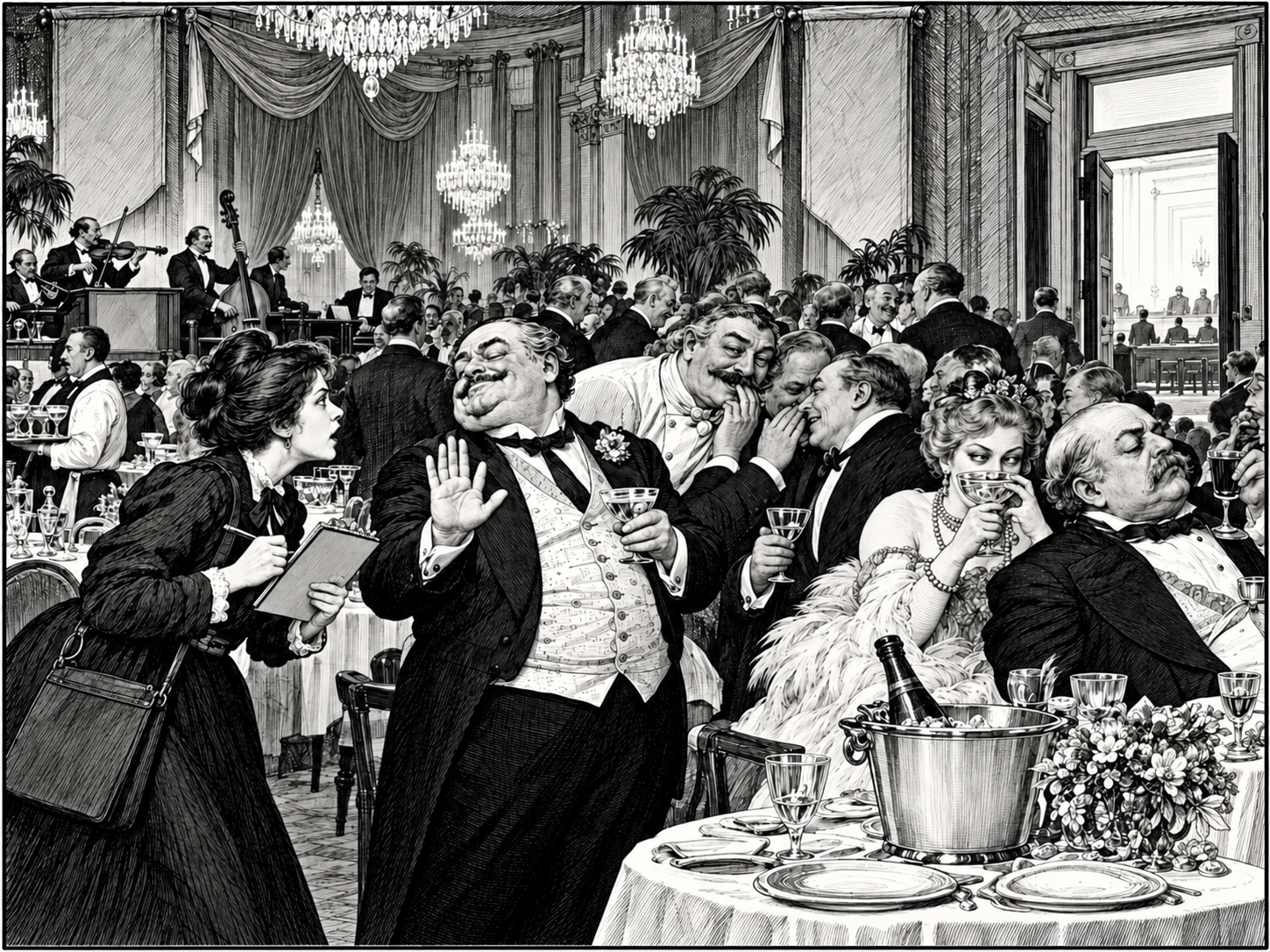
The wine flows freely, the speeches are plentiful, and the reporter discovers that questions are considerably less welcome. Meanwhile, the Town Council chamber remains open to anyone willing to have the conversation in public.
The Napa Valley Register takes a closer look at Yountville's unusually expensive political season.
Five days before an election, the Napa Valley Register reminds Yountville what good journalism looks like.
On March 3, Thomas Keller stood before the Yountville Town Council in his chef's whites and complained that nobody had bothered to ask his opinion about the Yountville Commons. He had reached out to councilmembers, he said, and welcomed a conversation. “Each one of you has my phone number; you know where I am every day.” It was a generous invitation from a man whose restaurant is famous for being extraordinarily difficult to get into. Unfortunately, when the Napa Valley Register took him at his word and requested an interview, Keller declined four times. On October 26, a reporter went to The French Laundry in person. Still no answer.
That small encounter captures something about Yountville's political season that has been difficult to describe without sounding like another participant in the quarrel. Everyone wants a conversation, provided the audience is sympathetic, the questions are predictable, and nobody is obligated to answer them. We have enjoyed a summer of conversation at some of the finest hospitality venues in the Napa Valley, complete with live entertainment, excellent wine, and carefully assembled guest lists. What has been harder to arrange is a conversation in which the people making accusations are expected to explain them. Lauren Spates has apparently discovered the problem too, although she approached it with the additional inconvenience of being a journalist.
Her October 29 article, “‘Commons’ Ground?”, opens a three-part Register series called “A Town Divided.” The first installment examines political influence and money; the next two will explore communications and the housing proposal itself. I am quoted several times, and my architectural firm served as the Town's Owner's Design Consultant on the Commons, so nobody should mistake me for a disinterested spectator. But I can appreciate the reporting without agreeing with every conclusion. In a controversy overflowing with opinions, Spates has done something refreshingly old-fashioned. She has investigated what people actually did.
The Season of the Party
Gary Jabara spent the summer entertaining Yountville residents at Estate Yountville, where the surroundings were splendid and the admission was free. There were mariachi musicians in July, country music in September, Oktoberfest in October, and a birthday cake for the host. Jabara explained that these gatherings concerned issues rather than politics, a distinction that became increasingly difficult to maintain as favored candidates were introduced and opponents of the Commons gathered around the microphones. According to the Register, officials and candidates supporting the project received no invitations. One can hardly blame a host for preferring agreeable dinner companions, although it is an unusual approach to a community-wide discussion.
Spates did not simply report that Jabara held parties and others objected to them. She reviewed recordings, correspondence, campaign filings, and public records, then interviewed people who had attended. She documented an independent expenditure committee that had already spent at least $28,000 supporting four candidates, the involvement of attorneys, expensive records requests, and Jabara's purchase of the Yountville Sun. She also noticed that Jabara had announced he was voting for Joe Tagliaboschi and Hillery Trippe, despite being registered to vote in Orange County. When asked, he explained that he was speaking figuratively. California election officials have yet to introduce a category for figurative ballots, but the explanation presumably satisfied its author.
One of the more affecting interviews came from Jennifer Brusstar of the Tug McGraw Foundation, who initially brought veterans to the gatherings believing they were occasions to honor them. She told Spates that the political speeches made her uncomfortable, and eventually she stopped bringing the veterans because she did not want them used as political pawns. There is something genuinely sad about that account. Veterans living in the Home deserve companionship, recognition, and invitations to community events, without finding themselves unexpectedly seated in the audience for a municipal campaign. Brusstar's explanation needed no embellishment, and Spates wisely gave it none.
An Artificial Intelligence Arrives in Yountville
Then comes Eric Appel, whose contribution to the controversy might deserve a separate chapter in the history of modern municipal finance. Appel, the partner of council candidate Jessi Bugden and an organizer of the petition against the Commons zoning ordinance, apparently impressed Jabara with his examination of the project's finances. Jabara told Spates that Appel had taken the Town's financial information and fed it into “AI or something that sorted it all out.” He praised Appel for doing a fine job of synthesizing the information. This is an extraordinary origin story for a campaign accusing an entire town government of financial incompetence.
The Yountville Sun reported in March that Appel claimed the project was reportedly $70 million over budget. A remarkable discovery, considering that no complete construction budget for the long-term plan had been adopted against which such a deficit could sensibly be measured. I would be delighted to examine the calculations that produced this revelation, but I have never seen them made public. Nor did Appel, Bugden, or Jabara telephone or email me to ask about the architectural work, the construction estimates, or the assumptions underlying the planning studies. The accusations reached the public microphone without first reaching the people who could answer questions about the numbers.
I use artificial intelligence myself, and I find it enormously useful. It can sort complicated information, test hypotheses, and uncover patterns that might otherwise go unnoticed. It can also confuse an estimate with a budget, misunderstand a question, and invent answers with the cheerful certainty of a man explaining golf handicaps after his third martini. The important thing is to examine its work, particularly when the conclusions are used to accuse other people of mishandling millions of dollars. If Appel has uncovered a serious financial error, publishing the calculations would be a public service. Until then, we have an accusation, a billionaire's endorsement of its author, and a mysterious computer that apparently cannot be called to the witness stand.
The Man Who Knew Nothing
Which returns us to Keller, who has twice told audiences I attended that he knew nothing about the Commons. His general manager at The French Laundry, Michael Minnillo, served on Yountville's Affordable and Workforce Housing Oversight Committee, established following the 2018 passage of Measure S. The committee has a narrow, important purpose: ensuring that hotel-tax revenues collected for affordable and workforce housing are spent for their intended purposes. It does not approve the Commons, select its architect, or authorize construction. Its responsibility is oversight of the public money, precisely the financial accountability the project's critics say has been missing.
I presented the Commons to that committee on September 25, 2025, with then-Town Manager Brad Raulston. Minnillo was present as we discussed expenditures, rents, accessibility, the prospective operator, and lease arrangements. The meeting was public, the materials were available, and the committee's function was to examine whether the spending aligned with Measure S. Several months later, on February 17, Keller himself attended part of a public study session devoted entirely to the Commons. Minnillo spoke at that meeting on behalf of the Thomas Keller Restaurant Group, discussing the difficulty of housing employees who commute from distant communities. The Yountville Sun reported both men's presence and published a photograph of Minnillo at the microphone.
None of this proves how much Keller understood or remembered, nor should anyone be required to master every detail of a municipal housing proposal. But it makes his public profession of ignorance difficult to leave unexplored, especially when his general manager participated in the very oversight process created to protect the housing funds. Keller may have excellent reasons for opposing the proposed unit sizes, parking arrangements, or financial structure. He has also said he supports workforce housing and already accommodates some employees in properties he controls. Those are useful subjects for a serious interview, which makes his unwillingness to speak with the Register all the more curious. On March 3, he invited a conversation with people who knew where to find him. The reporter found the address.
A Tale of Two Newspapers
The Yountville Sun occupies an interesting position in all this. After its former publisher suspended operations in May, Jabara bought the newspaper and revived it in July, promising that its editorial independence would continue. I have no evidence that he instructs its editor what to publish, and keeping a local newspaper alive deserves acknowledgment. But independence cannot exist solely as a promise from the proprietor, particularly when the proprietor is financing political expenditures, hosting campaign gatherings, and publicly criticizing the government his newspaper covers. The real test is whether the newspaper is prepared to ask its owner the same uncomfortable questions it asks everyone else.
The Sun has covered public meetings, recorded criticism, and published useful information, including the February study session attended by Keller and Minnillo. What it has not consistently done, in my view, is pursue the next question. A candidate claims the project is $70 million over budget. Compared with which budget? A businessman says the council wasted millions. Which expenditure was improper, and which council decision authorized it? A celebrated restaurateur says nobody discussed the Commons with him. What was he doing at the February study session, and what did his general manager learn while overseeing Measure S expenditures? None of those questions requires the newspaper to support the Commons. They require it to take its own reporting seriously.
Spates offers a useful contrast. She checked Jabara's voter registration, examined his political committee's spending, sought responses from the people involved, and searched court records when he threatened litigation against an anonymous whistleblower. She also disclosed that the Register had applied for a grant from the Town's Community Foundation, an acknowledgment of a potential interest that readers had every right to know about. The article is not perfect. It describes the Commons as having “fell apart,” when the council actually repealed the enabling zoning ordinance after the petition, leaving the property and the Town's housing problem exactly where they were. But a reporter need not arrive at all my conclusions to earn my appreciation for doing the work.
One other correction is worth making. The Register quotes me as saying that 90 percent of Yountville’s residents live at the Veterans Home or in its mobile-home communities. Obviously that’s not true. What I actually told the reporter was that approximately 90 percent of the people living in Yountville’s deed-restricted housing are residents of the Veterans Home or the town’s mobile-home communities. I was describing the composition of Yountville’s existing affordable housing, not suggesting that nine out of ten people in town live in those two places. That is a rather consequential distinction in a community where the central argument is about who can afford to live here especially since so much of it is specifically for seniors. I have asked the Register for that correction.
The Room We Already Have
Five days from now, Yountville will elect a mayor and two councilmembers. Whatever the result, the former elementary school property will still belong to the Town, the money already invested will remain spent, and the workers who cannot afford to live near their jobs will still have to commute home. The election will not create a financial alternative, resolve the housing question, or make the consequences of public decisions disappear. Those matters will eventually return to the council, where the competing arguments must be considered in the open. The people asking to change the Town's direction will have an opportunity to explain what that direction should be.
And Yountville already has a perfectly suitable place for that discussion. The Town Council chamber is neither glamorous nor especially comfortable, but it has microphones, published agendas, public records, professional advisers, and seats that do not require an invitation from a hotel owner. Anyone can attend, offer criticism, ask questions, and challenge the assumptions behind a proposal. Keller has used it, Minnillo has used it, Appel has used it, and so have hundreds of residents whose opinions differ. The more demanding task is to arrive with evidence, remain for the answers, and accept that public discussion involves people who may not agree with you.
The Register has two installments remaining, and I will read them with the same interest and skepticism I brought to the first. I am pleased that Spates is asking questions, but I do not need her to become an advocate for the Commons or an opponent of its critics. I would rather have another independent reporter willing to follow an argument wherever the evidence leads, even when that destination is inconvenient for me. With five days remaining before the election, that seems a more useful contribution to Yountville than another banquet, another campaign email, or another accusation whose supporting calculations nobody can find.
Disclosure: Brendan Kelly is principal of Kelly + Morgan Architecture, which served as the Town of Yountville's Owner's Design Consultant on the Yountville Commons. That scope is complete.
