
One week before the election, Yountville is charming, prosperous, and loved. But can a town devoted to preserving what it has also make room for people and possibilities it has nearly lost?
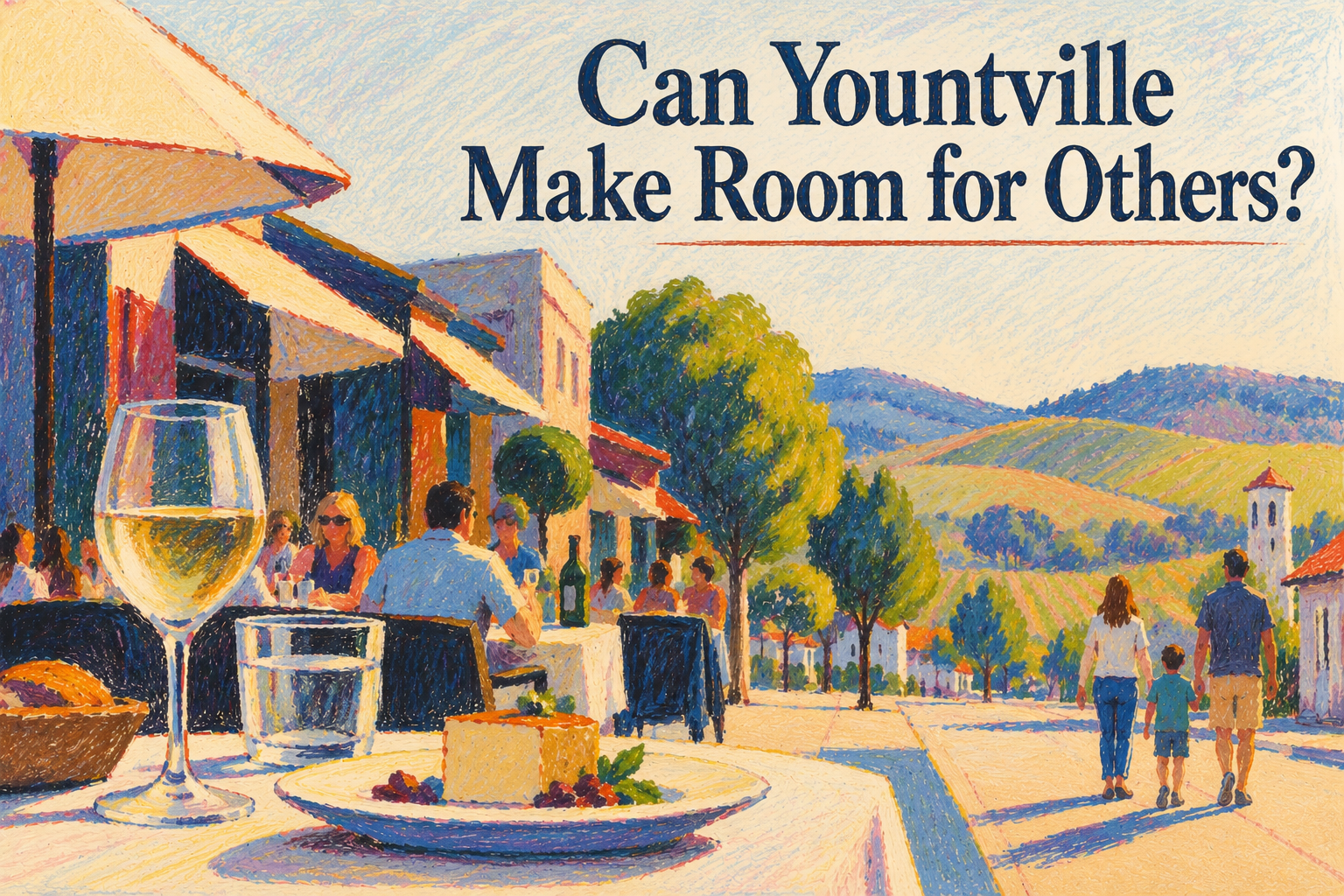
Yountville has become extraordinarily successful at welcoming visitors, but can it still make room for the working people who might call it home? This illustration captures the contrast at the heart of the essay: a flourishing hospitality economy in the foreground and the quieter possibility of another generation of families finding a place in the village beyond. The question is not whether Yountville must choose between prosperity and community, but whether its remarkable wealth can help sustain both.
The View From Washington Street
There may be no more convincing argument for the success of the American hospitality industry than a pleasant Saturday fall evening in Yountville. The sidewalks are immaculate, the gardens are tended, the restaurants are celebrated around the world, and hotel guests cheerfully pay more for a night's sleep than many Americans spend on a month's rent. Wine arrives in beautiful glasses, accompanied by explanations of its geological origins and occasionally the suggestion that a particular hillside possesses a personality. Nobody is explaining the geological origins of the people who wash the glasses. They arrive before the guests and leave after them, often driving considerable distances to participate in an economy that has become extraordinarily successful without making much room for them.
Yountville has good reason to be proud. It is a small town that accomplished something very few California communities managed during the last half-century: it became prosperous without becoming ugly. The surrounding agricultural landscape was preserved, the commercial center remained walkable, and an extraordinary hospitality industry developed without turning Washington Street into a six-lane highway lined with franchise restaurants and drive-through pharmacies. The result is a place admired by people who live here, people who work here, people who visit every year, and people who dream of someday affording the privilege. This achievement was neither an accident nor the product of a single charismatic leader. It came from decades of planning, restraint, investment, public service, private enterprise, and the willingness of earlier generations to make decisions whose benefits would arrive long after the people making them had left the room.
The financial results are impressive. In June, Yountville collected a record $971,724 in hotel occupancy taxes, nearly 25 percent more than the previous June, with average room rates reaching $821. An earlier study of the visitor economy estimated that hotel taxes supplied approximately 65 percent of the Town's general fund, an astonishing arrangement in which people who do not live here pay for much of the government serving those who do. Restaurant spending contributes additional revenues. It is a remarkably agreeable arrangement, particularly for residents familiar with the financial problems confronting other small California municipalities. Yountville has the enviable privilege of contemplating its future with a healthy bank account, substantial public assets, and the continuing enthusiasm of visitors willing to pay handsomely for the experience.
But prosperity has a peculiar way of concealing its unfinished business. Yountville's streets are beautiful, its accounts are healthy, its property values are extraordinary, and its elementary school has closed because the district could no longer sustain it. The houses remain, but the families that once occupied them are increasingly sold as second or third homes. The people who care for veterans, maintain the parks, manage the hotels, prepare the meals, and operate the public facilities generally cannot afford to establish their own households here because the town has severely limited new homes.. It is possible, apparently, to become an exceptionally successful town while gradually losing some of the things that made it a town in the first place.
One week from today, on November 3, Yountville will elect a mayor and two members of its five-person Town Council. The campaign has produced the customary promises of responsible leadership, improved communication, greater transparency, fiscal discipline, and a better Yountville, a collection of objectives so universally agreeable that one wonders how the town managed to become divided over them. Everyone wants a better Yountville. Everyone wants to protect its character. Everyone loves the place, or at least the version of the place that introduced itself to them when they first arrived.
The difficulty begins when someone asks what, exactly, those beautiful words will require.
Making Room for Others
There is an expression that has appeared repeatedly in discussions about Yountville's future: making room for others. It sounds harmless enough, the sort of thing a kindergarten teacher might write on a classroom bulletin board beneath a collection of construction-paper handprints. In Yountville, however, it describes a rather difficult social proposition. It means accepting that a community largely organized around retirement, expensive real estate, and the entertainment of visitors might also benefit from the presence of some younger residents who are neither wealthy nor retired. Not thousands of them. Not enough to turn Yountville into a suburban subdivision or suddenly provide housing for every person employed in town. Just enough to restore some of the generational variety that once came naturally to an ordinary American village.
The circumstances are unusual. Yountville is home to the 615-acre Veterans Home of California, a venerable institution established in 1884 to provide residential care and services for those who served their country. It also has two substantial manufactured-home communities, Bella Vista and Rancho de Napa, containing 299 homes according to the Town's adopted Housing Element. Eighty percent of those homes are reserved for people aged 55 and older. These are important and legitimate residential uses, and the Veterans Home is an essential part of Yountville's history and identity. But together they illustrate how much of the town's residential landscape is already dedicated, by mission or regulation, to seniors.
There is nothing wrong with older people wanting to live in a beautiful place. Many of them built it, protected it, volunteered for its institutions, supported its businesses, and contributed the time and money necessary to preserve the village that everyone now admires. Aging residents are entitled to security, companionship, and the pleasure of remaining in familiar surroundings. The question is not whether they belong. It is whether, in making Yountville such an appealing place to retire, the community has made it extraordinarily difficult for almost anyone else to begin.
Consider the workforce. Yountville's adopted Housing Element, using federal employment data from 2019, reports that approximately 82 percent of people working in town live somewhere else. At the Veterans Home, approximately 90 percent of employees commute from outside Yountville. Those figures and their implications are hardly obscure. The town functions as a major employment center while serving as a residential community for only a relatively small share of its workers. This arrangement is neither accidental nor particularly mysterious. Workers follow the available wages, housing follows the purchasing power of prospective residents, and Yountville's existing houses have become attractive to people whose financial resources have little relationship to the jobs available on Washington Street.
Nobody seriously imagines that the Commons, or any other single property in town, could house the thousands of people who work here. That was never a realistic objective. The more modest ambition was to create opportunities for a comparatively small number of them to become neighbors as well as employees, contributing something to the life of the village beyond their working hours. A restaurant manager might walk home after dinner service. A caregiver at the Veterans Home might live close enough to respond to an emergency without beginning another lengthy commute. A young couple might discover that they could remain in Yountville even if their parents had not purchased a house here forty years ago.
Making room for others is not a demand that Yountville become something unrecognizable. It is a question of whether the community has room for anyone whose biography does not begin with a successful career somewhere else.
The School That Might Be Needed Again
The former elementary school offers perhaps the most revealing evidence of Yountville's predicament. It closed in June 2020, a consequence of declining enrollment across the school district. For generations, children had walked through its doors, played on its grounds, and supplied the village with the small, noisy interruptions that distinguish a living community from a beautifully maintained collection of buildings. Its closure was a demographic milestone, even if it did not initially command the attention that a proposed apartment building or hotel expansion would later receive. A community had reached the point where one of its most ordinary civic institutions was no longer viable.
The Town purchased the former school property in 2024 for approximately $11 million, preserving local ownership of one of the few substantial parcels remaining in the village. The Commons planning process explored housing, recreation, civic activities, gardens, and public gathering spaces, but one of its more important innovations was architectural rather than programmatic. Yountville's existing deed-restricted housing, produced largely through inclusionary requirements attached to earlier hotel and residential developments, consists overwhelmingly of one- and two-bedroom homes, with a smaller number of three-bedroom units and virtually no studios. This reflects the economics of private development. One-bedroom apartments generally command higher rents than studios, often with less tenant turnover, giving developers little financial incentive to produce smaller accommodations for a young, mobile workforce. Yet studios are precisely what many single hospitality employees, caregivers, and younger workers need and can afford. The Commons initially emphasized studios and one-bedroom apartments to address this neglected segment of the housing market, not because the Town had concluded that families were unwelcome or that larger homes were unnecessary. The distinction matters because a housing program should respond to actual household needs rather than simply reproduce the unit mix that private developers have found most profitable.
The more consequential feature of the Commons was its form-based design, which established the scale, massing, placement, and architectural character of modest village buildings without permanently prescribing the number or size of apartments inside them. A village house containing eight studios and one-bedroom apartments could instead be configured as five two-bedroom homes, or perhaps four three-bedroom homes, within substantially the same building envelope and at a broadly comparable construction cost. Depending on the income levels served and the resulting rents, those arrangements could also produce comparable operating revenue while accommodating very different households. Rather than committing the entire property to one demographic profile, the Commons established a repeatable architectural framework that could respond to changing demand over successive phases. One building might accommodate eight single workers, another five couples or small families, and another four households with children, all within a coherent neighborhood of gabled roofs, gardens, paths, and shared public spaces. The initial unit mix was therefore a response to an identified shortage, not a permanent limitation on what the property could become. That flexibility is particularly important in a town that has already lost its elementary school and has almost no opportunity to accommodate younger families. The Commons could provide modest homes for workers today while retaining the capacity to welcome growing households tomorrow, potentially contributing to the conditions that might someday support a small school again.
The point of form-based design was never simply to accommodate different kinds of housing. It was to establish the scale, proportions, architectural character, and relationship of buildings to streets, gardens, and public spaces, while allowing their uses to evolve over generations. A well-designed village should not require its buildings to become obsolete every time the economy, population, or community's needs change. If this sounds like some revolutionary planning theory, consider the old building at Washington and Creek Streets. Built as a saloon around 1900, it later became a steam laundry, then a modest restaurant operated by Don and Sally Schmitt, and eventually one of the most celebrated restaurants in the world. Nobody who laid those original stones could have imagined Thomas Keller, three Michelin stars, or people traveling halfway around the world to eat dinner there. They simply built a good building, and Yountville spent the next century finding new reasons to use it.
Yet there has been remarkably little public discussion of whether portions of the publicly owned Commons property ought to preserve the possibility of a small school someday. Perhaps that school would be public, perhaps it would involve another educational arrangement, and perhaps the demographic conditions necessary to support it will not emerge for many years. Reopening a public school would require the participation of the district and sufficient enrollment, not merely a hopeful resolution from the Town Council. But long-range planning is precisely the discipline of protecting possibilities that cannot yet be exercised. A community that has spent decades preserving vineyard views ought to be capable of considering whether it should also preserve a place for children who have not yet been born.
The irony is difficult to overlook. The site was once a school, and the Town purchased it after the school closed because of declining enrollment. During the ensuing planning controversy, enormous attention was devoted to the precise number, size, appearance, and placement of proposed housing units. Far less attention was devoted to what the community might look like if younger households actually began returning, or whether the site should retain the flexibility to accommodate educational uses in that future. It would be unfortunate if a debate about preserving Yountville's character concluded without anyone seriously considering the restoration of one of the institutions that once defined it.
The school grounds represent something considerably larger than the acreage shown on a survey. They are one of the few places where Yountville can still make a consequential choice about what sort of community it hopes to become.
The Years of Work Nobody Can Put on a Postcard
The Commons did not appear one morning as an unsolicited architectural rendering slipped beneath the Town Hall door. It emerged from years of discussion about affordable housing, public land, civic facilities, and the continuing disappearance of ordinary working households. In 2018, Yountville voters approved Measure S by an overwhelming margin, dedicating an additional percentage point of hotel occupancy tax to affordable and workforce housing. The political and financial principle was sensible: a portion of the extraordinary wealth generated by visitors could help address the housing pressures associated with the economy they supported. The school property subsequently presented an opportunity to apply that principle to land the community could own and control.
What followed was the occasionally tedious but indispensable work of government. There were community meetings, surveys, advisory committees, financial studies, environmental reviews, architectural investigations, planning hearings, and repeated revisions. Residents expressed competing preferences about parks, buildings, housing, civic facilities, parking, and the future of the old school grounds. The Town Council unanimously adopted a conceptual site plan in March 2025 and completed subsequent environmental and zoning work. An organized referendum effort challenged the zoning, and the Council repealed the ordinance in June 2026 rather than place it on the ballot. The legal framework changed, but the publicly owned land, the previous studies, and the documented housing needs all remain.
None of that means the Commons must be built exactly as previously proposed. Questions about construction costs, public borrowing, housing operators, density, architecture, and the proper role of municipal government deserve serious answers. It is reasonable to explore nonprofit development partnerships, revised unit mixes, alternative financing arrangements, or a longer implementation schedule. But the analysis of an alternative begins with an actual alternative. A smaller project must establish how many homes it would provide and at what cost. A different delivery method must identify who would build, finance, maintain, and manage the property. A substantially revised program must explain which public benefits would remain and which would be surrendered.
This is the difference between questioning a plan and replacing it. The first requires skepticism, which is easy to acquire and occasionally available in wholesale quantities. The second requires knowledge, persistence, professional work, financial judgment, and a willingness to explain tradeoffs to people who will not all be pleased by the result. A community should welcome careful examination of its public projects. It should also recognize that the years spent producing a detailed plan represent something more substantial than the campaign promise to produce a better one.
The Housing Element Needs More Than Encouragement
Yountville's Housing Element was certified by the State of California in August 2024, an important accomplishment in a state where many communities have struggled to satisfy housing requirements. The document examines the town's population, land use, employment, housing stock, affordability, and opportunities for future construction. It also contains observations that ought to be familiar to everyone participating in the current debate. The concentration of senior housing, the limited availability of multifamily homes, the shortage of housing affordable to workers, and the extraordinary commuting patterns are not speculative criticisms invented during an election. They appear in the Town's own adopted planning record.
The most recent production numbers are sobering. During the 2023 to 2031 planning cycle, Yountville must accommodate a regional allocation of 72 homes across several income categories. As of July 2026, 13 had been built and 16 more approved, but only one of the required 19 very-low-income homes had been completed, with one more approved. The Town itself acknowledged in September that it was not on pace to meet this portion of its obligation. Of 1,372 existing homes counted in the same report, only 100 were deed-restricted as affordable to moderate- and lower-income households. These are not catastrophic numbers for a community of Yountville's size, but neither are they evidence of a problem that will solve itself through continued expressions of good intentions.
There is an additional difficulty that government income categories tend to obscure. A substantial portion of Yountville's missing younger population consists of people whose household incomes may be too high to qualify for deeply subsidized housing but far too low to purchase a typical detached house in town. They include couples with professional careers, skilled tradespeople, public employees, and working parents who might have been ordinary middle-class homeowners here a generation ago. California's affordable-housing programs address important needs, but they do not automatically reconstruct the missing middle of a community's housing market. That requires a broader conversation about housing types, attainable rents, family-sized units, and the relationship between wages and property values.
The Housing Element is a useful diagnosis. What it cannot do is produce a future merely by existing in a handsome binder at Town Hall.
Growing Old in Yountville
The housing question looks different from inside Yountville's manufactured-home parks. Many residents purchased their homes believing they had found one of the few remaining opportunities for relatively affordable ownership in the village. Unlike owners of conventional houses, however, they generally own the structure without owning the land beneath it. Monthly space rent is therefore an unavoidable expense, and its future increases can affect both household security and the value of the home itself. For retirees living on fixed incomes, that uncertainty can become particularly consequential.
The Town has been considering a mobile-home space-rent stabilization ordinance, with the Council directing further work in August. The issue raises legitimate concerns on both sides. Park owners have expenses and property rights, and residents have substantial investments that can become difficult to protect when the economics of land ownership and homeownership are separated. Designing an ordinance that provides reasonable protections while satisfying legal requirements takes care and expertise. The work is neither glamorous nor especially likely to generate an enthusiastic campaign postcard, but it matters greatly to the people affected.
What is interesting is how closely this issue resembles the Commons debate when the details are stripped away. In one case, Yountville is considering how to make room for people who cannot afford to enter the market. In the other, it is considering how to protect people whose continued residence may become less secure as land values and operating costs change. The first concern often involves younger households, while the second disproportionately involves older residents. Both reflect the increasing distance between the value of Yountville real estate and the financial circumstances of people who would like to make their lives here.
A community capable of protecting its historic architecture and scenic landscape ought to be capable of discussing the protection of its human relationships with comparable seriousness.
When a Town Becomes a Resort
There is a word for what has happened to Yountville over the last several decades: resortification. It is not a formal planning designation, but it describes a transformation that any longtime resident can recognize. Properties that once served local needs increasingly serve visitors. Homes become investments, commercial spaces become luxury destinations, and the economic logic governing the village gradually shifts from the requirements of everyday living to the expectations of people purchasing a brief and expensive experience. None of these changes necessarily involve bad intentions. Most are the predictable decisions of businesses and property owners responding rationally to an extraordinarily valuable location.
The cumulative effect is another matter. Walk through Yountville on a Saturday evening and consider how many illuminated doorways offer a place for local people to gather without purchasing an expensive meal, wine tasting, or hotel experience. There are exceptions, of course, and the Town has invested in public recreation, community facilities, parks, and cultural activities. But the distinction between a vibrant hospitality district and a vibrant town becomes difficult to ignore. Visitors are everywhere, yet the opportunities for spontaneous, inexpensive local social life can seem remarkably limited. A busy sidewalk is not necessarily evidence of a flourishing neighborhood if almost everyone on it has a reservation somewhere.
The old American town possessed an informal social geography that rarely appeared on architectural drawings. There were diners, taverns, bookstores, neighborhood shops, school events, recreation halls, and other places where people encountered one another without requiring a special occasion or an impressive credit limit. These establishments were seldom beautiful enough to feature in a visitor brochure. Their contribution was more consequential: they provided the settings in which familiarity became friendship and people gradually developed a shared sense of belonging. A local teenager could afford to occupy a table, a retired neighbor could recognize the bartender, and a family could go out without calculating whether the evening would consume a substantial portion of its grocery budget.
Yountville retains valuable civic institutions and a community life that many residents work hard to sustain. But there is a difference between organizing an occasional public event and possessing the everyday places where a community gathers naturally. A visitor may regard the absence of ordinary local businesses as evidence of refinement, since there are fewer distractions from the curated experience. A resident may experience the same absence as a loss of social possibility. It is entirely possible for Yountville to become more attractive as a destination while becoming less convenient, less affordable, and less socially varied as a place to live.
The hotel rooms are full. The restaurants are busy. But where does the town itself go on a Saturday night besides waiting for an expensive beer at an already crowded Panchas?
What the Land Becomes Next
The prosperity of Yountville's hospitality industry is especially interesting when considered beside the economic changes unfolding in the surrounding Napa Valley. In an October 25 essay entitled What the Land Becomes Next, vintner and rancher Ted Hall examines an agricultural economy confronting a structural correction after decades of expanding vineyard and winery investment. Hall chaired the county's Agricultural Protection Advisory Committee in 2015, giving him an unusually informed perspective on the relationship between land, wine production, commercial expectations, and public regulation. His central observation is that Napa built an elaborate system for creating vineyards and wineries without developing a comparable system for helping landowners decide what happens when those businesses cease to be economically viable.
The numbers are striking. Hall reports that approximately 6,000 acres of Napa vineyard have been removed since the fall of 2024, with an estimated 8,000 acres going unharvested in 2025. His analysis describes a region whose winery capacity expanded far beyond the volume of grapes grown locally, encouraging ever more expensive land, facilities, brands, and hospitality operations. Now the industry is adjusting to demand that no longer supports all the expensive production and marketing infrastructure accumulated during the long expansion. Some vineyards will be replanted, some wineries will survive because of distinctive products and loyal customers, and other properties may eventually find uses as estates, retreats, or alternative commercial facilities. None of those transitions will be simple, and many will involve substantial financial losses.
Hall is not predicting the end of Napa wine, nor does his analysis establish that Yountville's hotels are about to suffer an equivalent correction. Indeed, the town's recent hotel-tax receipts demonstrate the resilience of its particular hospitality economy. But the contrast is revealing. Just outside the village, a major industry is reconsidering assumptions about luxury demand that seemed dependable for decades. Inside Yountville, the public finances depend heavily on the continued willingness of affluent visitors to spend large sums on precisely the sort of premium experiences whose economics are being tested elsewhere in the valley. It is not unreasonable to ask whether a town should regard record room rates as permanent evidence of economic security when the industry surrounding it is discovering how quickly expensive assumptions can become obsolete.
The potential realignment of wineries and vineyard properties also raises important land-use questions beyond Yountville's municipal boundaries. Buildings originally justified as agricultural production facilities may become candidates for retreats, hospitality, private estates, or entirely different activities. Those changes will require their own planning judgments and regulatory decisions, and their effects may eventually influence visitor patterns throughout the valley. The agricultural preserve has been essential to Yountville's identity, but the economic activity occurring within that preserve is not frozen in time. Preserving the landscape and preserving the businesses that have occupied it are related but separate challenges.
Hall's essay ends with the recognition that land does not cease to exist when the enterprise occupying it becomes unsustainable. It will become something, whether through deliberate planning or the accumulated consequences of neglect and economic pressure. The parallel with Yountville is difficult to miss. The former school property will become something. The historic winery will become something. The surrounding vineyards will continue changing, as will the community's population and the economics of hospitality. The question is whether those changes will be guided by deliberate public choices or simply accepted after private markets have made the decisions for everyone.
What the Old Bricks Remember
A few blocks from the former school stands one of the most important surviving witnesses to Yountville's earlier economic life. The Groezinger Wine Cellars, constructed beginning in 1870 and listed on the National Register of Historic Places in 1982, belong to the agricultural and industrial village that existed long before the world discovered its restaurants. The buildings survived changes in the wine business and were adapted into commercial uses, becoming Vintage 1870 and eventually V Marketplace. Their history demonstrates that preservation and commercial activity need not be enemies. Buildings can acquire new purposes while retaining the physical characteristics that connect them to the past.
Now the property owner, Gary Jabara, is pursuing substantial alterations to the historic winery building as part of the Estate Yountville redevelopment. The submitted application proposes retail spaces on the first floor and a ballroom assembly space on the second, with interior and exterior modifications that may require structural and seismic interventions in the original masonry building. Such improvements can raise complicated preservation issues, particularly when changes may affect original openings, structural systems, and other character-defining features. On October 23, the Town issued a request for an independent historical-resource and environmental review. The application has not received final approval, and the independent review is intended to help establish whether the proposed work satisfies applicable preservation requirements.
It is worth considering how these decisions relate to the controversies surrounding the Commons. Much of the criticism of workforce housing has focused on the possibility that new buildings might alter Yountville's appearance or undermine its cherished village character. But historic character is not merely a question of whether new architecture looks sufficiently quaint. It resides in authentic materials, original construction, inherited relationships between buildings, and the visible evidence of how a place came into being. A newly constructed building can be redesigned if its appearance proves unsuccessful. Original nineteenth-century masonry removed during redevelopment cannot be recreated simply by commissioning a more historically sympathetic rendering.
There is no reason to presume that commercial development and historic preservation are inherently incompatible, nor should the owner of a landmark be denied the opportunity to propose reasonable improvements. But public scrutiny must be as exacting when the applicant is an influential business owner as when the proposal involves public housing or an ordinary residential project. Historic preservation standards are most meaningful when applied consistently, without regard to commercial prominence or political influence. The buildings have survived long enough to deserve a review conducted on their merits, rather than one shaped by the personalities surrounding the current election.
After all, Yountville cannot claim to be preserving its historic character if the standard of preservation changes with the identity of the person holding the building permit.
The Difference Between Loving a Place and Planning for It
The approaching election has generated unusual attention, political activity, and campaign spending for a community of Yountville's size. A committee called Build a Better Yountville has reported expenditures associated with the campaign, and public debate has focused on the relationship between commercial interests, political leadership, and future land-use decisions. Participation by property owners is legitimate, and campaign contributions or independent expenditures do not themselves establish improper influence. Nor does disagreement with a long-developed public project demonstrate that an alternative cannot succeed. But the concentration of important unresolved decisions makes transparency about money, public positions, and future proposals particularly valuable.
A better Yountville is certainly an appealing ambition, but the phrase does not describe a policy. It offers no explanation of how many workforce homes should be built, what income levels they should serve, how construction should be financed, or whether the Commons should preserve a future educational use. It says nothing about what protections might be appropriate for manufactured-home residents, how a historic winery should be adapted, or whether the commercial center needs more opportunities for ordinary local gathering. These questions do not admit easy answers, and reasonable people can disagree about them. But a detailed public record makes it possible to compare approaches, understand costs, and distinguish intended benefits from consequences that have not yet been considered.
The most useful distinction is not necessarily between incumbents and challengers, longtime residents and newcomers, or people who supported the Commons and those who opposed it. It is between proposals whose costs and consequences can be examined and aspirations that remain undefined. Past decisions deserve scrutiny, and experience should never become an excuse for avoiding difficult questions. New ideas also deserve consideration, but they become useful only when translated into workable policies. The test for any public official is the ability to connect a stated objective with the tedious practical requirements of accomplishing it.
Local governments rarely reward that sort of patience with applause. Much of the important work happens during long meetings in which financing structures, drainage systems, housing regulations, environmental impacts, maintenance obligations, and legal requirements are explained to rooms containing people who had hoped to get home before dinner. The proceedings are not particularly romantic. Yet these are the mechanisms through which communities preserve their assets, avoid expensive mistakes, and make decisions whose benefits may not become apparent for decades. A town as prosperous as Yountville can afford to undertake that work carefully. It cannot afford to substitute enthusiasm for it.
The People Who Are Not in the Room
Among the institutions that define Yountville, the Veterans Home deserves special attention. Its presence is much older than the luxury hospitality industry, and its purpose is inseparable from the community's history. California has invested heavily in modernizing the campus, including new skilled-nursing facilities intended to improve care for residents whose needs are increasingly complex. But the difficulty of recruiting and retaining qualified employees in an expensive housing market has been recognized in CalVet's own long-range planning. New buildings are an accomplishment, but they provide little comfort to residents when the staffing necessary to operate them is unavailable.
The connection between housing and caregiving should be obvious, yet it is surprisingly easy to overlook when discussing the appearance of new buildings or the costs of public projects. Caregivers who spend substantial portions of their days commuting have less time for their families, greater transportation expenses, and fewer opportunities to participate in the community where they work. The same is true of many hospitality employees, public workers, maintenance personnel, and service providers. They are essential to the daily functioning of Yountville, even though the town's housing market largely prevents them from becoming residents. Their absence from neighborhood meetings and political debates is therefore not especially mysterious.
More troubling is the absence of young people who have not yet had the opportunity to establish a life here. They do not attend Council meetings because they live somewhere else. Their children do not appear in local school enrollment because the school is closed and their families live in Napa, American Canyon, Vallejo, and beyond. Their preferences are seldom represented in surveys of existing residents, and their interests are difficult to measure through election results in a community where they cannot afford to vote because they cannot afford to live. A town can sincerely consult everyone within its boundaries while failing to hear from the people its decisions have placed outside them.
This is one of the central limitations of planning exclusively around the preferences of those who already possess a place in the community. Existing residents have legitimate concerns about change, and democratic government must take those concerns seriously. But long-range planning must also consider the people who will live with the consequences of present decisions, including those who cannot yet participate in making them. A generation ago, many of today's Yountville residents were the young people seeking an opportunity to establish themselves in a desirable place. The circumstances have changed so dramatically that the same opportunity may now require considerably more wealth than it did when they arrived.
The Fork in the Road
Perhaps the most important thing to understand about Yountville is that its prosperity and its demographic difficulties are not competing stories. They are consequences of the same extraordinary transformation. The agricultural preserve protected the landscape, careful planning maintained a desirable village, hospitality made the town wealthy, and scarcity made its existing houses enormously valuable. Those achievements came with costs that were not immediately visible. They appeared gradually in longer commutes, aging households, fewer children, greater dependence on visitors, and the increasing difficulty of sustaining an ordinary middle-class life within the town limits.
None of this requires Yountville to abandon the qualities that made it special. A town does not need large apartment blocks surrounded by asphalt to accommodate more people, nor must it surrender its gardens, historic buildings, village scale, or hospitality industry to welcome a younger generation. It does need to acknowledge that the success of the village as a resort is not necessarily the same thing as the success of the village as a community. Those objectives can reinforce one another, but they are not interchangeable. A beautifully restored hotel is a valuable asset, yet it does not replace a school. A celebrated restaurant contributes to the economy, yet it does not replace the informal social institutions where residents spend time together. And a thriving retirement community, however welcome, is not a substitute for the broader range of households that once populated Yountville's streets.
What makes this election consequential is the number of decisions arriving together. The Commons needs a workable future. The Housing Element requires sustained attention to its unmet objectives. Manufactured-home residents are seeking greater security. The Groezinger Winery faces an important historic-preservation review. The Veterans Home needs a dependable workforce, the hospitality industry needs employees, and the Town must continue managing the public revenues that make its considerable civic amenities possible. Beyond its boundaries, Napa's agricultural economy is adjusting to changes that may reshape the use and value of land throughout the valley. Each problem has its own legal requirements and practical constraints, but together they describe a community deciding how the benefits of its prosperity will be carried forward.
Yountville does not need to apologize for being charming or successful. It should celebrate the foresight of the people who protected its agricultural setting, preserved its historic buildings, built its civic institutions, and created one of America's most admired small towns. That inheritance is immensely valuable, and nobody should casually propose dismantling it. But preserving a community is a more demanding undertaking than preserving its appearance. It requires understanding which qualities made the place worth loving and which opportunities must remain available if future generations are to develop the same affection.
One day the present arguments will become history, just as the controversies surrounding earlier planning decisions have largely disappeared into the attractive landscape they helped create. The people who live here fifty years from now may know little about the personalities who dominated the election of 2026. They will know whether the Groezinger Winery survived with its character intact, whether the manufactured-home communities remained secure, and what became of the former elementary school property. They will know whether the sidewalks are still filled almost entirely with visitors or whether the village also contains younger residents, working families, and children making the ordinary noises that have become so uncommon here.
Perhaps the most telling possibility is a child walking to school in Yountville again. Not because a restored school building would solve every problem, or because a handful of workforce apartments would reverse decades of demographic change, but because such a morning would signify that the community had succeeded in preserving more than its buildings. It would mean that Yountville had found a way to make room for another generation without destroying the qualities that made earlier generations want to live here. For a town that has become exceptionally good at protecting the place it inherited, that may be the most important measure of what happens next.
The question is no longer simply how to preserve the Yountville you love. It is whether you can preserve enough of its possibilities for someone else to love it, too.
