
The Price of Planning Ahead
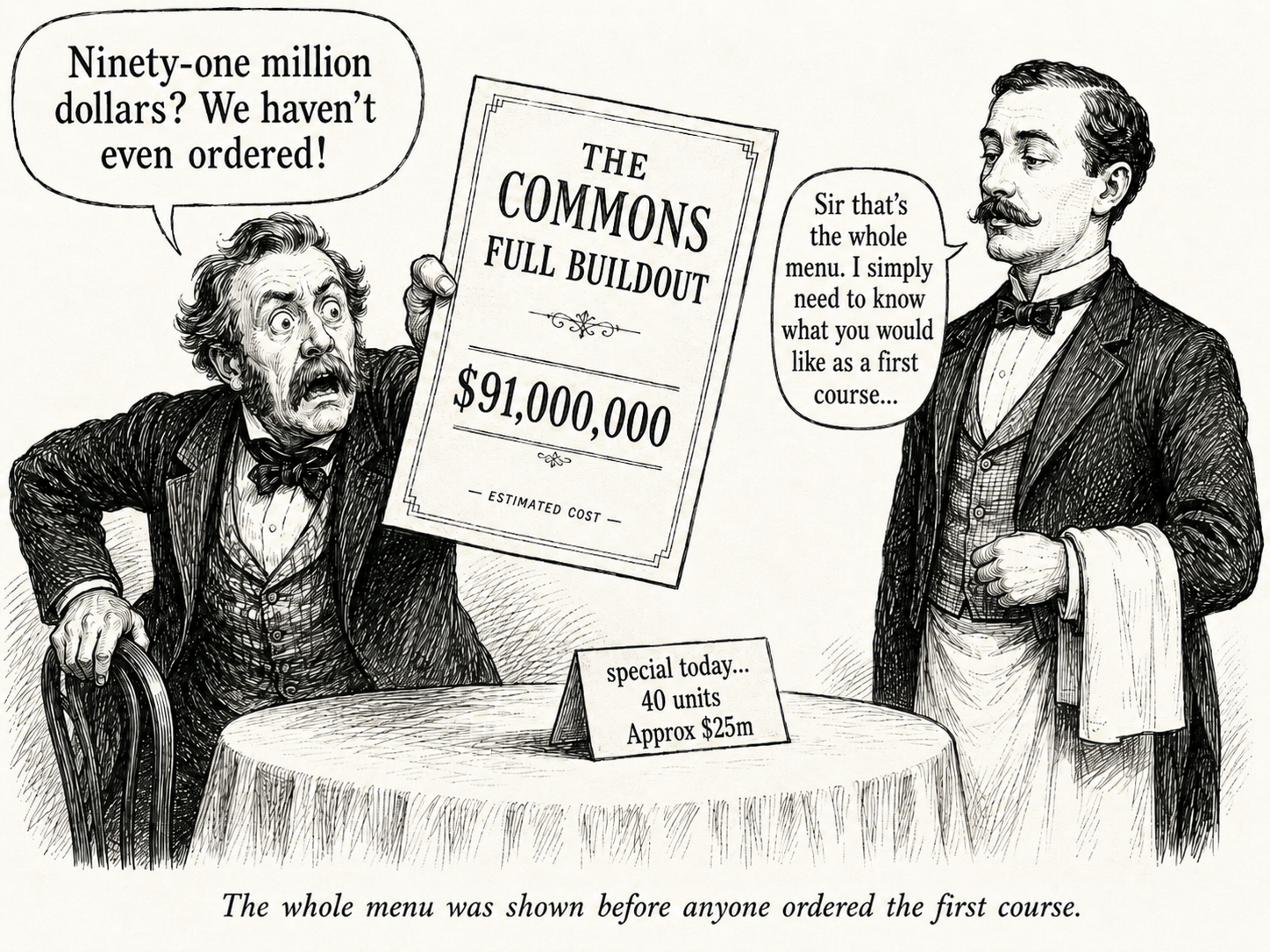
The cartoon captures the mistake at the center of the Commons cost debate: the Town showed the full long-term menu so it could decide what to build first, but many residents read that menu as if the whole bill had already come due.
Why Yountville had to understand the cost of the whole Commons before deciding what part it could actually build.
The number was said aloud in a public room for the first time in February 2026. A consultant from BAE Urban Economics stood before the Council and the residents who had come to listen and put the full cost of the Commons on the record: roughly $91 million. Council and citizens heard it in the same moment, which is how a public process is supposed to work and also how one can go wrong. The figure was large because the thing it described was large. Within days it had detached from its context and begun to travel on its own, repeated as though it were the price of a decision the Town had already made.
It described none of those things. The $91 million was not a construction contract, not a check the Town was preparing to write, and not a vote to build the full Commons. It was an estimate of what the entire seven-acre site might cost if, over many years and with partners not yet at the table, the Town eventually built out the whole civic and housing framework it had studied. The Town was not at the end of a construction process. It was near the beginning of a decision, trying to understand the full extent of the site before choosing what it could afford to do first. That gap, between the cost of everything and the cost of the first thing, is where most of the confusion took hold.
The Number
Part of the trouble was that three different numbers had entered the conversation and the public had run them together. The first was the $11 million the Town paid for the old school site in 2024. The second was roughly $1.5 million in predevelopment work, the cost of two years of architects, engineers, environmental review, and the meetings, spread across more than 20 public sessions, that produced a site plan the Council approved unanimously. The third was the $91 million ceiling. Each measured something different. The first was money already spent to acquire a public asset, the second money spent to understand it, the third a projection of what the asset might one day become. Heard together and stripped of their separate meanings, they sounded like a single runaway sum.
The ceiling itself described a full buildout: somewhere around 75,000 square feet of new construction, between 75 and 150 homes depending on the final unit mix, and roughly five acres of landscaping, parking, utilities, circulation, and public space across the site. Divided by the larger unit count, $91 million comes to a little over $600,000 per home. In the Bay Area, and for workforce and below-market housing in particular, that is a conservative planning figure rather than an extravagant one. None of that settles whether Yountville should build at that scale at all. Whether the market exists, what the right unit mix is, whether the site should hold fewer homes: those are fair questions, and reasonable people disagree about them in good faith. The point is narrower. The headline number, set against the real cost of building housing in Northern California, was ordinary for what it described.
The Town's near-term question was smaller and answerable. It was whether Yountville could build a first phase, about 40 homes in five buildings, at an estimated $25 million. That figure the Town could account for with money it largely already held: roughly $5 million in cash, about $16 million in Measure S bonds carrying somewhere near $800,000 a year, and a bank loan repaid out of the rents the buildings would earn. Nothing beyond that first phase was assumed. Later phases would depend on later votes, later funding, and partners who had not yet appeared, among them nonprofit housing developers, tax-credit investors, state programs, and grants. No one had approved $91 million, located $91 million, or proposed building the campus in a single motion. The question on the table was whether the Town could take a first responsible step and keep the option to do more.
The simplest way to see the mistake is to picture a menu that lists the price of everything the kitchen could ever make, every course and every bottle, and then to mistake that total for the bill at your own table. The full menu is a real document, and it may even be useful to the owner trying to understand the restaurant whole. It is not what you owe for dinner, which depends on how hungry you are, what you can afford, and whether you mean to come back. The Town had to understand the full site before it could choose the first phase. The public saw the full menu and many people read it as the bill. Once the largest figure became the story, the more useful question, what the Town should order first, dropped out of the conversation.
Planning in Public
There was a reason the Town had to price the whole site and not just one corner of it. The first building does not stand apart from the ground around it. It connects to pipes, driveways, transformers, sidewalks, storm drains, parking counts, and the trees that shade them, and those connections are designed at the scale of the whole property. CEQA did not require a contractor's bid. What it required was that the Town define and study the entire project it was considering, and once the full framework had been studied, responsible planning called for some sense of what the framework might cost. The $91 million followed from that work. It was a consequence of trying to understand the site, not evidence of a plan to build all of it at once.
The Town bought the school site in 2024 because it was a rare public asset at the center of town, the kind that does not come available twice. The school had closed in 2020, after more than 125 years. Once the Town owned the ground, the fences came down and the place began returning to ordinary use. The old library became a fitness room. The lunchroom became Schmitt Hall. A disused ball field became the town's first dog park. The snack shack became a farmstand. The neglected garden came back under Peter Jacobsen and a crew of volunteers. All of that happened before housing dominated the argument, and it is the part of the story most easily forgotten: the Commons was a working public place before it was a controversy.
Planning the site as a whole gave the Town control of questions a private developer usually settles in private: where the buildings would sit, which of the old structures might be kept, where open space belonged, how the work could be divided into phases, what kind of housing to consider. Yountville chose to answer those questions in public. That openness was the right instinct and also a real exposure. A project designed in full view shows people every uncertainty before any of it is resolved. The community saw the maximum buildout before the financing was settled, and the possibilities before they had been narrowed to choices. The Town was still doing that narrowing, still separating the first real decision from the full theoretical figure, when the process was cut short by the repeal.
The plan divided the site into 18 parcels, and that structure was read backward by many people. Eighteen parcels did not mean 18 projects at once. It meant the reverse: a way to improve the site in pieces as money and partners allowed, moving one parcel while another waited, building a first phase while the later ones stayed possibilities that a future Council could take up, change, or decline. That is how a small town builds something larger than a single building. It prepares the ground, builds what it can pay for, learns from the result, and then decides whether to go on. The first phase was not the whole answer. It was the only part the Town was actually ready to decide, and the part worth debating. The phasing strategy was and remains the Town’s most useful tool in terms of risk exposure.
The alternative to planning the Commons was not a simpler public project. It was waiting. Yountville has mostly gotten its workforce housing the indirect way. A large private development comes forward, the Town approves it, and the developer provides land or money or homes as a condition of approval. The hotel arrives first and the housing follows behind it. That method has produced real homes and should not be dismissed, but it runs on the developer's schedule rather than the town's. The community does not choose when the housing comes, how much of it there is, or where it sits. It negotiates a public benefit attached to someone else's private plan. The Commons was different only because the Town owned the land, which let it set the terms before a partner arrived, and meant any later partnership would begin from a position of control rather than need.
The Repeal
On June 2, the Council repealed the zoning and the tentative map, and it did so against its own obvious preference. A qualified referendum had left two paths. The Council could send the ordinance to a townwide vote, or it could repeal the ordinance itself. A vote would have carried the fight through the summer and deepened the divisions the referendum had already opened in a town this small. The Council chose the repeal, the quieter and in some ways harder road, on the judgment that mending a fractured community was worth more than winning a ballot question. That choice is to its credit even though it set the project back. It also means the repeal was not a verdict on the merits of the Commons. It was a decision to stop fighting about it for now to make sure residents understood the tradeoffs at the core of the public effort.
The repeal narrowed the path without resolving anything underneath it. It did not sell the land, end Measure S, erase the state housing obligation, or make the town's workers any more able to live where they work, and it did not even close the door on housing at the site. The repeal restored the property's public-facilities zoning, and that designation still allows a public agency to build housing there through a conditional use permit, an approval no referendum can reach. What remained was the same public property, the same need, and the same funds already committed to the purpose, now with fewer tools to act on them. Every real question stayed open as well. The right number of homes, the size of a first phase, the unit mix, the parking, the pace: none of it was answered. What the repeal removed was not the need but the framework that would have let those questions be answered in order. It treated the largest possible version of the plan as though it were the only version, and made the smallest practical step harder to take.
There is an irony in that. The cost estimate existed because the Town was trying to plan responsibly, and the estimate then became the reason many people decided the planning had been irresponsible. The number meant to show the Town understood the full scope of what it owned was read instead as proof of recklessness.
The real price of planning ahead was never only the money paid to consultants, architects, engineers, and the environmental review. It was the political cost of showing the whole problem before the community was ready to separate the possible from the immediate, the difference between what a plan presents and what it actually proposes.
A public plan is not a purchase order.
It is a way of seeing the choices before you make them. Some parts of the Commons, a public pool among them, might well have proved too expensive. Some would have had to wait. Some would have needed partners who were not yet at the table. None of those judgments can be made clearly while the cost of a long-term framework is mistaken for the price of a single decision. The workforce problem that prompted the Commons is still here. The school site is still public land. Measure S still exists, and because those funds helped buy the property, housing still has to be considered there in some real way. What disappeared on June 2 was not the need, the land, the obligation, or the money already spent toward the purpose. The thing that was lost was the clearest path the Town had drawn toward a first decision, which was never whether to build everything, but whether to build something modest enough to begin and useful enough to matter.
☾
Brendan Kelly Yountville · June 13, 2026
Brendan Kelly served as Owner's Design Consultant on the Yountville Commons for roughly two years. That work is complete. He writes here as a private citizen.
