
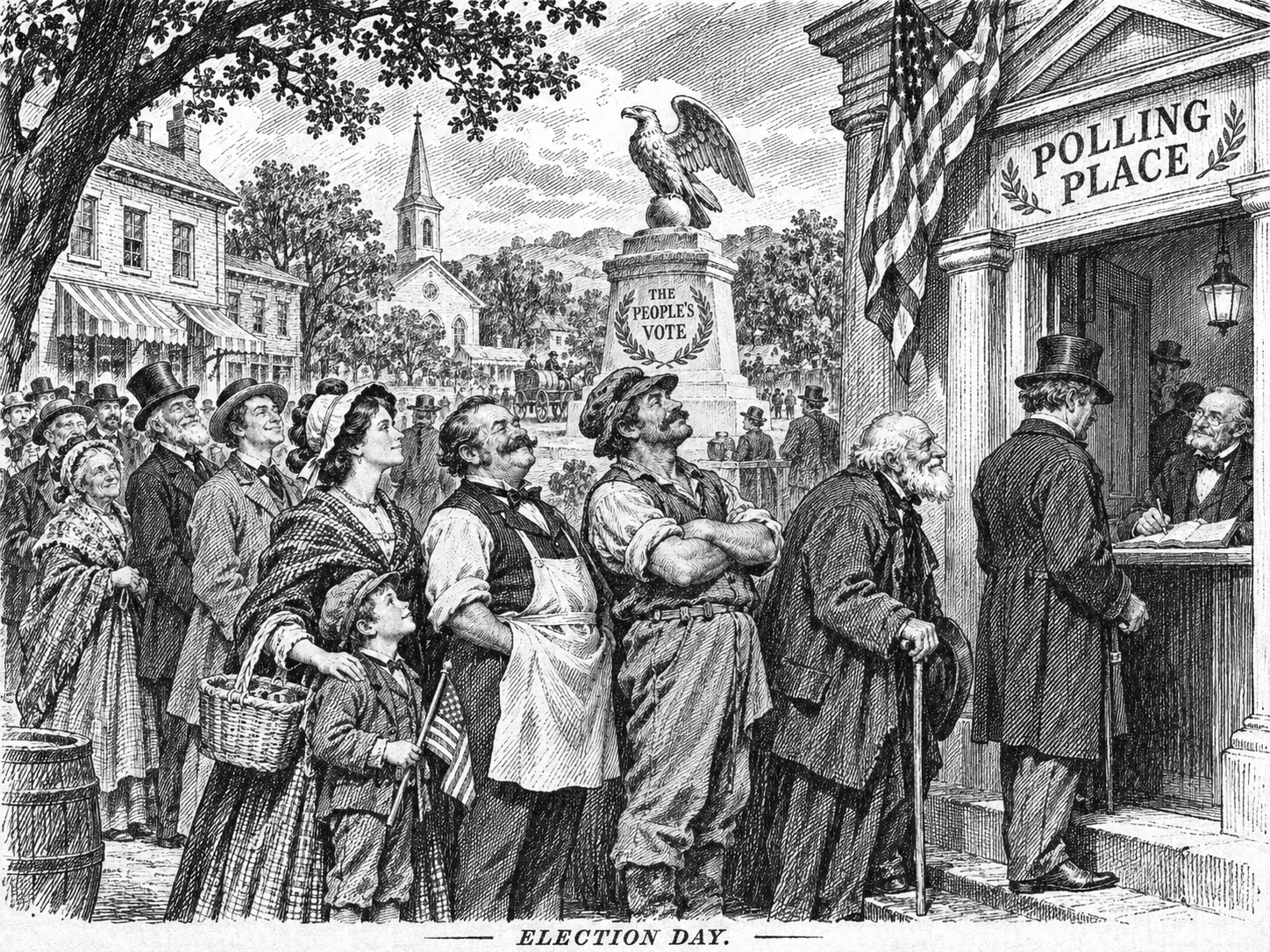
Election Day in Yountville. After months of accusations, arguments, and campaign literature, the voters finally have their turn. Tomorrow, the signs will come down, the speeches will end, and the seven and a half acres will still be there. Democracy gets its day in the sun. Wednesday morning, the less glamorous work of governing begins again.
An Election Day Dedication
This essay is dedicated to all the loyal readers of the Moon, who now number between 800 and 1,000 with each post. It is dedicated as well to the one reader who would very much like the Moon to go away. That reader has not missed an issue, which is its own kind of loyalty, and I am not ungrateful for it.
Free speech is one of the quiet wonders of a free country. It lets an ordinary person say plainly what they have seen and heard, and it never asks first whether the people being described hold an office, a fortune, or a famous name. This week’s reporting in the Register showed how far that simple idea can carry. A reporter read the emails and the survey responses, listened to the meeting recording, and set them beside what people had said in public. The work required no special access and no secret sources. It required eyesight, a set of ears, and the patience to use them, which turned out to be a scarce resource this election season.
Many of you have written to me these past few weeks with corrections, documents, questions I had not thought to ask, and encouragement on days when it was welcome. You understood early that this election was never only about a housing plan. It was about who decides the future of this town, and whether those decisions are made in public by people who have gone to the meetings, paid attention and are able to reach consensus with their neighbors. That remains true whatever the count shows tomorrow morning. The record stays public, and the Moon will go on reading it.
Thank you for reading, all of you, including the one reader still making peace with the idea of free speech, even in Yountville.
In Praise of the Boring Work
On Election Day, a salute to the people who listened, read, designed and decided, and to the town that will need them back at work again tomorrow.
Gary Jabara has spent this year telling Yountville that the Commons is a mistake. In a September interview he called continuing down the Town’s path “insanity.” Asked whether he had read the Town’s two studies of the project, he told the Napa Valley Register, “I didn’t read either one.”
That admission appears in the second installment of Lauren Spates’ series on the Yountville Commons, published the day before the election. Her article is titled “Commons’ Confusion?” and identifies a breakdown in communication as the central problem. That is a fair conclusion. The more useful thing she did was ask the people demanding answers whether they had read the answers the Town provided. Several had not.
It is fitting that this argument concerns an elementary school. Children once arrived at that property expecting someone to ask whether they had done their homework. The school closed in 2020, and the Town bought the seven-and-a-half-acre property to put it to work for another generation. Nobody expected its next educational purpose to be a remedial reading assignment for critics.
The Dog Ate My Housing Element
Jabara calls the Commons “not well thought out, far too expensive” and larger than the need. Those are legitimate subjects for debate. Public construction is expensive, municipal finance is complicated, and nobody should build anything because the drawings are attractive and the consultants have nice shoes. The Town commissioned studies on exactly those questions: a workforce housing analysis from BAE Urban Economics and financial scenarios from KNN Public Finance.
Jabara read neither. It is a little like a restaurant critic panning a kitchen he has never eaten in. One can criticize a financial proposal without studying every spreadsheet, and wealthy people have long hired others to read spreadsheets for them. The criticism carries less weight when its author has not opened the analyses that address it.
He also praised Councilmember Hillery Trippe because “she does her homework,” which suggests homework is something he admires mainly in others. Mayoral candidate Joe Tagliaboschi told Spates he was “not familiar” with the studies, while worrying that the narrative had been shaped to fit a predetermined outcome. Consultants do make mistakes. The way to find them is to read the documents the consultants prepared and place in the public record.
Jabara’s remedy is to hire his own expert. He has retained land-use attorney Jeff Dodd to study the Town’s housing obligations and propose alternatives, and he describes Dodd as an “unrelated third party.” Dodd confirms Jabara is his client. That is not a scandal. Lawyers generally work for the people who hire them, a custom that predates municipal housing studies. Dodd may produce good work. A study paid for by a private party is still not a public study, and calling it independent does not make it one.
The Missing Invitation
Thomas Keller has made Yountville famous in places where people can pronounce quenelle. At the March 3 Council meeting he said nobody in Town leadership had ever asked his views on the Commons. Coming from one of the town’s most influential employers, the complaint landed and the story was reported nationwide.
Emails provided to the Register show Keller’s executive assistant arranged a February 11 meeting with Mayor Margie Mohler, Councilmember Robin McKee, Keller and his representatives. Multiple attendees confirmed it took place. His general manager, Michael Minnillo, had answered the 2024 employer survey (“Hopefully the school site works out!!”) and later joined the consultant’s employer focus group. Keller himself attended the February 17 study session. None of this shows he got the answers he wanted. It does show he was in the room.
Boardwalk Investments, Jabara’s real estate company, answered six of the nine survey questions with “n/a - company policy” and left the other three blank. Employers have legitimate reasons to protect employee information and need not answer every municipal survey. Declining to provide information and then complaining that nobody collected it are two different positions, and they do not sit comfortably together.
Jabara did later send the Town a survey of 172 employees showing strong interest in two-bedroom units at $1,700 to $2,200 a month and little interest in studios. That is useful, and it is what participation looks like. It is also one employer’s preference, which has to be reconciled with construction cost, rent, site planning and the workers of every other business in town. Keller promised a similar survey. The Register could not find one.
The Communication Problem
Spates is right that communication failed, and Town leaders say so. Mayor Mohler says the Town never explained how residents’ comments were sorted into a plan. McKee says the process outpaced public understanding. Those admissions deserve to be taken seriously, not treated as proof of collapse.
I spent much of the past two years on the Commons design and the outreach around it: open houses, workshops, advisory board discussions, Council presentations, individual conversations, and enough coffee to make my nervous system a minor medical curiosity. People had ideas about parks, parking, building sizes and the character of the public spaces. Some were incorporated. Others were modified or ran into engineering, budgets, accessibility and gravity. Architecture is the art of fitting competing demands into finite space, and the most popular request is always to make everything larger for less money. We could have explained those decisions better, and I include myself.
Poor communication is not the same as no communication. The public planning process began in 2024. The Council unanimously approved a conceptual site plan in March 2025. The February 17, 2026 study session ran nearly four hours, with consultants, staff and Council members answering questions on housing need, phasing and financing. By the Register’s account of the recording, residents asked thoughtful questions, the answers reflected where the project stood, and everyone agreed more information would follow. It was a working session on how to build in stages, not the unveiling of a finished project.
Weeks later came the petition to repeal the zoning. It qualified, and on June 2 the Council repealed the ordinance rather than send it to the ballot. The repeal did not sell the land or end the Town’s housing obligations. It restored the old zoning and reopened the question. Somewhere between February and June, a preliminary financial scenario began to be discussed as though every building had been approved and every dollar spent.
A Town or a Developer
The question that matters most has received less attention than bedroom counts. Yountville can keep the property and build housing as a municipal asset, or it can spend public money to help someone else build and own it. The Commons proposed the first. Rent could eventually support Town finances while keeping the housing for local workers. That approach carries real risk: construction cost, debt, maintenance and the need for competent long-term management. Handing over valuable public land, subsidizing housing the Town will never own, or waiting on the private market for rents workers can pay all carry risk too. Those are questions for side-by-side financial comparison. Pointing out that most cities do it the other way does not answer them.
Yountville has resources most California towns do not: a visitor economy that pays for well-kept public facilities, and a centrally located property that may never again be available for a broad civic purpose. The financial assumptions should be tested and the alternatives compared, in language residents can follow without a semester of municipal bond finance. Abandoning a strategy because it is unconventional would be an odd choice for a town whose most famous businesses became famous by refusing to be conventional.
The Commons is not perfect, and no serious plan is. What remains open is whether the town will use what it has learned to improve the proposal or reset to the beginning with each new objection. In architecture, that is the difference between design development and an endless first meeting. It gets expensive, and the people waiting for housing are not the ones at the meetings. More than 80 percent of Yountville’s workers commute in, according to figures cited by the Register. They keep the town running and have little voice in its decisions.
The Boring Work
Today Yountville votes. The campaign literature has arrived and the accusations have circulated, and through all of it the seven and a half acres have not moved an inch. The Town still owns them, the housing need is unchanged, and a practical decision is still waiting.
I am grateful for Spates’ reporting. She did not write a defense of the Commons or excuse its proponents’ mistakes. She compared public claims with the record. She found employer consultation where exclusion had been described, professional studies where inadequate analysis had been alleged, and unfamiliarity with the very reports being challenged. She also found real communication failures, fair disagreement over unit types, and open questions about the Town’s financial risk. That is a more useful story than two camps shouting across Washington Street.
Most of what made the Commons possible was dull. Staff assembled packets that ran to hundreds of pages. Council members read them, sat through study sessions that crept toward four hours, and answered the same questions at the tenth meeting that they had answered at the first. Residents came to workshops, wrote comments, and watched some of their ideas survive and others not. Consultants ran the numbers twice. None of it makes a good campaign mailer. It is how a town decides anything, and the people who did it deserve more credit than the people who arrived late to announce that it had not been done.
Nobody needs a degree to take part in local government, and no resident should be dismissed for not reading a 248-page housing assessment. Experience and skepticism count. When the argument turns on whether an analysis was adequate or a consultation took place, though, it is fair to ask whether anyone read the analysis or checked the calendar. Otherwise the debate becomes competing recollections, and one side has the meeting minutes. If you doubt me, you have not read the recent articles in the Napa Register.
Tomorrow the next Council inherits the property along with the research, testimony, design work and open choices that come with it. It can revise the Commons, change the financing, or pursue a different strategy. The quality of whatever it decides will depend less on how loudly people hold their convictions than on how carefully they have read the evidence.
Whoever wins tonight, the work will be waiting Wednesday morning, and most of it will be boring. The new council will have to read the packets, sit through the meetings, and sign their name to a decision. Three of the loudest voices in this campaign have already shown how they feel about that kind of work. Gary Jabara read neither study. Thomas Keller let four requests from the Register go unanswered, along with a reporter who stopped by The French Laundry in person. Joe Tagliaboschi, who would like to be mayor, told the Register he was “not familiar” with the reports. The old school asked more of its third graders, and most of them delivered. They brought their books, raised their hands, and learned that the reading was due Monday whether or not they felt like doing it. The building has been closed for six years. The lesson is still available to anyone willing to see it, and the town will be fine as long as the people running it are ready for the difficult work of governing. Meanwhile, the speeches, the yard signs and the divisiveness will find their way to the recycling bin. Amen.
Based on Lauren A. Spates’ November 2, 2026 Napa Valley Register report, “‘Commons’ Confusion? The Communication Breakdown at the Heart of Yountville’s Housing Debate,” and the Town of Yountville’s published Commons planning record.
Disclosure: Brendan Kelly is principal of Kelly + Morgan Architecture, which served as the Town of Yountville's Owner's Design Consultant on the Yountville Commons. That scope is complete.
