
The Story the Local Press Missed
By Brendan Kelly
I served as the lead Owner's Design Consultant for Yountville Commons. That role is complete. I write here as a private citizen and as founder of The Yountville Moon, which exists to give public decisions the context ordinary meeting coverage too often leaves out.
The problem with the recent Napa Register story on Yountville Commons, and the Press Democrat story, is not that they got the meeting wrong. The Yountville Town Council did vote to begin repealing the Commons zoning ordinance. That repeal followed a referendum petition. Council members spent the discussion calling for more information, more outreach, more time, and more clarity.
All of that is accurate.
None of it explains what happened.
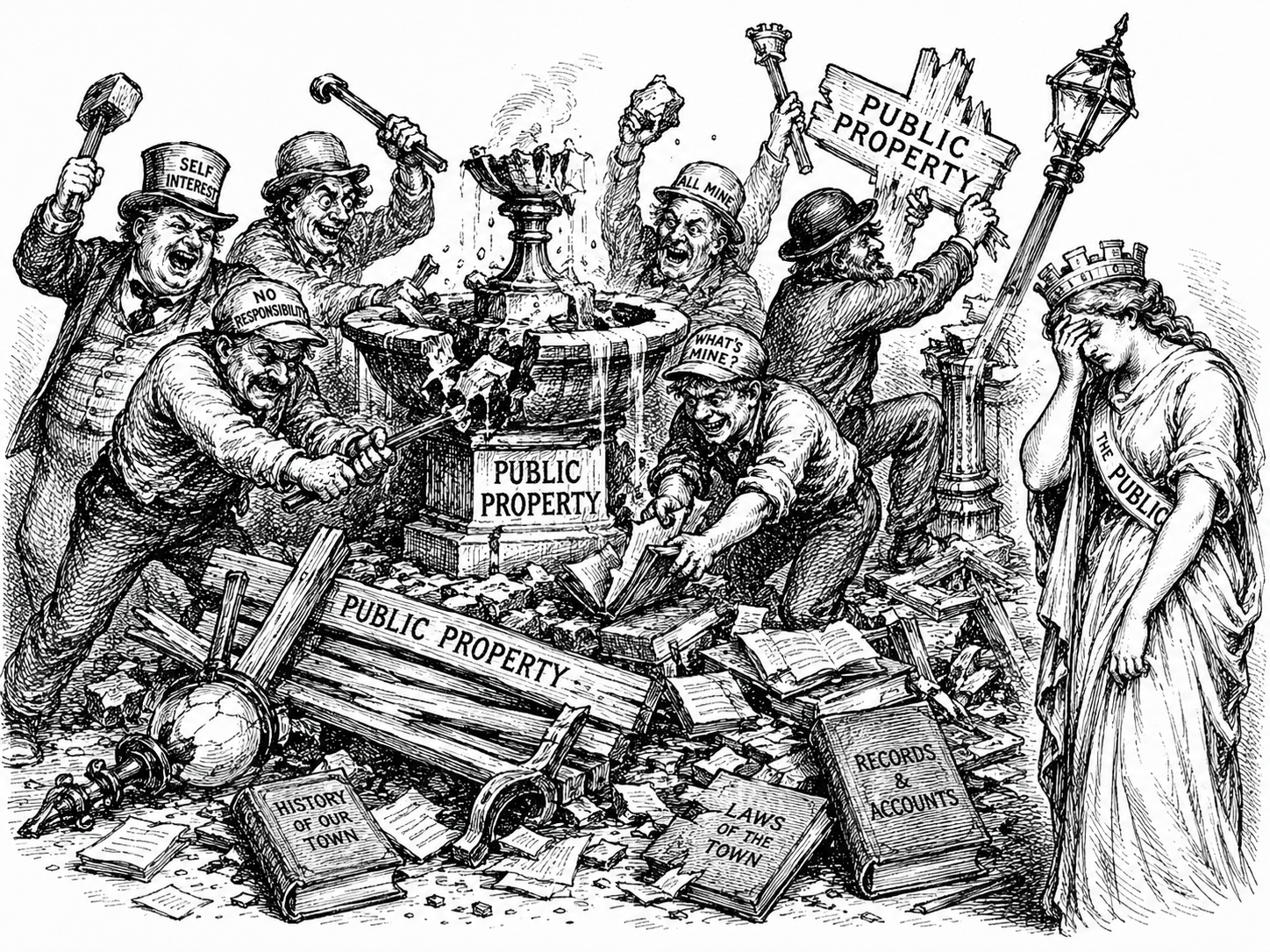
Illustration created for the Yountville Moon. Everyone in the picture has a private reason. The thing they are breaking belongs to everyone else.
The story presented the repeal as if Yountville had been considering a fully designed housing project, the public objected, and the Council wisely agreed to slow down. That is the soft, procedural version of events. It is also the version that protects everyone from having to understand the basic mechanics of what the Town was actually doing at the Council meeting on June 2, 2026.
Yountville did not have a final building project in front of the Council. There was no construction contract, no approved set of buildings, no decision to pour foundations or hire a builder or commit the Town to a final development program. What the Council had approved was the land-use framework: zoning, a tentative map, and the environmental work needed to make the former school site capable of becoming something more useful than a closed school campus with a handful of temporary civic uses.
That distinction matters because entitlements are not decorative. They are how land becomes more valuable, more flexible, and more capable of solving a real problem.
The Town bought the former Yountville Elementary School site for $11 million in 2024. That was the central public investment, and it was not a casual one. It was the acquisition of the rarest thing in Yountville: a large, publicly controlled site where the Town could address workforce housing without waiting for private owners to solve a problem they have no particular motive to solve.
The remaining $3 million or so was not wasted. Some of it converted the old school library into a health club and turned the all-purpose building into the Don & Sally Schmitt Hall now used for children's camps and other public programs. Some paid for the renovation of the abandoned community garden, the Farmstand Cafe in the old Little League snack shack, and Yountville's first dog park on an unused ball field. The rest covered the designers, consultants, outreach, public meetings, and environmental documents needed to test whether the site could carry the civic and housing role the Town had identified for it.
The opposition's figure is $14 million. A reporter could have added $11 million in land and existing buildings plus roughly $3 million in improvements and planning and explained it simply with a single phone call. The total is not a mystery. The Town bought land and improved a closed school site for public use while doing the planning work that makes long-term housing possible. People can argue about the next step, the design, the financing, or the unit count. Treating spending that is fully accounted for as if it were a mystery is not reporting.
The more important question is what the referendum campaign actually destroyed.
The Council had not approved a final project because it was never given a final project to approve. What it had approved were the entitlements that gave the public property a path forward. That is called stewardship in the public realm. Those entitlements were the one thing the Town, as landowner and public agency, could create that would make the site more valuable than it was the day it was bought. The zoning and tentative map established possibility, not obligation. They mandated no building and prevented no revision. The Town remained free to change the unit mix, adjust the phasing and financing, test different delivery models, or refine the civic program. What the framework did was make the site capable of carrying a serious housing proposal.
Then a small, organized group used the referendum process to force the Council into repealing that framework.
That is legal. It is also a very big deal.
The story is not simply that some residents had concerns. Residents always have concerns, and concerns are part of public life. The real story is that roughly 10 percent of registered voters, the share that signed the petition, was able to force the Town to unwind land-use value it had spent years creating, before it had even selected a final development project.
Here is the part the repeal did not touch. The school site sits on Public Facilities zoning. In 2024, the same year it bought the site, the Town amended that zoning to give the Council discretionary authority to approve housing on its own land through a use permit or a development agreement. Those 2024 provisions were not part of the ordinance the referendum suspended. They still stand. The base standards are modest, so the surviving path supports a smaller project than the Commons concept, and restoring that scale is a separate question I will take up elsewhere. But the simple point holds. A public agency building housing on public land does not need the repealed ordinance to begin. The Council can say that plainly, and it should.
No one in the coverage put the obvious questions to the people who organized the referendum. Did the organizers understand that they had not stopped a final project, only stripped away the zoning and map work that made the public land useful? Were they aware that the Town still owns the site, still carries housing obligations, and now has fewer approved tools to meet them? And the simplest question went unasked: if not this framework, then what, and how does repealing the zoning make the site more usable, more fundable, or more likely to house the town's workforce?
None of that is hostile. It is the basic work of reporting.
Those are the questions a local newspaper should ask when a public agency spends years turning a closed school site into a civic and housing opportunity, only to have that work knocked backward by a referendum campaign built around fear, suspicion, and the phrase "small-town character."
Instead, the public got a meeting summary.
This is exactly why The Yountville Moon exists.
Yountville does not need another place where quotes from public meetings are arranged in the order they were spoken. It needs a place that explains what those quotes obscure, that is willing to say process language can become a hiding place, and that notices when elected officials describe a situation as if they were spectators to their own votes.
Four members of the current Council had voted for the zoning framework before the repeal. The Zoning and Design Review Board supported the project unanimously. Staff, consultants, designers, and residents took part in roughly 25 public meetings and outreach sessions. The Town produced environmental documents and created interim public uses on the site. All of it was the ordinary work of a public agency that owns land in a housing crisis: building a path from public purpose to actual implementation.
Then, when the project began to look as if it might move from conversation to action, the opposition hardened.
That is the part people in town understand instinctively, even when polite reporting will not name it. The safest housing project is the imaginary one. Workforce housing has near-universal support in the abstract. Everyone is for nurses, caregivers, hotel workers, and restaurant employees living closer to town, as long as no real entitlement, map, parking count, unit mix, building height, financing plan, or construction phase is attached to the sentiment.
The moment something real appears, the language changes. The process becomes confusing, the studies insufficient, the parking impossible, the financing reckless. The units are too small and the buildings too big. The town is moving too fast, and the character of Yountville is suddenly at risk.
Some of those concerns may deserve discussion. None of them explains why the proper remedy was to erase the entitlement framework before a final project was ever presented.
That is the core absurdity.
The referendum campaign did not stop a bad building. It stopped the Town from keeping a public land-use tool, and it left a property bought for public purposes less ready to serve them. Years of public planning turned back into talk, and the result was treated as progress.
This would be easier to tolerate if the school site were just another parcel. It is not.
Yountville Elementary closed in 2020 after more than 125 years. That closure should have ended any illusion that the town's housing problem was theoretical. A town does not lose its elementary school by accident. It loses it when families cannot afford to live there, when workers are pushed farther away, and when the age structure shifts until daily life no longer matches the postcard the town sells of itself.
The school site is physical evidence of that failure. It is also the best chance to answer it.
That is why Measure S matters here. Measure S was not a vague pot of money. Voters approved it for workforce and affordable housing by more than 72 percent, paid for by a 1 percent surcharge on hotel guests. If the Town used those funds to acquire the school site, then repealed the zoning framework and failed to produce a credible housing path on that site, it should expect hard questions. The questions would not be about missing money, because the money is accounted for. It bought land, created public amenities, and paid for planning work.
The problem is purpose.
If public money secured the site for workforce housing, the Town has to show that the purpose is still alive. That means saying which parts of the prior work remain usable, whether a revised entitlement path is coming back, and how the environmental work, outreach, design studies, and site planning will be reused rather than buried because a petition drive forced a repeal.
That is where the Council should focus, and not on the easy alternatives. The repeal was not a gift of time. The claim that the town agrees on more than it disagrees is not a plan. Another season of workshops mostly rewards the people most committed to stopping housing, by giving them more time to run out the clock.
The Council should put the real questions in front of the public rather than leave them to a newspaper. The first set is about value: what the repealed zoning and tentative map were worth to the property, and what the repeal gave away. The next is about reuse: which parts of the prior work survive, and what can actually be built on the site under current zoning. The hardest set is about consequence. If the school site no longer carries a significant share of the Regional Housing Needs Assessment (RHNA), the Town has to say what will. And the Measure S accounting belongs in the open, with a plain explanation of how the purpose of those funds remains intact.
Those are the questions that matter now. They are also the questions that should have been in the newspaper.
Local journalism fails when it confuses balance with vagueness, when it treats every public comment as an equal unit of meaning, and when it watches a meeting, quotes a few officials, adds a sentence about concerns, and calls that context.
Context is not the same as chronology.
The chronology is simple. The Town bought the school site, created interim public uses on it, and spent money on outreach, design, and environmental review. The Council and the Zoning and Design Review Board advanced an entitlement framework with zero public pushback. When the Commons zoning was approved 4-1, there was not a single member of the public speaking against the entitlements that would allow a former school to turn into a new public asset where parks, open space, civic uses, and workforce housing would all co-exist. A referendum campaign then forced a choice between an election and repeal, and the Council chose repeal. The property is less entitled than it was a week ago, and the housing problem sits exactly where it was when they purchased the property in 2024.
The context is harder. A town that claims to support workforce housing recoiled when the first serious Town-controlled site began to move toward implementation. A small, organized minority used an old legal tool to strip value from a public asset. Elected officials who had supported the framework now have to explain how they will preserve the purpose of the land purchase. A local newspaper reported the surface of the meeting and missed the public consequences.
That is the story.
The Commons may come back in a different form, and it probably should. A smaller version, phased differently, explained better, financed differently, or built through a different partnership would be fine. That is what entitlement work and public ownership are for. Owning the land gives the Town control. Planning gives it options. Public investment makes a difficult thing possible before the market makes it impossible.
But if the Town lets the repeal become an excuse to drift, the referendum will have done more than stop an ordinance. It will have taught every future opposition group the lesson: wait until something real appears, gather a small number of signatures, and force the Town back into the fog.
The Council does not need to defend every detail of the old Commons concept. It does need to defend the value of the work already done and stop acting as if the repeal erased its responsibility. The school site was bought, improved, studied, and entitled on purpose. The Council should say so and make clear the public investment produced real public wealth.
The next journalist who writes about this should ask the people who forced the repeal a simple question: did you understand that you were not just stopping a project you disliked, but dismantling a significant public value the Town had created on land it bought in part to solve a housing problem?
Until that question is answered, the story has not been reported. It has only been observed.
