
Preserved in Amber
Eight towns embedded in long-protected agricultural landscapes, drawn at the same scale. The one with the most land holds the fewest people.
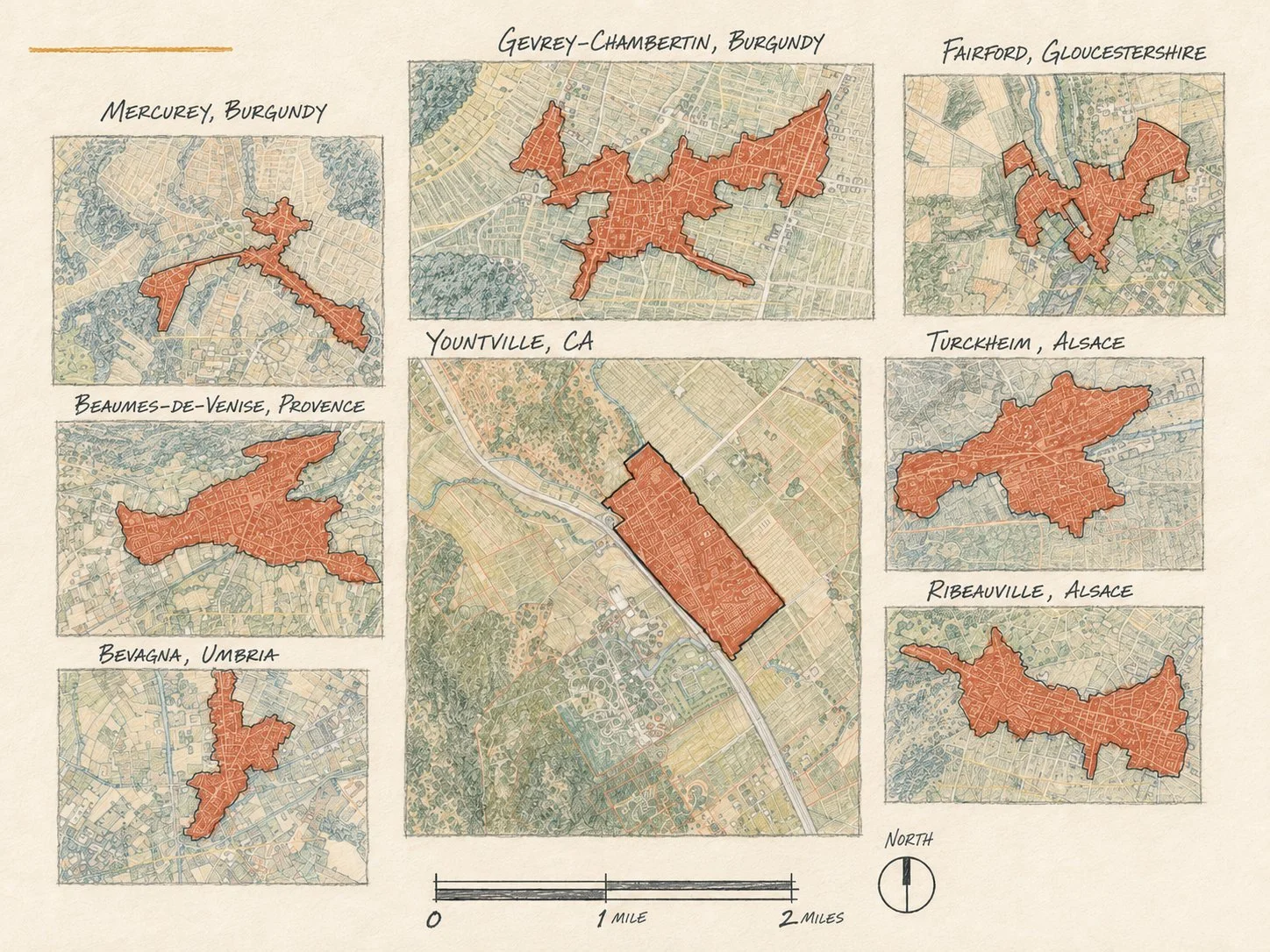
Eight towns drawn at the same scale. Seven settled agricultural villages of comparable population in France, England, and Italy, shown alongside the urbanized rectangle of Yountville, California. Scale bar two miles.
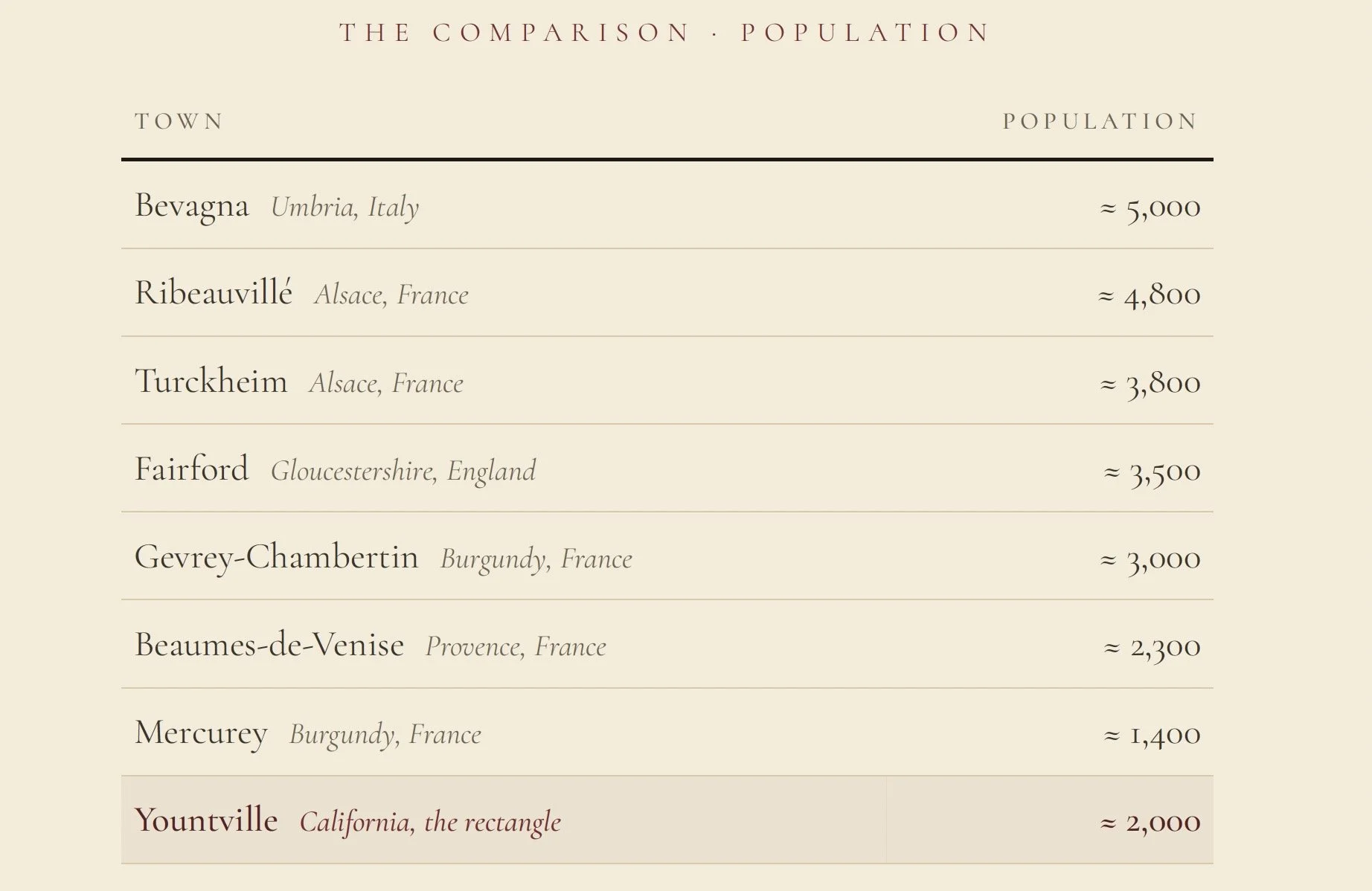
The Yountville figure reflects the urbanized rectangle north of Highway 29 and excludes the institutional population of the Veterans Home of California. All other figures are municipal approximations.
I.
At first glance the towns appear related. Small populations. Agricultural settings. Vineyards and fields wrapping tightly around urban edges. The diagram almost suggests cousins separated by geography but united by form. Then the illusion collapses.
The seven European and English towns hold between roughly fifteen hundred and five thousand people. Yountville's rectangle, larger than any of them, holds barely two thousand. The same scale reveals a town that is approximately twice the size of its closest morphological peers at roughly half the population. The density differential approaches fourfold.
That single comparison contains most of what follows.
II.
The Burgundian villages, the Alsatian villages, the Provençal village, the Umbrian village, the English settlement evolved through centuries of compression and necessity. Their edges are irregular because they were not imposed all at once. Their streets bend because they followed property lines, footpaths, drainage patterns, walls, churches, market pressures, inheritance disputes, and accidents. Buildings gathered tightly because proximity served work, storage, and winter together.
These were not wine towns. They were settled agricultural communities where wine was one product among many. The cooper, the baker, the priest, the widow, the schoolteacher, the merchant, and the wine grower occupied the same organism because the broader agricultural economy required proximity. Density accumulated not because wine demanded it but because life did. The wine industry layered onto an already complete settlement pattern.
Then there is Yountville.
A long rectangle stretched along Highway 29, assembled largely through postwar California development patterns, later refined through landscape discipline and hospitality money into something visually elegant enough to disguise its origins. Remove the vineyards and much of the underlying morphology would not feel remotely European. It would feel familiar to anyone who has spent time in suburban California between 1955 and 1995. Detached houses. Condominiums. Parking lots. Setbacks. Ranch homes. Auto dependency concealed beneath expensive planting palettes.
This is not an insult. It is simply what happened.
I I I .
Napa Valley successfully preserved agriculture. It did not preserve or create urbanism. Those are different achievements, though Yountville increasingly treats them as interchangeable. The valley's agricultural protections remain one of the great land-use accomplishments in American history. Much of California consumed itself with subdivisions and arterial roads while Napa County, through extraordinary political discipline, held onto an agricultural landscape of global significance. It deserves admiration. The valley floor did not become Orange County north. The hills were not consumed by cul-de-sacs.
But preservation creates edges, not towns.
What happens inside those edges follows a logic Burgundy and Alsace never had to face. The Napa County Agricultural Preserve, adopted in 1968 to protect a working agricultural landscape, eventually produced something different from what its authors intended. A scarce, beautiful, and politically protected view. That view became commercially valuable in a way no Burgundian view ever was. The view became a luxury good. The valley reshaped itself around the value of looking at it, while the work of producing within it remains vital to the region’s economy.
Yountville responded to that economic gravity the way any small town would. It became a more of a hospitality landscape rather than a working settlement. The pattern that emerged on the ground is ordinary postwar California sprawl. Detached houses, parking lots, single-use zoning, generous set‐backs. That is the vocabulary nearly every American town of comparable age was assembled from. There is nothing unique about it and nothing about it that prevents incremental adaptation. Patterns can change. The question is whether the political will exists in town to change them.
That question is harder in California than almost anywhere else. Ten percent of registered voters can suspend any local ordinance by referendum. The mechanism is part of what has produced the housing crisis here and across the state. It does not block housing in theory. In practice it freezes incremental adaptation at the precise moment a community attempts it.
The European villages demonstrate something obvious enough to be missed. A working agricultural landscape, a beautiful protected view, a vital town center, and housing for the workers who run the place can coexist within the same boundary. They are not in zero-sum competition. The hotel owner, the famous chef, the retiree on the bocce court, the second-home buyer, and the dishwasher who would like to walk to her shift can share a town. They have shared towns in Burgundy, Alsace, Provence, Umbria, and the Cotswolds for centuries. The diagram is not an indictment. It is a proof of concept.
I V .
The easiest way to understand the town is to stop looking at its restaurants and begin looking at its housing stock. Much of Yountville is not composed of ancient stone buildings or tightly compressed urban fabric. It is composed of ranch homes, aging condominiums, manufactured housing, retirement enclaves, and suburban residential fragments inserted into a spectacular landscape. The genuinely historic structures are overwhelmingly utilitarian. Wineries, agricultural facilities, barns, and the 1928 elementary school now serving as Town Hall. The places where production, storage, education, and labor actually occurred. The historic town was not founded on curated consumption. It was founded on work.
The modern version increasingly behaves less like a town than a carefully managed hospitality environment. Washington Street functions beautifully as a tourist corridor. It is elegant, controlled, and lucrative. But a hospitality district is not automatically urbanism. One can spend an entire afternoon in Yountville moving from tasting room to restaurant to boutique hotel without encountering much evidence of ordinary civic life. Children are strangely absent. So are small apartments, mixed-income housing, corner stores serving working households, inexpensive rentals, or any meaningful evidence that the labor force sustaining the place lives nearby.
The labor is present. Thousands of workers sustain the valley every day. They arrive in the morning from elsewhere and disappear at night into the regional commute shed stretching toward Fairfield, Vallejo, American Canyon, and Vacaville. And farther.
The fear underlying many Yountville housing debates is not really about architecture. It is about adjacency. About whether a town built around consumption and tranquility can psychologically tolerate becoming a genuine mixed-income settlement again. Workforce housing proposals trigger panic because they threaten the fantasy that Yountville somehow exists outside normal economic life. Yet the town's entire prosperity depends on a labor force large enough to sustain one of the most sophisticated hospitality economies in the United States.
The town borrows the imagery of Europe while resisting the very conditions that produced European urbanism in the first place. It loves the village aesthetic but fears the compactness, density, social mixing, and economic interdependence that historically accompanied it. The result is a kind of theatrical simulation of rural European life built atop deeply suburban assumptions about privacy, property, separation, and stasis.
And still the town asks to be preserved in amber.
Twenty or thirty workforce units provoke moral panic. Small apartment buildings are discussed as though they represent metropolitan invasion. The irony is difficult to overstate. The metropolitan consumer culture residents fear is already fully present. The Disneyfication did not arrive with affordable housing proposals. It arrived through the transformation of the valley into a luxury consumption landscape. Orange County is not coming. In many respects it arrived years ago carrying tasting menus instead of mouse ears.
V I .
What remains unresolved is whether Yountville intends to become an actual town again or simply a more refined version of a resort corridor. Those are not the same thing. A real town contains friction. Economic diversity. Young families. Older residents. Small rentals. Workers living nearby. Incremental change. Physical compression. The ordinary messiness of human coexistence. Historic European villages survived because they remained economically alive across centuries, adapting continuously to changing conditions while retaining coherent form.
There is nothing anti-capitalist about saying so. The independent agricultural town may be one of the most American capitalist inventions ever produced. Land, labor, risk, ownership, craft, production, exchange, family enterprise, and local pride bound together in a visible place. A real farm town is not a socialist fantasy. It is capitalism with dirt under its nails and owners who have to look their workers, neighbors, customers, and competitors in the eye. That is what made these places strong. The problem is not commerce. The problem is extraction disguised as stewardship.
V I I .
The trailer park resident and the landed old-town preservationist may imagine themselves as enemies, but they are often protecting the same thing without knowing it. The last remnants of a town that still belongs, however imperfectly, to people who actually live there. Their common enemy is not the dishwasher, the nurse, or the young family trying to rent within ten miles of work. Their common enemy is the distant owner who turns the town into a revenue device and spends the proceeds somewhere else.
When the person profiting most from a town does not live in the town, there is a very good chance the town is being mined.
That is what the diagram cannot quite show but everything around it confirms. Residents were told to fear the workers. They were told that ordinary housing would threaten property values, ruin village character, and invite the wrong future. The workers were never the force turning Yountville into something synthetic. The workers were the last proof that it was still connected to a real economy. The greater transformation came from those who understood that Napa could be sold more profitably as fantasy than as place.
As capitalism, this is genius. The danger is not that the town becomes ugly. The danger is that it becomes so perfectly curated, so frictionless, and so optimized for consumption that residents slowly lose the ability to tell whether they are living in a town or merely passing through an exquisitely managed version of one.
